
Oxford is older than its university, and this guide follows that story through five places on a short line across the centre: Oxford Castle, the Covered Market, the Saxon tower of St Michael at the North Gate, the History of Science Museum and the Bodleian Library. Together they take you from a Saxon watchtower and a Norman castle to the Georgian market and the libraries and instruments of the scholars.
Oxford Castle & Prison
The castle was begun around 1071 by Robert D'Oyly, a Norman baron, to control the town after the Conquest. Its timber defences were later replaced in stone, and the great earth mound, the motte, still rises beside New Road. The tallest survivor, St George's Tower, is built of a local rubble stone called coral rag and is now generally thought to be Saxon, perhaps a watchtower by the old west gate of the town, older than the castle around it.
The castle's best-known story comes from the civil war between King Stephen and the Empress Matilda. In December 1142, after a siege of about three months, Matilda escaped. The popular version says she waited for the river to freeze, dressed in white against the snow and was let down from the walls; one chronicler of the time instead says she left through a gate. Later the site became a prison, which only closed in 1996. Part of it is now a hotel, and Oxford Castle & Prison is the first stop on our Oxford scavenger hunt.
- St George's Tower, the plain, narrow stone tower that is the oldest part of the site.
- The motte, the grassy mound of the castle, with a well chamber dating from the 13th century inside.
- The crypt of the castle chapel, founded in 1074 and later rebuilt on a new spot, and the old prison wings with their rows of small windows.
The Covered Market
The Covered Market opened on 1 November 1774 to clear messy street stalls from the town's main streets. It was planned by John Gwynn, who also designed Magdalen Bridge, and it began with twenty butchers' shops; after 1773 meat could only be sold inside the market. Today it is owned by the city council and still mixes butchers, bakers and food stalls with small independent shops, and it is one of the stops on our Oxford scavenger hunt.
- The entrances on the High Street, part of Gwynn's design, and the side entrances on Market Street.
- The Golden Cross passage, a narrow alley of small shops that links the market to Cornmarket Street.
The Saxon tower of St Michael at the North Gate
On Cornmarket Street stands the plain stone tower of St Michael at the North Gate, dating from around 1040. The church claims to be the oldest building in Oxford, and its name recalls that it stood beside the north gate of the medieval town wall. The gate had a prison called the Bocardo, where the Protestant bishops known as the Oxford Martyrs, Thomas Cranmer, Hugh Latimer and Nicholas Ridley, were held before they were burned at the stake in 1555 and 1556 just outside the wall, on what is now Broad Street.
The whole tower can be visited, and the climb to the top gives one of the best views over the city centre. On the way up you pass small displays about the church's past, including a link to the Pre-Raphaelite circle: the designer William Morris and Jane Burden were married here on 25 April 1859.
- The door of the Oxford Martyrs' cell from the Bocardo, on display in the tower.
- The old clock mechanism inside the tower, and the marriage record of William Morris and Jane Burden.
The History of Science Museum
The building on Broad Street was finished in 1683 for the collection of Elias Ashmole, and it is described as the world's oldest surviving purpose-built museum building. When the Ashmolean moved to Beaumont Street, the collector Lewis Evans gave his historic scientific instruments, and in 1924 the old building became the home of what is now the History of Science Museum. It is one of the stops on our Oxford scavenger hunt.
- The collection of about 170 astrolabes, described as the most complete in the world.
- The blackboard Albert Einstein used for a lecture in Oxford on 16 May 1931, saved by Oxford dons after the lecture.
- Early clocks and scientific instruments, from sundials to microscopes, displayed on several floors of the old building.
The Bodleian Library
The Bodleian is the main research library of the University of Oxford and the second-largest library in Britain, with more than 13 million printed items. A university library already existed in the 15th century: Duke Humfrey's Library, built above the Divinity School and completed in 1488, was named after Humphrey, Duke of Gloucester, who gave his manuscripts. After a period of decline, the diplomat Sir Thomas Bodley paid for its revival, and it reopened as the Bodleian Library on 8 November 1602.
In 1610 Bodley agreed with the Stationers' Company that the library would receive a copy of every book they registered, the start of its role as a legal deposit library. Readers still promise not to bring in or kindle any fire or flame. The library also uses the round Radcliffe Camera, built in the 1730s and 1740s to designs by James Gibbs and part of the Bodleian since 1860. The Bodleian and the Radcliffe Camera are both stops on our Oxford scavenger hunt.
- The Tower of the Five Orders in the Schools Quadrangle, built in the 1610s, with columns of the five classical orders stacked one above the other.
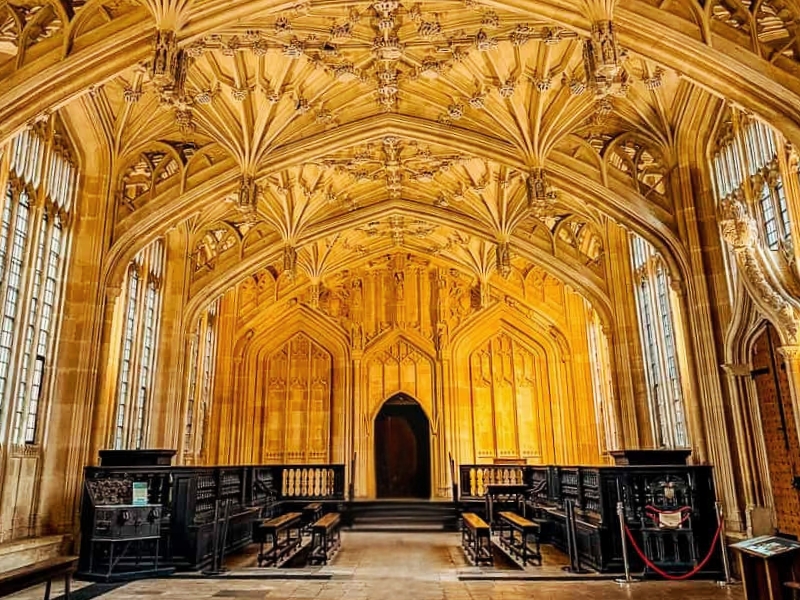
- The Divinity School, the 15th-century room under Duke Humfrey's Library, with its richly carved stone vaulted ceiling.
- The Weston Library across Broad Street, the former New Bodleian, reopened in 2015 with exhibition spaces open to visitors.
How to see them in one walk
Start at Oxford Castle at the western end of the centre, then walk up Queen Street and into Cornmarket. Detour into the Covered Market through the Golden Cross passage, then come back to Cornmarket for the Saxon tower of St Michael at the North Gate and climb it for the view. From the tower it is a short walk along Broad Street, past the cross set into the road near where the martyrs died, to the History of Science Museum. The Bodleian and the Radcliffe Camera are just behind it, so the walk ends among Oxford's libraries.
See Oxford with World City Trail
Our Oxford scavenger hunt turns the city centre into a game you play on your phone. The route links 10 stops, starting at Oxford Castle & Prison and ending at Christ Church Meadow. Oxford Castle & Prison, the Covered Market, the History of Science Museum and the Bodleian Library from this guide are all stops, along with the Ashmolean Museum, the University of Oxford, the Radcliffe Camera, the Story Museum, Christ Church and Christ Church Meadow. At each stop you solve a puzzle and learn a story, at your own pace.
There is also a self-guided walking tour and an outdoor escape game in Oxford, for people who prefer a different format.
Play the Oxford scavenger hunt →
Take the self-guided walking tour of Oxford →
Play the outdoor escape game in Oxford →
Facts checked in October 2026.