
The Royal Library was founded in 1648 by King Frederik III, who envisioned a comprehensive collection of European works for the benefit of his court and country. From its inception, the library was built to serve as a universal repository of knowledge, and by the end of the 18th century, it had become one of the most excellent libraries in Europe.
A pivotal moment in its history occurred in 1793 when it was opened to the public, a progressive move that reflected the ideals of the Enlightenment. Over the centuries, the library’s collection grew exponentially through a legal deposit law, which mandates that a copy of every work printed in Denmark since the 17th century be deposited there. This policy has resulted in an almost complete collection of all Danish printed works dating back to the first Danish book in 1482.
In 1989, the library merged with the prestigious Copenhagen University Library, solidifying its role as the country’s principal research library. Today, it operates from multiple sites, but its main home on the island of Slotsholmen in central Copenhagen remains the heart of the institution.
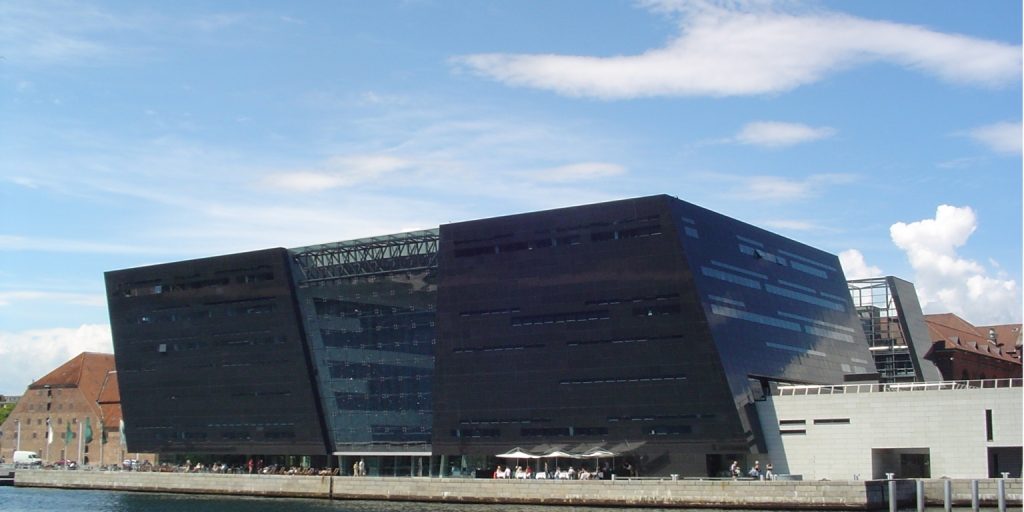
The Black Diamond: Modernity on the Waterfront
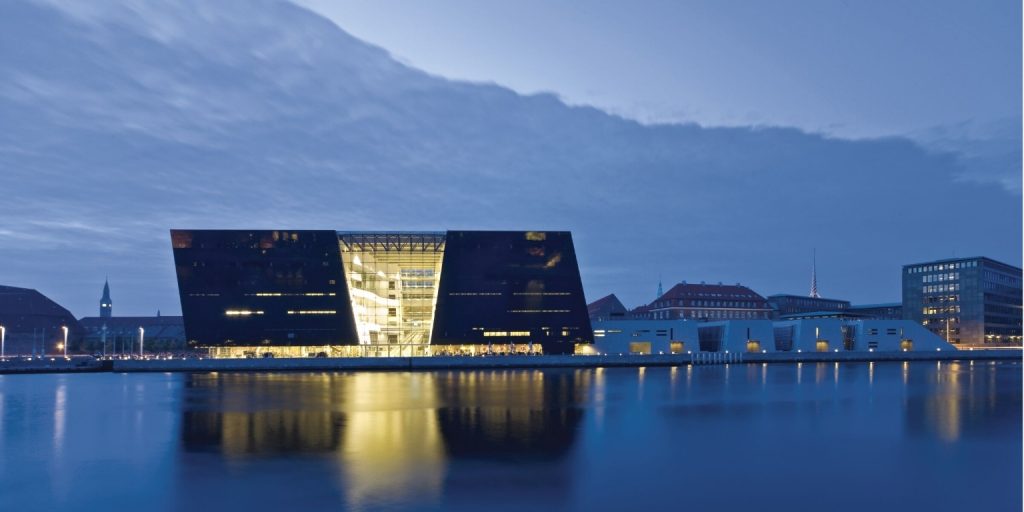
The most striking feature of the Royal Library is its magnificent modern extension, a building known as the Black Diamond (Den Sorte Diamant). Completed in 1999 and designed by the Danish architects Schmidt Hammer Lassen, the building is a stunning example of contemporary architecture. Its nickname comes from its polished black granite cladding from Zimbabwe and its irregular, faceted angles, which reflect the light and the waters of the Copenhagen harbor.
The Black Diamond is a cultural center as much as it is a library. Its design ingeniously connects the city with the sea through a vast glazed atrium that cleaves the building into two. This central, light-filled space serves as a public plaza, housing a café, a bookshop, exhibition areas, and a concert hall known as the Queen’s Hall, which hosts a variety of literary events, concerts, and performances. A spectacular skywalk with a large, suspended mural by artist Per Kirkeby connects the new building to the old, symbolizing the fusion of past and present.
The Black Diamond in Royal Library has been instrumental in revitalizing the Copenhagen waterfront. It broke with the traditional notion of a library as a closed, elitist institution and transformed it into an open and accessible public space. Its clean lines and democratic design have made it a key landmark and a source of civic pride.
Treasures Within the Walls
Beyond its architectural splendor, the Royal Library holds an incredible wealth of historical and cultural treasures. Its collection of over 32 million items includes not just books and manuscripts but also maps, photographs, music scores, and a vast digital archive. Some of its most significant items are inscribed on UNESCO’s Memory of the World International Register, including the manuscripts of philosopher Søren Kierkegaard and writer Hans Christian Andersen.
Among its other priceless holdings are original documents from the Viking Age, ancient Icelandic manuscripts, and historical maps of the Arctic regions. The library’s National Museum of Photography and the Danish Folklore Archive are also housed within the Black Diamond, adding to its cultural richness. The library’s exhibition spaces provide a unique opportunity for visitors to see some of these rare and valuable artifacts up close, offering a deep dive into Denmark’s heritage.
The Royal Library is a vibrant, living institution that serves as a bridge between the past and the future. It honors its role as a guardian of national heritage while embracing modernity and technology. For anyone visiting Copenhagen, the Black Diamond is an unmissable stop that offers a unique blend of architectural innovation, historical depth, and cultural vibrancy.