
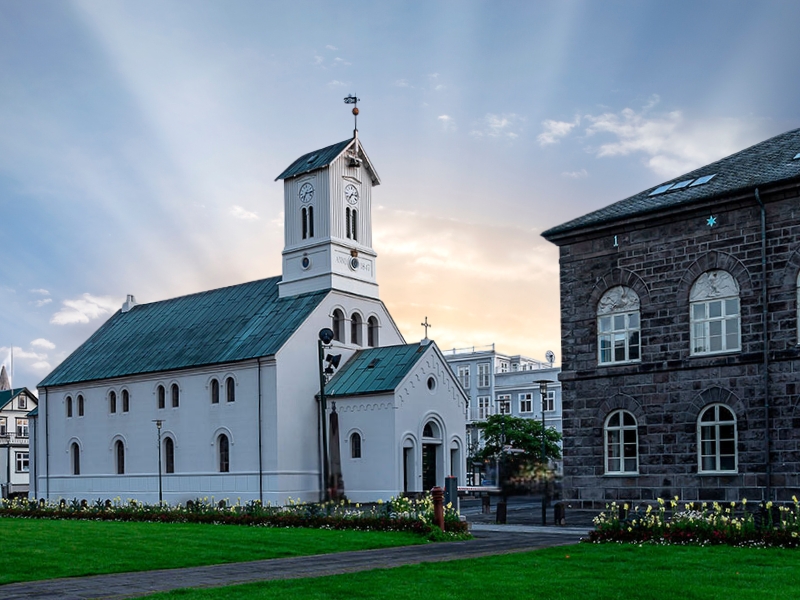
Reykjavík's oldest streets lie in a small area between the harbour and Tjörnin, the city pond. This guide covers five places there that tell how a trading village became a capital: the statue of the first settler Ingólfur Arnarson, the House of Collections, the cathedral Dómkirkjan, City Hall on the pond and the National Gallery of Iceland. All five are stops on our Reykjavík scavenger hunt, and you can walk between them in an easy loop.
Ingólfur Arnarson on Arnarhóll
On top of Arnarhóll, the grassy hill above the harbour, stands a bronze statue of Ingólfur Arnarson, who according to the medieval Book of Settlements was the first permanent Norse settler in Iceland, traditionally in 874. The sagas tell that he threw his high-seat pillars overboard as he neared the coast and settled where they washed ashore, which became Reykjavík; this is a legend, not recorded history. The statue is by the sculptor Einar Jónsson. It was commissioned by the craftsmen's association of Reykjavík and was unveiled on 24 February 1924.
- The view from the hill over the harbour and Harpa towards Mount Esja across the bay.
The House of Collections
Across Hverfisgata from Arnarhóll stands Safnahúsið, the House of Collections, built in 1906–1908 to the design of the Danish architect Johannes Magdahl Nielsen. It was made to hold the nation's memory under one roof: the National Library, the National Archives, the Natural History Museum and the collection of antiquities all moved in around 1908. For a while it was called the Culture House, and in 2014 it took back its old name.
Today the House of Collections is run by the National Gallery of Iceland and shows Icelandic art from the gallery's collection. The long-running exhibition Resistance brings together treasures of Icelandic art, and a show on folklore in Icelandic art runs alongside it. In 2012 the former reading room also served as a courtroom, for the trial of former prime minister Geir Haarde after the banking crash.
- The crests with the names of Icelandic writers along the facade.
- The works in the Resistance exhibition, drawn from the National Gallery's own collection.
Dómkirkjan
Dómkirkjan, Reykjavík Cathedral, stands on Austurvöllur square next to the Parliament House. The church was first built in 1787–1796 in a plain neoclassical style, to a design by Andreas Kirkerup, and consecrated in 1796. It was one of the first buildings put up with Reykjavík's future as the capital in mind. In 1847–1848 it was rebuilt and enlarged by the Danish architect L. A. Winstrup, and it was last restored in 1999–2000. It is the seat of the Bishop of Iceland and the mother church of the Church of Iceland.
The cathedral is small, but it has a set role in national life: every session of the Althing, since the parliament was revived in 1845, opens with a service here, after which the members walk next door to the Parliament House. In its early years the attic of the church even housed the first collections of what became the National Museum and the National Archives. When the cathedral marked its 220th anniversary in 2016, the bishop pointed out that it still has exactly the same role as when it was built.
- The baptismal font by Bertel Thorvaldsen, the Danish sculptor of Icelandic descent who worked mostly in Rome.
- The altarpiece painted in 1847 by G. T. Wegener, copied in many other churches around Iceland.
- The organ, built in Berlin by Karl Schuke in 1985, with three manuals and 31 stops.
Reykjavík City Hall
Ráðhús Reykjavíkur, City Hall, stands on the north shore of Tjörnin. It was designed by the Reykjavík practice Studio Granda, which won an international competition, and finished in 1992. The mayor's offices are here, and the hall is used for art exhibitions, functions and live music.
- The large three-dimensional relief map of Iceland in the hall, where you can pick out glaciers, fjords and volcanoes.
- The birds on Tjörnin right outside: ducks, swans and geese gather along the shore.
The National Gallery of Iceland
Listasafn Íslands, the National Gallery of Iceland, was founded in 1884 in Copenhagen by Björn Bjarnarson, and its first works were mostly gifts from Danish artists. The collection came to Reykjavík and was shown in the Parliament House from 1885 to 1950, then in the National Museum building, before it moved in 1987 to its present home on Fríkirkjuvegur, on the east bank of the pond.
That building has an unexpected past. It was put up in 1916 as a freezing plant, designed by Guðjón Samúelsson, who later drew Hallgrímskirkja, and it was adapted and extended for the gallery by Garðar Halldórsson. The gallery focuses on Icelandic art of the 19th and 20th centuries, alongside foreign works. The gallery also looks after the House of Collections and the Einar Jónsson Museum, so the sculptor of the Ingólfur statue on Arnarhóll has a whole museum of his own in the city.
- The view of the building across Tjörnin from the opposite shore.
How to see them in one walk
Start on Arnarhóll by the statue of Ingólfur Arnarson, then cross Hverfisgata to the House of Collections. Walk down through the old centre to Austurvöllur for Dómkirkjan and the Parliament House beside it, and carry on south to City Hall on the edge of Tjörnin. Finish by walking along the east side of the pond to the National Gallery of Iceland. If you still have energy, Rainbow Street and Hallgrímskirkja are uphill to the east of the pond.
See Reykjavík with World City Trail
Our Reykjavík scavenger hunt turns the city centre into a game you play on your phone. The route links 10 stops, from the Sun Voyager to Hallgrímskirkja, and all five places in this guide are stops, along with Harpa, the Parliament House and Rainbow Street.
There is also a self-guided walking tour and an outdoor escape game in Reykjavík, for people who prefer a different format.
Play the Reykjavík scavenger hunt →
Take the self-guided walking tour of Reykjavík →
Play the outdoor escape game in Reykjavík →
Facts checked in October 2026.