
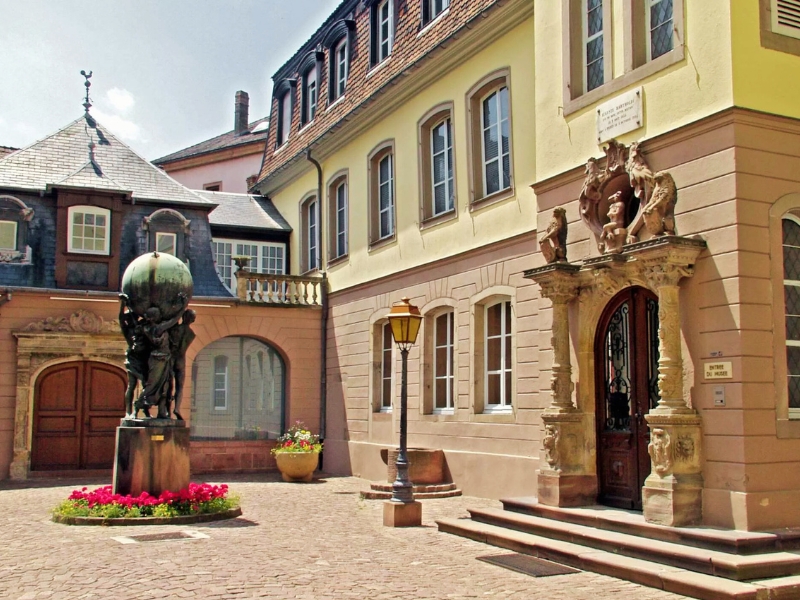
The Musée Bartholdi is the house on the Rue des Marchands where Frédéric Auguste Bartholdi, the sculptor of the Statue of Liberty, was born in 1834. His widow left it to the town, and since 1922 it has held his models, drawings and paintings, from the Lion of Belfort to the fountains and statues you pass all over Colmar.
The Musée Bartholdi at a glance
- Where: 30 Rue des Marchands, in the old town between St Martin's Church and the Maison Pfister.
- Opened: as a museum on 18 November 1922, in an 18th-century town house that was the Bartholdi family home.
- What it is today: a museum of the sculptor's life and work, with the "Maisons des Illustres" label for houses of famous people.
- Time needed: about an hour.
From family home to museum
Bartholdi was born here on 2 August 1834. His father died when he was two, and his mother moved with her sons to Paris, but the family kept the Colmar house and often came back for long stays. Bartholdi trained as a painter and architect before turning to sculpture. His first major public work, the statue of General Rapp, was made for Colmar in the 1850s; later came the Lion of Belfort, finished in 1880, and the Statue of Liberty in New York, inaugurated in 1886. He died in Paris in 1904.
In 1907 his widow bequeathed the house to the town on condition that it become a museum. The First World War, and the fact that Colmar was then part of the German Empire, delayed the project: the museum only opened in 1922, after Alsace had returned to France. Two 17th-century doorways of the house were listed as historic monuments in 1929. Over the years the museum has been renovated and its collections extended, and it now spreads over three floors.
What to look for
- In the courtyard, Bartholdi's bronze group Les Grands Soutiens du Monde: three figures for Justice, Labour and Patriotism holding up a globe, shown at the Paris Salon in 1902.
- The two 17th-century doorways, older than the 18th-century house around them.
- Studies and models for the Statue of Liberty, which show how the figure developed over the years.
- Preparatory models for Bartholdi's monuments in Colmar, such as the Roesselmann and Schwendi fountains and the statue of General Rapp.
- Surviving pieces of lost works, including heads from the Bruat fountain, destroyed in 1940.
The face that moved Albert Schweitzer
Among the fragments in the museum are the sandstone heads of the continents from the Bruat fountain on the Champ de Mars. The fountain was destroyed in 1940, and only the heads were saved. Albert Schweitzer, who went to school in Colmar, later wrote that the sad face of the figure representing Africa had stayed with him since childhood, and the town still links it to his decision to work as a doctor in Africa.
Tips for your visit
- Combine the museum with a walk to Bartholdi's statues around town: the Schwendi Fountain, the Roesselmann Fountain and the Bruat Fountain are all within reach on foot.
- Go early or late in the day; the Rue des Marchands is one of the busiest streets in the old town at midday.
- Leave time for the courtyard, the quietest spot in this part of town.
Nearby
- Maison Pfister: a merchant's house of 1537 with a wooden gallery and painted walls, a few steps away.
- St Martin's Church: Colmar's largest church, a few minutes' walk north.
- Koïfhus: the old customs house of 1480, with its coloured tile roof, a short walk south.
- Little Venice: the canal district, a few minutes further south, past the Fishmongers' quarter.
See Colmar with World City Trail
Our Colmar scavenger hunt turns the old town into a game you play on your phone. The route links 10 stops and takes around 2 hours, with about 33 minutes of walking. The Musée Bartholdi is one of the stops, and the route also passes the Roesselmann Fountain and Little Venice. You can play in English, German, French, Italian, Spanish or Dutch.
If you prefer a different format, there is also a self-guided walking tour and an outdoor escape game in Colmar.
Play the Colmar scavenger hunt →
Take the self-guided walking tour of Colmar →
Play the outdoor escape game in Colmar →
Facts checked in October 2026.