
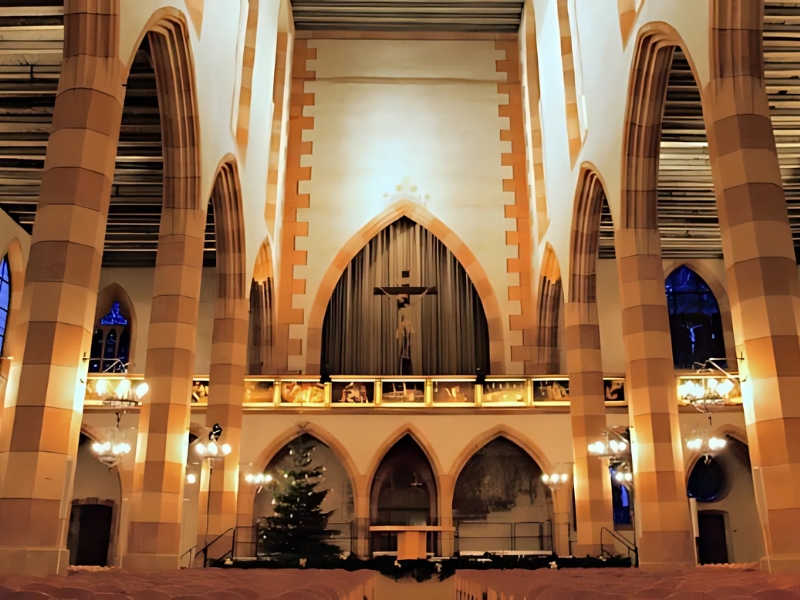
The Église Saint-Matthieu is a Gothic former Franciscan church on Colmar's Grand-Rue, used by the town's Protestants since 1575. For more than 270 years a wall cut it in two, with Protestants in the nave and Catholics in the choir, and the wall only came down in 1987.
Saint-Matthieu at a glance
- Where: 3 Grand-Rue, in the south of the old town, a short walk from the Koïfhus.
- Built: 13th–14th centuries, as the church of a Franciscan friary.
- What it is today: a Protestant church, also used for concerts; a listed historic monument since 1948.
- Time needed: 20–30 minutes inside when it is open.
Friars, Reformers and a dividing wall
The church is the only part left of Colmar's Franciscan friary, which around 1290 was counted among the finest in the region. It follows the plan of the mendicant orders: a wide, plain nave with aisles and a flat ceiling for preaching to large crowds, and a taller choir with rib vaults. When the Reformation reached Colmar in 1575, the town gave the church to the Protestants, along with a bell topped by a cockerel.
In 1715, after Alsace had come under French rule, the king ordered that the choir be given to Catholic worship. The arch between nave and choir was bricked up, and for generations two congregations used one building. The choir was returned to the Protestants in 1937, but the wall stayed until 1987. A restoration from 1995 to 1998 brought the whole space back together, so that today you can again see the church as the friars built it, one long hall from the door to the choir windows.
What to look for
- The stained glass, including a window of 1480 by Peter Hemmel of Andlau, one of the leading glass painters of the Upper Rhine.
- The rood screen (jubé) between nave and choir; with the wall gone, you can now look past it from one end of the church to the other.
- Traces of medieval wall paintings and the painted wooden ceiling of the nave.
- The organ case of 1732 by Andreas Silbermann, part of a famous Alsatian family of organ builders.
- A marble bust of the Colmar philanthropist Jean-Daniel Hanbart by Auguste Bartholdi, made free of charge for the Protestant community.
Why the cockerel?
Many Protestant churches in Alsace carry a cockerel on the bell or spire, while Catholic churches carry a cross. The cockerel recalls Peter's denial of Jesus before the cock crowed, and it became a sign of a Protestant congregation. At Saint-Matthieu it came with the bell the town handed over in 1575, at the start of the church's Protestant history.
Tips for your visit
- Opening is limited and run by volunteers, often on summer afternoons; check locally before you go, or come for a concert.
- The church is a place of worship: avoid visiting during services and keep your voice down.
- Combine it with the Koïfhus and the Fishmongers' quarter, both a few minutes away.
Nearby
- Koïfhus: the old customs house of 1480 with its glazed tile roof, a short walk along the Grand-Rue.
- Fishmongers' quarter: the colourful guild houses on the Quai de la Poissonnerie, a few minutes' walk.
- Little Venice: the canal district along the Lauch, just south.
- St Martin's Church: Colmar's largest church, about ten minutes north.
See Colmar with World City Trail
Our Colmar scavenger hunt turns the old town into a game you play on your phone. The route links 10 stops and takes around 2 hours, with about 33 minutes of walking. The Église Saint-Matthieu is one of the stops, along with the Ancienne Douane, the Fishmongers' quarter and St Martin's Church. You can play in English, German, French, Italian, Spanish or Dutch.
If you prefer a different format, there is also a self-guided walking tour and an outdoor escape game in Colmar.
Play the Colmar scavenger hunt →
Take the self-guided walking tour of Colmar →
Play the outdoor escape game in Colmar →
Facts checked in October 2026.