
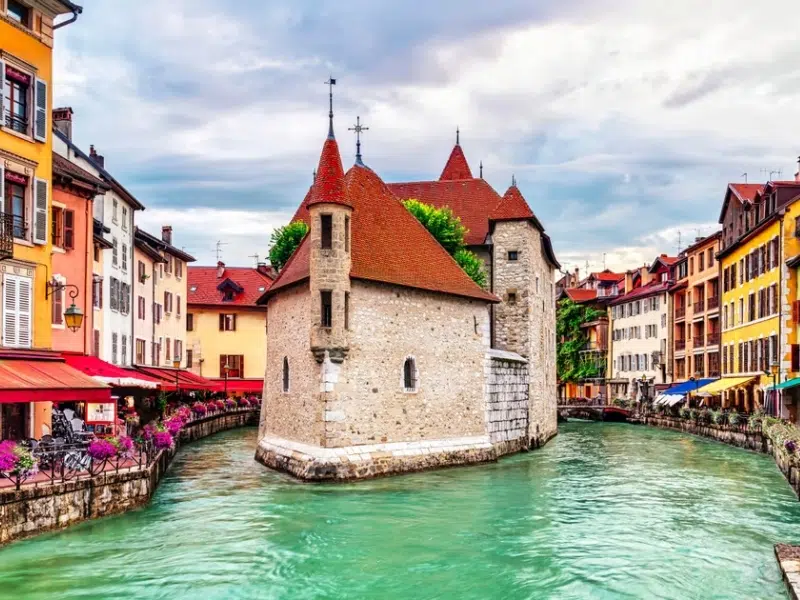
The Palais de l'Île is the stone building on a small rocky island in the middle of the Thiou canal in Annecy's old town, the view that appears on almost every postcard of the town. Its core goes back to the 12th century, and over the centuries it served as a fortified house, a mint, a courthouse and, for the longest time, a prison.
The Palais de l'Île at a glance
- Where: on a natural rocky island in the Thiou, in the old town between the quays.
- Built: the oldest part dates from the 12th century, with later additions.
- What it is today: the town's centre for architecture and heritage (CIAP), with exhibitions and the old cells open to visitors.
- Time needed: 10 minutes to see it from the bridges; about 45 minutes with the inside.
Seven centuries of uses
It began as a fortified house of the lords of the island. The first written mention, in 1325, already describes it as a prison: the castellan of Annecy paid Jean de Monthoux, lord of the island, to feed two prisoners. In 1355 Count Amadeus III of Geneva obtained from Emperor Charles IV the right to strike gold and silver coins, and a mint worked here until the end of the 14th century, when the line of the Counts of Geneva died out. By the late 16th century the building housed the court and was known as the Palais de justice de l'Île.
From the 18th century it held administrative offices while remaining a prison, a role that lasted until 1864. It then served as an old people's home from 1865 to 1880, and later, for shorter periods, as a drawing school, a gymnasium and lodgings. When a plan to demolish it was put forward, writers and heritage officials protested, and on 16 February 1900 the building was classified as a historic monument. Restoration began straight away; the last major campaign took place from 1983 to 1985.
What to look for
- The shape: the building follows the outline of its rock, and its pointed end makes it look like the bow of a ship moored in the canal.
- The cells: inside, you can walk through the former prison cells and the rooms of the old courthouse.
- The water around it: the Thiou is the outflow of Lake Annecy, so the clear water on both sides comes straight from the lake.
- The quays: walk along the canal on both sides to see the building from different angles; each bridge gives a new view.
- The old town setting: tall old houses line the canal on both sides, the scene that made Annecy's old town famous.
A barrier in front of the island
Because the Thiou drains the lake, its flow has always followed the lake level, and Annecy used to flood often. In the 19th century the engineer Sadi Carnot, later President of France, built a barrier in front of the Palais de l'Île that raised the lake by about 20 centimetres, mainly to give more water power to the industries downstream. The gates in front of the building were removed in 1965, when the system was motorised and replaced by a new installation further upstream.
Tips for your visit
- Come early in the morning or at dusk for the classic photo without crowds on the bridges.
- Look at it from more than one bridge: the views from upstream and downstream are completely different.
- Visit the CIAP inside if you want the background on the old town's architecture before walking on.
Nearby
- Pont Morens: the first stone bridge over the Thiou, once lined with leaning houses, a few minutes' walk.
- Cathédrale Saint-Pierre: the 16th-century church that served Geneva's bishops in exile, a short walk away.
- Château d'Annecy: the castle of the Counts of Geneva on the hill above, now the town museum.
See Annecy with World City Trail
Our Annecy scavenger hunt turns the old town into a game you play on your phone. The route links 10 stops and takes around 2 hours, with about 18 minutes of walking. The Palais de l'Île is one of the stops, along with Pont Morens, Annecy Cathedral and the Pont des Amours. You can play in English, German, French, Italian, Spanish and Dutch.
If you prefer a different format, there is also a self-guided walking tour and an outdoor escape game in Annecy.
Play the Annecy scavenger hunt →
Take the self-guided walking tour of Annecy →
Play the outdoor escape game in Annecy →
Facts checked in October 2026.