
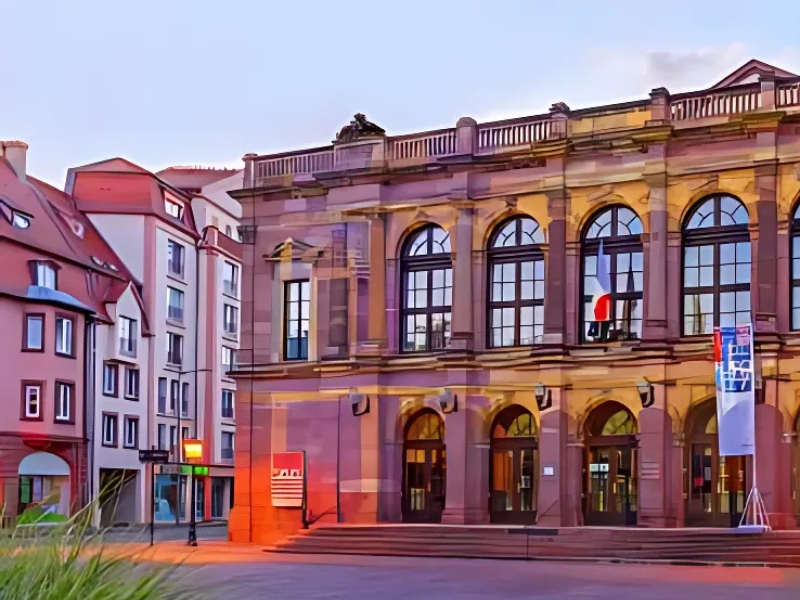
Colmar's municipal theatre is a classical building from 1849 on the square in front of the Unterlinden Museum. Behind its sober five-bay front is a round auditorium in the Italian tradition, with three tiers of galleries, and it stands on ground that once belonged to the medieval Unterlinden convent.
The Théâtre Municipal at a glance
- Where: Place Unterlinden, at the north end of the old town, right next to the Unterlinden Museum.
- Built: 1847–1849; opened on 8 March 1849, extended in the early 1900s and restored around 2000.
- By: architect Louis-Michel Boltz; the interior decoration is by the Parisian decorator Boulangé.
- What it is today: the town's main stage for theatre, opera, dance and concerts, with around 30,000 spectators a year.
- Time needed: 10 minutes to look at the outside; an evening if you see a performance.
A stage on convent land
In the early 19th century Colmar wanted a proper theatre, and the town looked at several sites, among them the Koïfhus, the Dominican church and the Champ de Mars. The choice fell on an outbuilding of the former Unterlinden convent, which had stood empty since the Revolution. Work began in 1847 and the theatre opened two years later, in March 1849. The same architect, Louis-Michel Boltz, later designed Colmar's covered market of 1865 in Little Venice.
The plan is simple and still easy to read from outside: a front block with the entrance hall and foyer, a middle block with the auditorium and stage, and a rear block with offices and dressing rooms. Inside, the horseshoe-shaped hall with its three galleries follows the Italian model used in opera houses across Europe. The building was enlarged in the early 20th century and thoroughly restored around 2000, when the hall was modernised and the number of seats reduced.
What to look for
- The front with five bays, a restrained classical design that contrasts with the half-timbered houses a few streets away.
- The three blocks of the building, with the taller stage house rising behind the façade.
- The square in front, where the theatre faces the old convent buildings and the chapel of the Unterlinden Museum.
- If you get inside, the round hall with its three tiers of galleries and the painted decoration by Boulangé.
Why not the Koïfhus?
The early plans make a nice what-if: if the town had picked the Koïfhus, the old customs house on the Grand-Rue, Colmar's best-known medieval public building would now be a theatre. Instead the theatre went to the north edge of town, and a few years later, in 1849, the Unterlinden convent next door also became a museum. The two institutions have shared the square ever since.
Tips for your visit
- Check the season programme: the hall is mostly open for performances, and on European Heritage Days in September there are often visits.
- The façade looks best in the late afternoon, when the light falls on the square.
- Arrive early for a show and have a drink in one of the cafés around Place Unterlinden.
- Combine the theatre with the Unterlinden Museum and a walk south along the Rue des Têtes.
Nearby
- Unterlinden Museum: next door, home to the Isenheim Altarpiece in a 13th-century convent.
- Dominican Church: a few minutes' walk away, with Martin Schongauer's Madonna of the Rose Bower.
- Maison des Têtes: a Renaissance house of 1609 decorated with carved heads, close by.
- Place Rapp: the square with Auguste Bartholdi's statue of General Rapp, his first public monument, next to the Champ de Mars park.
See Colmar with World City Trail
Our Colmar scavenger hunt turns the old town into a game you play on your phone. The route links 10 stops and takes around 2 hours, with about 33 minutes of walking. The Théâtre Municipal is one of the stops, together with the Unterlinden Museum next door and the Parc du Champ de Mars. You can play in English, German, French, Italian, Spanish or Dutch.
If you prefer a different format, there is also a self-guided walking tour and an outdoor escape game in Colmar.
Play the Colmar scavenger hunt →
Take the self-guided walking tour of Colmar →
Play the outdoor escape game in Colmar →
Facts checked in October 2026.