
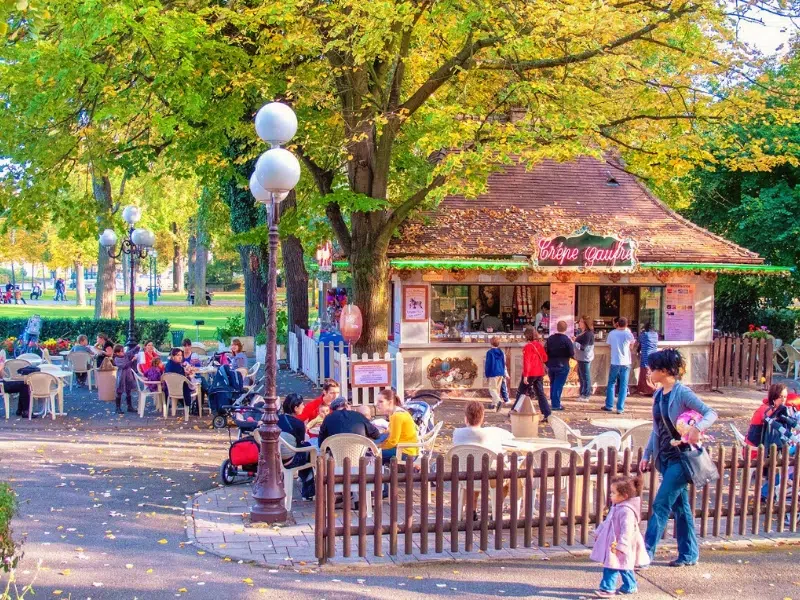
The Parc du Champ de Mars is Colmar's main city park, a tree-lined green space between Place Rapp and the prefecture of the Haut-Rhin, just west of the old town. At its centre stands Auguste Bartholdi's fountain for Admiral Bruat, whose original stone figures were destroyed in 1940 and whose figure of Africa is said to have inspired Albert Schweitzer.
The Champ de Mars at a glance
- Where: between Place Rapp to the north and the prefecture to the south, on the western edge of the old town.
- Created: a promenade outside the walls from the 1740s; named Champ de Mars and laid out as a park in 1793.
- By: the central fountain is by Auguste Bartholdi (1864), rebuilt in 1958 by the architect Michel Porte and the sculptor Gérard Choain.
- What it is today: a public park with lawns, shady paths, a playground and a carousel.
- Time needed: 20–30 minutes, longer with children.
From parade ground to park
In the mid-18th century the area outside Colmar's walls became a public promenade named after the royal intendant Barthélemy de Vanolles. It was used for military drills and public ceremonies, and in 1793, during the Revolution, it was renamed Champ de Mars, after the Roman god of war, like the famous parade ground in Paris. Rows of lime trees were planted under the First Empire, and in 1808 the northern part was separated off; since 1856 it has been called Place Rapp, after the statue of General Rapp by Bartholdi unveiled there that year.
The park's paths form a cross, with a central alley running from the steps of the prefecture, built between 1862 and 1866, to Place Rapp. In 1864 Bartholdi's fountain for Admiral Armand Joseph Bruat, a Colmar-born naval officer who died in 1855, was set up in the circle at the centre; it was the first fountain in Colmar with a water jet system. In 1940 the Nazi authorities destroyed it. The bronze statue of the admiral was saved, restored and placed on a new fountain inaugurated in 1958.
What to look for
- The bronze statue of Admiral Bruat on top of the fountain, facing Bartholdi's statue of General Rapp across Place Rapp.
- The postwar fountain of 1958, a simpler design that replaced Bartholdi's original basin with its four continents.
- The cross-shaped layout of the paths, best seen from the central circle.
- The prefecture's main staircase at the southern end of the central alley.
- The old trees, the lawns and, for children, the playground and carousel.
Schweitzer and the face of Africa
Bartholdi's original fountain showed four sandstone figures representing the continents. Only their heads survived 1940, and they are now in the Musée Bartholdi. Albert Schweitzer, who went to school in Colmar, wrote that the sad face of the African figure stayed with him from boyhood, and the town links it to his decision to become a doctor in Africa. Seeing the heads in the museum makes a good pair with a walk through the park.
Tips for your visit
- Come in the late afternoon, when the light falls through the trees and locals come out for a walk.
- Start at Place Rapp to see the two Bartholdi statues facing each other, then walk the central alley south.
- It is a good place for a picnic or a break between the museums and Little Venice.
Nearby
- Place Rapp: the square at the park's north end with Bartholdi's statue of General Rapp, his first public monument.
- Little Venice: the canal district along the Lauch, a short walk east.
- Musée Bartholdi: the sculptor's birthplace, with the surviving heads of the Bruat fountain, about ten minutes on foot.
- Unterlinden Museum: home to the Isenheim Altarpiece, about ten minutes north.
See Colmar with World City Trail
Our Colmar scavenger hunt turns the old town into a game you play on your phone. The route links 10 stops and takes around 2 hours, with about 33 minutes of walking. The Parc du Champ de Mars is one of the stops, along with the Théâtre Municipal, the Unterlinden Museum and Little Venice. You can play in English, German, French, Italian, Spanish or Dutch.
If you prefer a different format, there is also a self-guided walking tour and an outdoor escape game in Colmar.
Play the Colmar scavenger hunt →
Take the self-guided walking tour of Colmar →
Play the outdoor escape game in Colmar →
Facts checked in October 2026.