
This guide covers six places on the western side of Montpellier's old town, the Écusson: the church of Saint-Roch, the Arc de Triomphe, the Promenade du Peyrou, the Saint-Clément aqueduct, the cathedral of Saint-Pierre and the anatomy museum of the Faculty of Medicine. They are close together and tell two of the city's big stories: the royal stamp Louis XIV put on a town that had been a Protestant stronghold, and eight centuries of medical teaching.
Église Saint-Roch
Saint Roch, the pilgrim saint called on against the plague, was born in Montpellier in the 14th century, and this church is the city's sanctuary to him. It was built between 1860 and 1867 to plans by the architect J. Cassan, in a neo-Gothic style borrowed from the churches of northern France, on the site of the church of Saint-Paul, which was destroyed during the siege of Montpellier in 1622.
The church was never finished: the transept, the apses and the spires planned above the bell tower were not built, and the niches on the façade are still empty. Inside are the relics that draw pilgrims, among them a leg bone brought from Venice in 1856, and a modern stained-glass window above the high altar shows the saint with his dog. The church is a stop for pilgrims on the way to Santiago de Compostela, its feast on 16 August brings processions through the streets, and it is one of our scavenger hunt stops.
- The unfinished façade, with empty niches where statues were meant to stand.
- The statue of Saint Roch by Baussan (1884), made for the top of the façade and now kept inside the church.
- The trompe-l'œil fresco on the wall facing the church, painted in 2005 when the square in front of it was opened up.
Arc de Triomphe
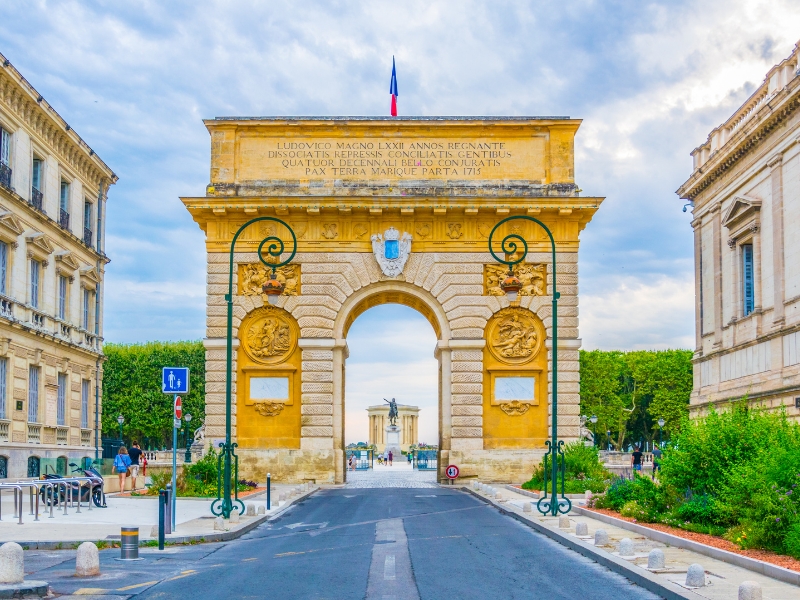
At the top of rue Foch stands Montpellier's triumphal arch, completed around 1692 on the site of one of the gates in the medieval walls. It was designed by François d'Orbay and raised to glorify Louis XIV, more than a century before Paris began its own Arc de Triomphe. The arch was the ceremonial entrance to the royal square of the Peyrou behind it.
Look at the carved reliefs and medallions on both faces, which celebrate the king's reign, the attic painted in ochre and yellow, and the royal coat of arms, restored to its French blue. You can climb the roughly 90 steps to the top only on a guided visit with the tourist office; the view takes in the old town, the sea and, on clear days, the Pic Saint-Loup and the foothills of the Cévennes. The arch is a stop on our scavenger hunt.
Promenade du Peyrou
Walk through the arch and you are on the Promenade du Peyrou, a raised royal square laid out at the end of the 17th century on the highest ground of the city to frame an equestrian statue of Louis XIV. With its terraces, balustrades and rows of trees, it is the place where Montpellier comes to walk, read and watch the sunset.
The bronze horseman has a story of its own. The first statue, made in Paris after designs by Jules Hardouin-Mansart, was cast by 1692 but only reached Montpellier in 1717. In October 1792 revolutionaries pulled it down and sent it to be melted into cannon, and a guillotine was set up on the spot. The statue you see today is a smaller 19th-century replica by Jean-Baptiste Debay. The Peyrou is a scavenger hunt stop.
- The water tower at the far end, a small classical temple ringed by columns, where the aqueduct delivered its water to the city.
- The view from the western terrace over the roofs and the arches of the aqueduct towards the hills.
Aqueduc Saint-Clément
From the water tower, the arches of the Saint-Clément aqueduct run away to the north-west. Work on it began in 1753 to bring spring water into the town, and it was designed by the engineer Henri Pitot, who took the Roman Pont du Gard as his model for the two tiers of arches. The water ended its journey at the Peyrou, from where it fed the fountains of the old town.
The most impressive stretch, with its double row of arches, runs through the Arceaux district just below the Peyrou. It is a lived-in monument rather than a museum piece: a market sets up under the arches several mornings a week, and people play pétanque in their shade. The aqueduct is one of our scavenger hunt stops.
Cathédrale Saint-Pierre
Montpellier's cathedral began as the church of a Benedictine monastery founded in 1364 by Pope Urban V, who had studied in the city. It became a cathedral in 1536, when the bishop's seat moved from Maguelone on the coast to Montpellier. The building suffered badly in the Wars of Religion of the 16th century and was repaired in stages; its choir was rebuilt and enlarged in the 19th century.
Its porch is unlike any other in France: two massive round pillars topped with cones hold up a stone canopy in front of the door, giving the church the look of a fortress. Step inside to see how tall and plain the single nave is, in the southern Gothic style. The cathedral is one of our scavenger hunt stops.
Musée d'Anatomie
Right beside the cathedral, in the former monastery, is the Faculty of Medicine. Montpellier's medical school is one of the oldest in the world (its first statutes date from 1220), and its anatomy museum grew out of a rule of 1798: no student could sit the final exams without handing in an anatomical specimen. The collection was moved in 1852 into a long gallery with colonnades and display cases built for it, and it was listed as a historic monument in 2004.
The museum holds thousands of specimens, wax models, casts and surgical instruments, and it is one of the largest anatomy collections in France. It has been closed for renovation for several years, with no reopening date announced at the time of writing, so check before you go. Even when it is closed, the faculty's façade next to the cathedral porch is worth a look.
How to see them in one walk
Start at the church of Saint-Roch and walk west through the lanes of the Écusson to rue Foch, which leads straight up to the Arc de Triomphe. Pass through the arch onto the Promenade du Peyrou, cross to the water tower and go down the steps to follow the arches of the Saint-Clément aqueduct into the Arceaux district. Come back along boulevard Henri IV to the cathedral of Saint-Pierre and the Faculty of Medicine next door; the Jardin des Plantes is just across the street if you want a rest in the shade.
See Montpellier with World City Trail
Our Montpellier scavenger hunt turns the old town into a game you play on your phone. The route links 10 stops, from the Place de la Comédie to the Place de la Canourgue. Five places in this guide are stops: the church of Saint-Roch, the Arc de Triomphe, the Promenade du Peyrou, the Saint-Clément aqueduct and the cathedral, and the route also takes in the Opéra Comédie, the rue Arc-en-Ciel and the Jardin des Plantes.
If you prefer a different format, there is also a self-guided walking tour and an outdoor escape game in Montpellier.
Play the Montpellier scavenger hunt →
Take the self-guided walking tour of Montpellier →
Play the outdoor escape game in Montpellier →
Facts checked in October 2026.