
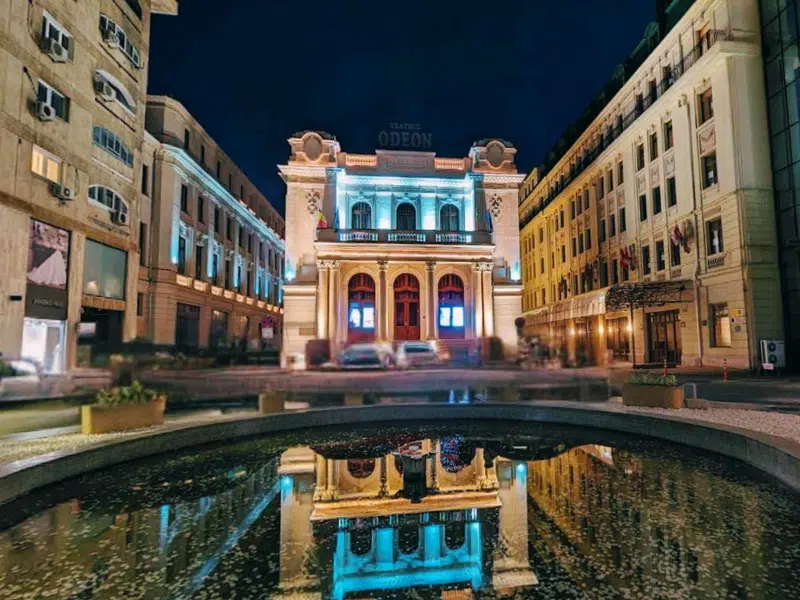
Calea Victoriei, one of Bucharest's main avenues, runs north from the old town past most of the places that tell the city's story. This guide follows it for seven of them: the National Museum of Romanian History, the Stavropoleos church, the Cărturești Carusel bookshop, University Square, the Odeon Theatre, Revolution Square and the Romanian Athenaeum. Together they cover nearly three centuries, from an 18th-century Greek monk's church to the square where the communist regime fell in 1989.
National Museum of Romanian History
The museum stands at number 12 Calea Victoriei, in the former Palace of the Post Office, an eclectic building designed by Alexandru Săvulescu and approved in 1892; its model was the main post office in Geneva. Part of the building still houses a philatelic museum. The history museum spans Romanian history from prehistory to modern times, but the building has long been under restoration and only partly open, so the visit centres on three permanent exhibitions: the Treasury, the cast of Trajan's Column and the Lapidarium.
The Treasury is the highlight: it holds the Romanian Crown Jewels and the Pietroasele treasure, a hoard of gold objects from late antiquity. The museum made international news in January 2025, when the gold Helmet of Coțofenești was stolen while on loan to the Drents Museum in the Netherlands; according to the museum, it was recovered in April 2026.
- The plaster cast of Trajan's Column, whose reliefs tell the story of the Roman conquest of Dacia.
- The Lapidarium, with 166 carved stones from across Romania.
Stavropoleos Church
A few steps from the museum, in a narrow street of the old town, stands a small church built in 1724 by the Greek monk Ioannikios Stratonikeas, during the reign of Prince Nicholas Mavrocordatos. It was built inside the precinct of his inn, whose income supported the monastery; the inn and the other buildings were demolished at the end of the 19th century, and only the church survived. The name comes from the Greek Stavropolis, the city of the cross. Today it is a convent, and its Byzantine choir, founded in 1994, sings neo-Byzantine church music.
- The porch, with its carved stone columns and painted vaults, a fine example of the Brâncovenesc style, the Romanian blend of Byzantine and Renaissance forms.
- The library, in a building designed by the architect Ion Mincu, with the largest collection of Byzantine music books in Romania.
Cărturești Carusel
On Lipscani street, named after the merchants who brought goods from Leipzig, this bookshop fills a building put up in the early 20th century for the Chrissoveloni family, Greek bankers who had their bank here. Later it became a general store, and by the late 1990s it had fallen into decay. A five-year rehabilitation was completed in 2015, and the building reopened as a bookshop of the Cărturești chain, with white balconies around a bright central hall.
University Square
University Square marks the northeastern edge of the old town. The University of Bucharest stands on the site of the Princely Academy, founded in 1679, and its present neoclassical front was built between 1921 and 1943. Across the boulevard rise the National Theatre and the tower of the InterContinental hotel, built in 1968 to 1970. In 1990 the square was the scene of the Golaniad, a long peaceful student protest against former communists in government, which ended in violence when miners from the Jiu Valley were brought in.
- In front of the university, four statues of figures from Romanian history and education: Ion Heliade Rădulescu, Michael the Brave, Gheorghe Lazăr and Spiru Haret.
Odeon Theatre
Back on Calea Victoriei, the Odeon Theatre plays in the Majestic hall, a building inaugurated in 1911 that earlier housed the Comedy Theatre. The company itself began in 1946 as a workers' theatre of the railway, Teatrul Muncitoresc CFR Giulești, moved into this building in 1974 and took the name Odeon in 1990, after the revolution. It is one of the best-known stages in the city, with a main hall of about 300 seats and a smaller studio.
- The Majestic hall is one of the few theatres in Europe with a sliding ceiling, which can open above the audience.
Revolution Square
Until 1989 this was Palace Square, named after the royal palace. On 21 December 1989 Nicolae Ceaușescu called a mass rally here, meant to show support for him; instead it turned into the popular revolt that brought him down. The next day he and his wife fled by helicopter from the former Central Committee building on the square.
Around the square stand the former Royal Palace, now the National Museum of Art of Romania, the Athénée Palace hotel, the Central University Library and the Memorial of Rebirth. The equestrian statue of King Carol I, destroyed in 1948, was recreated and unveiled again in December 2010.
Romanian Athenaeum
On the north side of the square, the domed Athenaeum is Bucharest's main concert hall. It was designed by the French architect Albert Galleron and opened in 1888, though work went on until 1897. Part of the money came from a public appeal that lasted 28 years, remembered by its slogan: give one leu for the Athenaeum. Today it is the home of the George Enescu Philharmonic, and in 2007 it received the European Heritage Label.
- Inside the concert hall, the fresco by Costin Petrescu, 75 metres long and 3 metres high, which runs around the room and tells Romanian history from Trajan's conquest of Dacia to the union of 1918.
- The building's link to that union: on 29 December 1919 a conference held here voted to ratify the union of Bessarabia, Transylvania and Bukovina with the old kingdom.
How to see them in one walk
Start at the History Museum on Calea Victoriei and turn into the old town for Stavropoleos and, a little further on Lipscani, Cărturești Carusel. Pass through the Macca-Vilacrosse passage back to Calea Victoriei, then walk east to University Square. Return to Calea Victoriei and head north past the Odeon Theatre to Revolution Square, where the National Museum of Art fills the former Royal Palace, and finish across the square at the Romanian Athenaeum, ideally with a concert.
See Bucharest with World City Trail
Our Bucharest scavenger hunt turns the city centre into a game you play on your phone. The route links 10 stops, from the National Museum of Romanian History to the Romanian Athenaeum, and all seven places in this guide are stops, along with the Macca-Vilacrosse passage, the National Museum of Art and the Royal Palace. At each stop you solve a puzzle and learn a story, at your own pace.
There is also a self-guided walking tour and an outdoor escape game in Bucharest, for people who prefer a different format.
Play the Bucharest scavenger hunt →
Take the self-guided walking tour of Bucharest →
Play the outdoor escape game in Bucharest →
Facts checked in October 2026.