
Almost everything most visitors come to see in Dresden stands in a small area of the old town between the Zwinger and the Elbe. This guide covers nine of those places in the order you meet them on foot: the Zwinger, the Semperoper, the cathedral, the Transport Museum in the Johanneum, the Neumarkt, the Frauenkirche, the Albertinum, the Academy of Fine Arts and Brühl's Terrace. Nearly all of them were wrecked in the bombing of February 1945 and rebuilt over the following decades, which is part of their story.
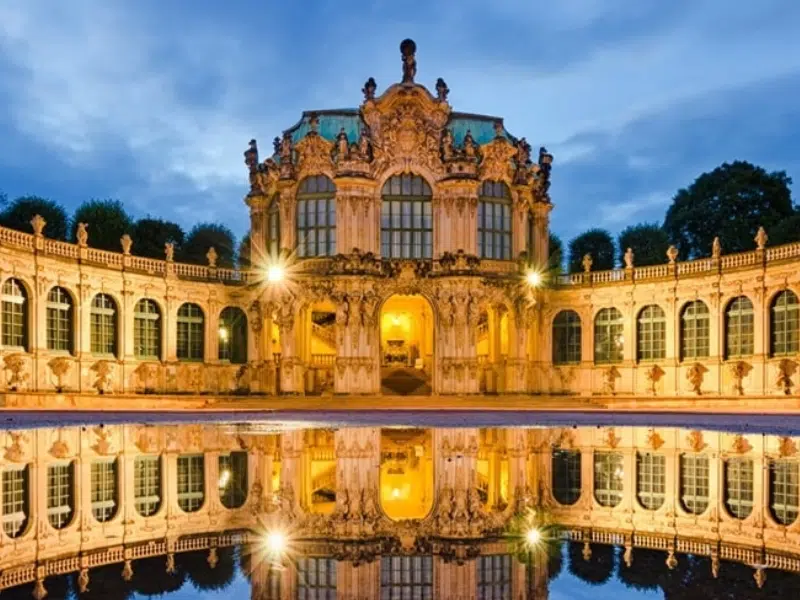
The Zwinger
The Zwinger was built in stages from 1710 to 1728 for Augustus the Strong, Elector of Saxony and King of Poland, as a setting for court festivities. The architect was Matthäus Daniel Pöppelmann and the sculpture is by Balthasar Permoser: pavilions and galleries crowded with figures, garlands and fountains frame a vast inner courtyard. Some parts, such as the Crown Gate, stand on sections of the old city wall. The side towards the Elbe stayed open until Gottfried Semper closed it with a gallery wing, built from 1847 and opened in 1855.
The bombing of 13 to 15 February 1945 left most of the Zwinger in ruins. Rebuilding started in 1945, parts reopened in 1951, and by 1963 it had largely been restored to its pre-war state. Today it holds three museums: the Old Masters Picture Gallery in the Semper wing, the Porcelain Collection and the Mathematisch-Physikalischer Salon with its clocks and scientific instruments.
- The Crown Gate, topped by a crown, a reminder that the Saxon elector was also King of Poland.
- The Semper wing on the Elbe side, home of the Old Masters Picture Gallery, a calmer 19th-century answer to Pöppelmann's Baroque.
The Semperoper
Dresden's opera house carries the name of its architect, Gottfried Semper. His first building opened in 1841 and burned in 1869; the second was built by his son Manfred to Gottfried's plans and finished in 1878. After the bombing of 1945 only the outer walls were left, and the rebuilt house reopened on 13 February 1985, forty years to the day after the raid, with Weber's Der Freischütz. Wagner's Rienzi, The Flying Dutchman and Tannhäuser had their premieres here, and so did Richard Strauss's Salome, Elektra and Der Rosenkavalier. It is the home of the Saxon State Opera and the Staatskapelle Dresden.
- Above the main entrance, a chariot pulled by four panthers and driven by Dionysus.
The Cathedral (Hofkirche)
Across Theaterplatz stands the former Catholic court church, designed by the Italian architect Gaetano Chiaveri for Augustus III, a Catholic ruler in a Lutheran land. It was consecrated in 1751 and finished in 1755, and a raised passage links it to the Residenzschloss, the royal palace. In 1964 it became the cathedral of the Diocese of Dresden-Meissen, and since 1980 it has also carried the name Kathedrale Sanctissimae Trinitatis.
- Inside, the organ, the last work of the great organ builder Gottfried Silbermann, and a Rococo pulpit by Balthasar Permoser.
- The crypts of the Wettin family, which hold Augustus the Strong's heart and the remains of the last King of Saxony.
Transport Museum (Johanneum)
The Transport Museum fills the Johanneum, a Renaissance building on the Neumarkt. It was built in 1586 to 1590 by the architect Paul Buchner as the stables of Elector Christian I, with the armoury above, and in the 1870s it was converted into a museum and named after King Johann of Saxony. The transport museum opened here in 1956, in a building still damaged from the war, and today shows railway, cars, bicycles and motorcycles, aviation and shipping under one roof.
- Behind the building, the Stallhof, the old stable yard, described as the only original tournament ground of its kind still preserved in Europe.
The Neumarkt
The Neumarkt, or new market, lies on raised ground that kept it safe from Elbe floods, and it was one of the first parts of Dresden to be settled. Under Augustus the Strong it filled with Baroque houses around the Frauenkirche. The firestorm of 1945 destroyed it almost completely, and for decades the square lay mostly empty. After reunification the city decided to rebuild it as it had looked before the war, divided into eight quarters, a project that began with the Frauenkirche and has been criticised by some architects as inauthentic.
The Frauenkirche
The Lutheran Church of Our Lady was designed by George Bähr and built from 1726 to 1743; Bähr died before it was finished. Its sandstone dome, nicknamed the Stone Bell, rose high above the city. The church survived the first two nights of bombing, but on 15 February 1945 the dome collapsed, and for about 45 years the pile of rubble was kept as a war memorial.
Rebuilding began in 1994, and the church was consecrated again on 30 October 2005. More than 8,500 original stones were recovered from the rubble and about 3,800 of them were reused; they are the dark blocks scattered across the light new sandstone. The new gilded cross on the dome was made by Grant Macdonald Silversmiths of London, and the craftsman who built it, Alan Smith, is the son of a pilot who took part in the bombing of Dresden.
- In front of the church, the bronze statue of Martin Luther by Adolf von Donndorf from 1885, which survived the bombing and was put back after restoration.
The Albertinum
On the edge of Brühl's Terrace, the Albertinum stands on the site of an arsenal built in 1559 to 1563. The architect Carl Adolf Canzler turned it into a museum of sculpture in 1884 to 1887, named after King Albert of Saxony. Today it houses the New Masters Gallery and the Sculpture Collection, from Romanticism to the present. After the Elbe flood of 2002 it was renovated, with a new flood-proof storage building, and reopened in 2010.
Academy of Fine Arts
The art academy goes back to 1764, when Elector Frederick Christian founded it, and the painter Otto Dix was among its teachers. Its building on Brühl's Terrace was designed by Constantin Lipsius and built in 1887 to 1894. The glass dome on top is known in Dresden as the lemon squeezer, because of its shape.
Brühl's Terrace
The terrace, high above the Elbe, was once part of the city's fortifications. It takes its name from Count Heinrich von Brühl, minister of Augustus III, who from 1737 built a palace with a gallery, library and gardens here; it was given to him in 1747. In 1814 the Russian governor Nikolai Repnin opened it to the public, and its view over the river earned it the nickname Balcony of Europe.
- The broad staircase up from Schlossplatz, with Johannes Schilling's sculptures of the Four Times of Day, and on the terrace the monuments to Gottfried Semper and to Johann Friedrich Böttger, a pioneer of European porcelain.
How to see them in one walk
Begin at the Zwinger and walk through it to Theaterplatz for the Semperoper and the cathedral. Pass the Residenzschloss and turn into Augustusstrasse to see the long porcelain mural of the Fürstenzug on the wall of the Stallhof, which leads you to the Johanneum and the Transport Museum. Continue onto the Neumarkt and the Frauenkirche, then walk east to the Albertinum and the Academy of Fine Arts. Climb onto Brühl's Terrace and follow it back towards Schlossplatz, with the Elbe below you.
See Dresden with World City Trail
Our Dresden scavenger hunt turns the old town into a game you play on your phone. The route links 10 stops, from the Zwinger to the Academy of Fine Arts, and eight places in this guide are stops: the Zwinger, the Semperoper, the cathedral, the Transport Museum, the Neumarkt, the Frauenkirche, the Albertinum and the Academy, along with the Residenzschloss and the Fürstenzug. Brühl's Terrace is not a stop, but the route passes right by it. At each stop you solve a puzzle and learn a story, at your own pace.
There is also a self-guided walking tour and an outdoor escape game in Dresden, for people who prefer a different format.
Play the Dresden scavenger hunt →
Take the self-guided walking tour of Dresden →
Play the outdoor escape game in Dresden →
Facts checked in October 2026.