
Annecy's old town sits where the Thiou river leaves the lake, and almost everything worth seeing lies between the canals and the shore. This guide covers six places on that short stretch: the old island prison, the Pont des Amours, the cathedral, the statue of the chemist Claude Louis Berthollet, the town hall and the church of Saint-François-de-Sales. Together they tell the story of a town that was ruled by the counts of Geneva, the dukes of Savoy and the kings of Sardinia before it became French in 1860.
Palais de l'Île
The Palais de l'Île is the stone building shaped like the prow of a ship in the middle of the Thiou canal, and it is the picture most people take home from Annecy. It dates back to the 12th century and over the centuries served as a lords' residence, a courthouse, a mint and above all a prison. Today it houses an interpretation centre on the architecture and heritage of the town, with exhibitions on how Annecy grew.
From the bridges on either side you can see how the building fills its small island completely, with water flowing past on both sides. The classic view is from the Pont Perrière or the Quai de l'Île.
- The old cells inside, which you can visit along with the exhibition.
- The flower boxes on the bridges and railings, part of the reason Annecy is known for its floral displays.
Pont des Amours
This slim iron footbridge crosses the Canal du Vassé between the Jardins de l'Europe and the lawns of the Pâquier, right where the canal meets the lake. It was built at the start of the 20th century to replace an older wooden bridge. A local legend says that couples who kiss on the bridge will stay together forever. From the middle you look down the canal lined with moored boats and out to the mountains around the lake.
- The view south across the lake from the centre of the bridge, best at sunset.
Cathédrale Saint-Pierre
The cathedral was built in the 16th century as the church of the Franciscan friars. After the Reformation, the bishops of Geneva could no longer live in Calvinist Geneva and settled in Annecy instead, and Francis de Sales, bishop from 1602 to 1622, preached here. The church became the cathedral of the new diocese of Annecy in the 19th century. Its Renaissance facade is plain, and the young Jean-Jacques Rousseau studied music with its choirmaster in the late 1720s.
- The plain Renaissance facade on the narrow Rue Jean-Jacques Rousseau, a street named after the town's most famous young pupil.
Statue of Claude Louis Berthollet
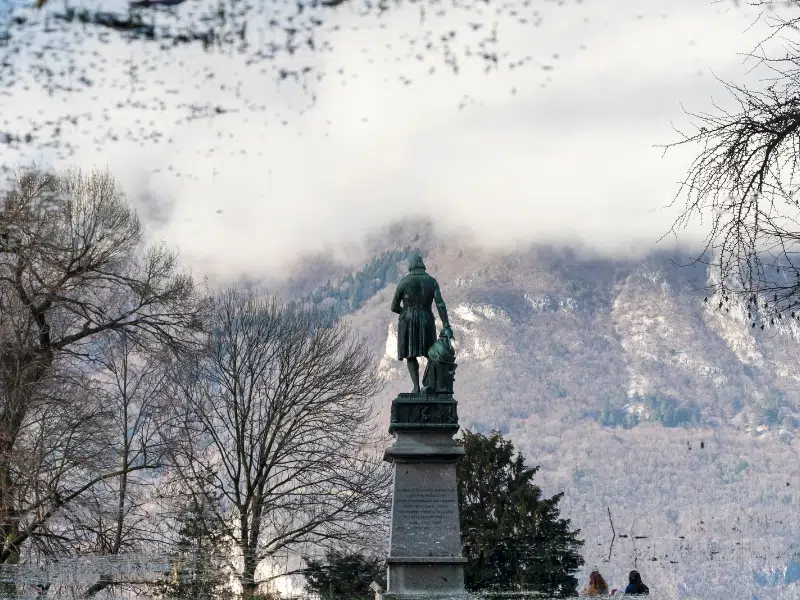
Claude Louis Berthollet was born in 1748 in Talloires, on the shore of Lake Annecy, and became one of the leading chemists of his age. He discovered that chlorine could be used to bleach cloth, worked with Antoine Lavoisier on the new names of chemical substances, and went with Napoleon on his expedition to Egypt in 1798. His bronze statue by Carlo Marochetti was set up in 1843 in the Jardins de l'Europe and has been a listed historic monument since 2016.
- The pedestal and the figure of the scientist, close to the town hall and the lakeside gardens.
- Talloires, his birthplace, a village on the eastern shore of the lake that you can reach by boat in summer.
Hôtel de Ville
Annecy's town hall stands between the old town and the lake. Its plans were approved in 1846, when Savoy still belonged to the Kingdom of Sardinia, and the architect François Justin gave it the Sardinian neoclassical style of the time, with a central section of tall columns under a triangular pediment. In the 1990s the square in front was redesigned by Jean-Michel Wilmotte. Since 2017 the town hall has served the new, larger commune of Annecy, formed by merging the town with several neighbouring communes.
- The columns and pediment of the central front, and the square with its water basin.
- The lakeshore a few steps away, where the tour boats leave from the quays.
Église Saint-François-de-Sales
On the bank of the Thiou, near the Palais de l'Île, stands the church of Saint-François-de-Sales. It began as the chapel of the first monastery of the Visitation, the religious order founded in Annecy in 1610 by Francis de Sales and Jane Frances de Chantal. The chapel was rebuilt from 1642 to hold their tombs, with a facade inspired by the Gesù church in Rome. The relics were later moved to the Basilica of the Visitation above the town, and since 1923 the church has served Annecy's Italian community.
- The baroque altarpieces in the side chapels, seven of them in all.
How to see them in one walk
Start at the Église Saint-François-de-Sales on the Thiou, then cross to the Palais de l'Île and follow the canal towards the lake. Turn into the old town to visit the Cathédrale Saint-Pierre in the Rue Jean-Jacques Rousseau. Walk on to the Hôtel de Ville and the Jardins de l'Europe beside it, where you find the statue of Berthollet. Finish at the Pont des Amours and continue onto the Pâquier lawns for the view of the lake and the mountains. Annecy is small, so you can do this at an easy pace and still have time for the lakeside. With more time, climb the lanes to the Château d'Annecy above the old town, now a museum.
See Annecy with World City Trail
Our Annecy scavenger hunt turns the old town into a game you play on your phone. The route links 10 stops, from the Pont des Amours to the Pont Morens, and all six places in this guide are stops, along with the lake panorama, the Église Notre-Dame-de-Liesse and the Place Notre-Dame. At each stop you solve a puzzle and learn a story, at your own pace.
There is also a self-guided walking tour and an outdoor escape game in Annecy, for people who prefer a different format.
Play the Annecy scavenger hunt →
Take the self-guided walking tour of Annecy →
Play the outdoor escape game in Annecy →
Facts checked in October 2026.