
Most visitors to Amsterdam walk the same line without knowing it: out of Centraal Station, down the Damrak to Dam Square, and on across the canals to the Westerkerk. This guide covers six places on that line, from the station and the old stock exchange to the city's oldest church, the square with its palace, monument and wax museum, and the church whose bells Anne Frank could hear from her hiding place.
Centraal Station
Amsterdam's main station opened in 1889. It was designed by Pierre Cuypers, the architect of the Rijksmuseum, and the two buildings share the same red-brick neo-Renaissance style. The station stands on three artificial islands in the IJ, supported by thousands of wooden piles, and its construction cut the old city off from its harbour front, which many people criticised at the time.
- The two towers on the facade: one holds a clock, the other a wind vane that once showed sailors and merchants the wind direction.
- The Basilica of St Nicholas across the water, the big domed Catholic church that greets you as you leave the station.
Beurs van Berlage
This long brick building on the Damrak was built between 1898 and 1903 as the city's commodity exchange, to designs by Hendrik Petrus Berlage. With its plain brick walls, honest construction and few ornaments, it broke with the historical styles of the time and is seen as a starting point of modern Dutch architecture. Today it is used for conferences, exhibitions and concerts.
- The clock tower on the corner and the carved stone and tile details that tell the history of trade.
Oude Kerk
The Oude Kerk (Old Church) is the oldest building in Amsterdam. It began as a wooden chapel and was consecrated as a stone church in 1306, then grew over the next centuries into the large Gothic church you see now. It stands in the middle of De Wallen, the red-light district, which makes for an unusual contrast between a medieval church and the windows around it.
Its floor is made almost entirely of gravestones, and among the people buried here is Saskia van Uylenburgh, Rembrandt's wife, who died in 1642. Today the church is also used for contemporary art exhibitions and concerts.
- The wooden vaulted ceiling, among the largest medieval wooden vaults in Europe.
- The small bronze relief of a hand on a breast set into the paving outside, placed there anonymously in 1993.
Dam Square and the Royal Palace
Dam Square is where the city began, at a dam built across the Amstel river in the 13th century, which also gave Amsterdam its name. Its west side is filled by the Royal Palace, built between 1648 and 1665 as the town hall, at the height of the Dutch Golden Age, to designs by Jacob van Campen. It became a royal palace in 1808 under Louis Napoleon, and the Dutch king still uses it for state visits and official receptions.
Opposite stands the National Monument, a white stone pillar unveiled in 1956 in memory of the victims of the Second World War. Every year on 4 May the national remembrance ceremony is held here, with two minutes of silence at eight in the evening.
- The bronze Atlas carrying a globe on the back of the palace roof, above the pediment.
- The sculptures on the National Monument, including chained men and a woman with a child, by John Rädecker.
Madame Tussauds Amsterdam
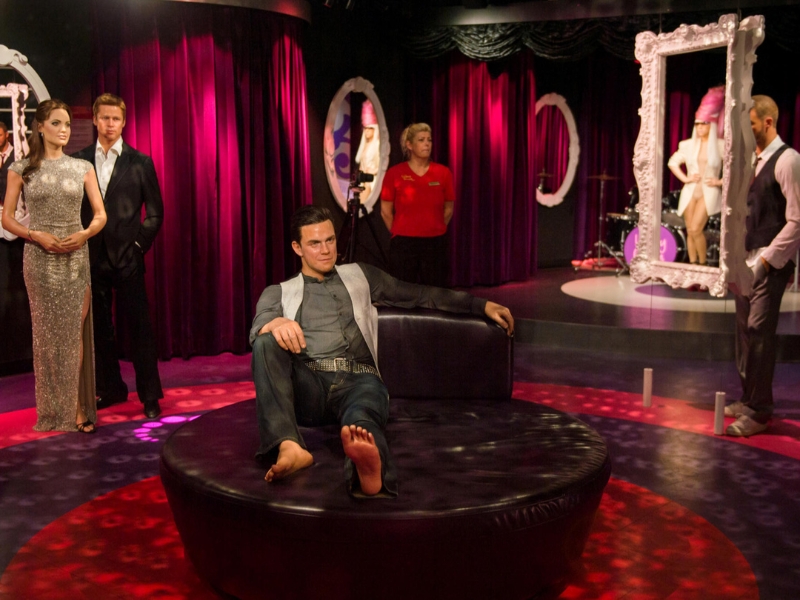
Amsterdam's wax museum was the first Madame Tussauds outside the United Kingdom. It was founded in 1970 on the Kalverstraat and moved in 1991 to the upper floors of the former Peek & Cloppenburg department store on Dam Square, built in 1914–1917. The figures range from Dutch Golden Age painters and the royal family to sports stars, musicians and film actors.
- The Dutch rooms, with figures of the royal family and painters of the Golden Age such as Rembrandt.
Westerkerk
The Westerkerk was built between 1620 and 1631 for the Protestant community of the new canal ring. Its architect, Hendrick de Keyser, died before it was finished. Its tower is the tallest church tower in Amsterdam and carries the imperial crown of Maximilian of Austria, which the emperor allowed the city to use in its coat of arms in 1489. Rembrandt was buried in the church in 1669, though the exact place of his grave is unknown.
The Anne Frank House is next door on the Prinsengracht. In her diary, Anne Frank wrote about the comfort of hearing the Westerkerk's bells while she was in hiding.
- The statue of Anne Frank by Mari Andriessen on the Westermarkt, beside the church.
- The Homomonument, three pink granite triangles on the Westermarkt, the first memorial in the world to gay men and women persecuted for their sexuality.
How to see them in one walk
Start at Centraal Station and walk south along the Damrak. The Beurs van Berlage is on your left, and a few streets behind it, to the east, is the Oude Kerk. Come back to Dam Square for the Royal Palace, the National Monument and Madame Tussauds. Then walk west behind the palace, along the Raadhuisstraat, crossing the Herengracht and the Keizersgracht to reach the Westerkerk on the Prinsengracht. Finish in the Nine Streets just south of it, a grid of small shops and cafés between the canals.
See Amsterdam with World City Trail
Our Amsterdam scavenger hunt turns the old centre into a game you play on your phone. The route links 10 stops, from Centraal Station to the Nine Streets (De 9 Straatjes), and Centraal Station, the Beurs van Berlage, the Oude Kerk, the Royal Palace, the National Monument, Madame Tussauds and the Westerkerk are all stops, along with the Basilica of St Nicholas and the Anne Frank monument. At each stop you solve a puzzle and learn a story, at your own pace.
There is also a self-guided walking tour and an outdoor escape game in Amsterdam, for people who prefer a different format.
Play the Amsterdam scavenger hunt →
Take the self-guided walking tour of Amsterdam →
Play the outdoor escape game in Amsterdam →
Facts checked in October 2026.