
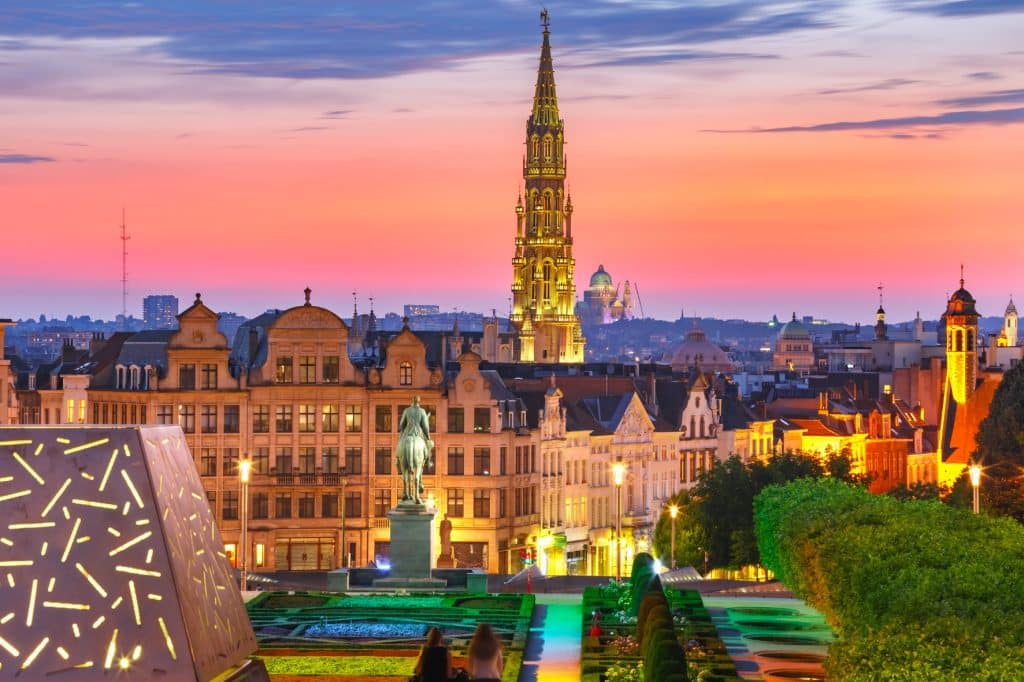
Brussels packs most of its best-known sights into a compact centre: the Grand Place, two small statues that are famous far beyond their size, a 19th-century shopping arcade, the cathedral and the Mont des Arts all lie within an easy walk. This guide covers those five and adds one place further out, the Sonian Forest, for when you want trees instead of facades.
Grand Place
The Grand Place has been the city's main square since the Middle Ages. Its Town Hall, finished in the 15th century, has a Gothic spire crowned by a statue of St Michael slaying the devil. In August 1695 a French army under Marshal de Villeroy bombarded Brussels and destroyed most of the square, but the guilds rebuilt their houses within a few years in rich baroque style, which is why the facades look so unified. The square has been a UNESCO World Heritage Site since 1998.
Opposite the Town Hall stands the Maison du Roi, or Breadhouse, rebuilt in neo-Gothic style in the 19th century, which now holds the Brussels City Museum. Every two years, in August, the square is covered with a giant carpet of begonias.
- The gilded guildhalls, each with its own name and emblem, such as the house of the boatmen with a stern-shaped gable.
- The statue of St Michael on top of the Town Hall spire.
- The house called Le Pigeon, where Victor Hugo stayed in exile in 1852.
Manneken Pis and Jeanneke Pis
A few streets south of the Grand Place, a small bronze boy has been peeing into a fountain since 1619, when Jérôme Duquesnoy the Elder made him. The statue on the corner today is a copy; the original is kept in the Brussels City Museum. Manneken Pis owns a wardrobe of more than a thousand costumes, and on many days of the year he is dressed for a festival, a national day or a club, and some of the outfits are on display in the nearby GardeRobe MannekenPis museum.
- Jeanneke Pis, a squatting girl added in 1987, in a narrow dead-end alley off the Rue des Bouchers.
- The legends about the boy's origin, including one about a child who saved the city by putting out a fuse; none can be proven.
Royal Galleries of Saint-Hubert
Opened in 1847 and designed by the architect Jean-Pierre Cluysenaar, these glass-roofed arcades were among the first covered shopping galleries in Europe. Three linked sections, the King's, Queen's and Princes' galleries, house chocolate shops, bookshops, cafés, a theatre and a cinema, under an arched iron and glass roof.
- The marble pilasters and the inscription Omnibus omnia, all for all, on the facade at the entrance.
Cathedral of St Michael and St Gudula
Brussels' cathedral stands on a slope between the old town and the upper town. It was built in Gothic style from the 13th century to the early 16th century, and its two square towers face west over a wide flight of steps. It is the setting of Belgian royal weddings and state funerals. Inside, the stained-glass windows of the 16th century are among the finest in the country.
- The baroque wooden pulpit, carved with Adam and Eve driven out of Paradise.
- The remains of an earlier Romanesque church, visible through openings in the floor.
Mont des Arts
The Mont des Arts is a terraced garden and set of cultural buildings laid out in the 1950s and 1960s between the lower town and the royal quarter. From the top of the steps you get one of the best views of the Town Hall spire. Nearby are the Royal Museums of Fine Arts of Belgium, including the Magritte Museum, and the Musical Instruments Museum in an Art Nouveau department store.
- The carillon clock on the arch at the top, with a little figure that strikes the hours and bells that play a tune.
- The equestrian statue of King Albert I at the lower end and the view across the formal garden.
Sonian Forest
The Sonian Forest (Forêt de Soignes or Zoniënwoud) covers more than 4,000 hectares on the south-eastern edge of the city and stretches across all three Belgian regions. It is best known for its tall beech trees, planted in straight rows in the 18th century, which form what locals call a beech cathedral. Several forest reserves inside it are part of a UNESCO World Heritage Site for ancient beech forests in Europe, listed in 2017.
The forest is a favourite place for walking, running and cycling, and it is easy to reach by public transport, so it makes a good half-day outside the centre. It is not on our scavenger hunt route.
- The priory of Rouge-Cloître (Rood Klooster), a former monastery on the forest's edge.
- The lakes and paths around Groenendaal, on the Flemish side.
How to see them in one walk
Start at the Grand Place, walk south to Manneken Pis, then return through the square and into the Rue des Bouchers to find Jeanneke Pis. The Royal Galleries of Saint-Hubert begin right there. Walk through the arcades, cross the street and climb to the Cathedral of St Michael and St Gudula. From the cathedral, head south along the slope to the Mont des Arts and the Royal Museums of Fine Arts. Save the Sonian Forest for another half-day, by tram or train from the centre.
See Brussels with World City Trail
Our Brussels scavenger hunt turns the city centre into a game you play on your phone. The route links 10 stops, from the Parlamentarium to the Cathedral of St Michael and St Gudula, and the Grand Place, Manneken Pis, Jeanneke Pis, the Royal Galleries of Saint-Hubert, the carillon on the Mont des Arts and the Royal Museums of Fine Arts are all stops, along with Luxembourg Square and the Royal Palace. At each stop you solve a puzzle and learn a story, at your own pace.
There is also a self-guided walking tour and an outdoor escape game in Brussels, for people who prefer a different format.
Play the Brussels scavenger hunt →
Take the self-guided walking tour of Brussels →
Play the outdoor escape game in Brussels →
Facts checked in October 2026.