
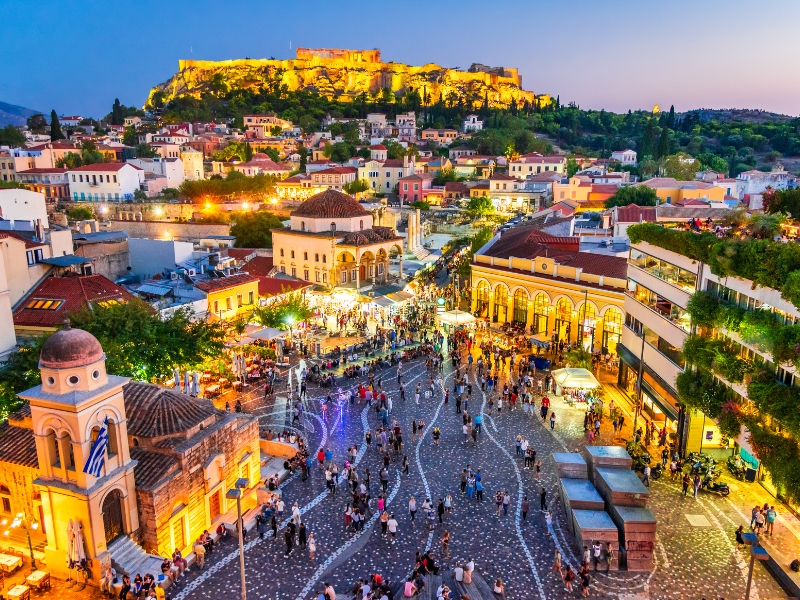
This guide covers seven places on the north and south sides of the Acropolis: Monastiraki, the Library of Pantainos, the Tower of the Winds, Plaka, the Theatre of Dionysus, the Odeon of Herodes Atticus and the statue of General Makriyannis. They sit so close together that you can link them in one walk, and between them they cover 2,500 years of Athens, from Greek drama and Roman gifts to the War of Independence.
Monastiraki
Monastiraki means 'little monastery', after the small Pantanassa church that still stands in the square, the last trace of a convent that once filled the area. Today the square is one of the city's busiest crossroads, with a metro station, the flea market streets of Ifestou and Pandrossou running off it, and views up to the Acropolis from the rooftop terraces around it. It is one of the stops on our scavenger hunt.
- The Tzisdarakis Mosque, built in 1759 during Ottoman rule, on the edge of the square; it now holds a collection of folk pottery.
- The columns of Hadrian's Library, the Roman emperor's grand library and courtyard, right beside the square.
Library of Pantainos
Inside the Ancient Agora, just south of the rebuilt Stoa of Attalos, are the remains of a library given to the city around 100 AD by an Athenian philosopher, Titus Flavius Pantainos. It was a set of rooms and colonnades on the Panathenaic Way, the road that processions took up to the Acropolis. Raiders known as the Heruli destroyed it in 267 AD, and only low walls and column bases are left. A marble inscription found here sets out the library's rules: no book may be taken out, and it is open from the first hour to the sixth. The library is one of the scavenger hunt stops.
Tower of the Winds
The Horologion of Andronikos of Kyrrhos is an eight-sided marble tower in the Roman Agora, about 13.5 metres tall and usually dated to the 2nd or 1st century BC. It was a public clock and weather station in one: sundials on the outside, a water clock fed from a spring on the Acropolis inside, and a weathervane on the roof. It later served as a church and, in the 18th century, as a lodge for dervishes. After restoration it reopened to visitors in 2016, and it is also on the scavenger hunt route.
- The eight wind gods carved along the top, one facing each direction, among them Boreas, the cold north wind, blowing into a conch shell.
- The lines of the sundials scratched into the walls below the reliefs.
- The channels in the floor that once carried water for the water clock.
Plaka
Plaka is the old neighbourhood that wraps around the northern and eastern slopes of the Acropolis, a maze of stepped lanes, neoclassical houses, Byzantine churches and tavernas. Much of it dates from the 19th century, when Athens became the capital of the new Greek state, but it sits on top of the ancient city and ruins appear between the houses. Its busiest streets are Adrianou and Kydathineon.
- Anafiotika, the cluster of small whitewashed houses just below the Acropolis rock, built in the 19th century by builders from the island of Anafi.
- The Choragic Monument of Lysicrates, a small round monument from the 4th century BC that celebrated a winning theatre production.
Theatre of Dionysus
On the south slope of the Acropolis lies the theatre where Western drama took shape. The plays of Aeschylus, Sophocles, Euripides and Aristophanes were first staged here at the festival of Dionysus, in the 5th century BC, when the seating was still made of wood. The stone theatre you see today was built in the 4th century BC and later remodelled by the Romans. It held many thousands of spectators, packed in rows up the hill.
- The marble thrones in the front row, reserved for priests and officials, with the carved seat of the priest of Dionysus in the centre.
Odeon of Herodes Atticus
Further west along the south slope stands the Odeon, a Roman theatre that the wealthy Athenian Herodes Atticus built in 161 AD in memory of his wife, Regilla. Its tall stone front, with rows of arches, is one of the most recognisable sights below the Acropolis. The original wooden roof is long gone, but the theatre was restored in the 1950s and is used again: the Athens Festival holds concerts, opera and drama here in summer. You can only go in for a performance, but you can look down into it from the path up to the Acropolis. It is a scavenger hunt stop.
Statue of Ioannis Makriyannis
On Dionysiou Areopagitou, the pedestrian street below the Acropolis, stands a bronze statue of General Ioannis Makriyannis (1797–1864), one of the leaders of the Greek War of Independence. He fought during the siege of the Acropolis, and later became a politician who pressed King Otto for a constitution. He also taught himself to write as an adult and left memoirs that many Greeks value for their plain, spoken language. The statue, by the sculptor Giannis Pappas, shows him in uniform with his sword, and the district around it is named Makrygianni after him. It is one of the scavenger hunt stops.
How to see them in one walk
Start in Monastiraki Square and walk along the Ancient Agora to the Library of Pantainos, then east to the Tower of the Winds in the Roman Agora. From there climb into Plaka, past Anafiotika, and follow the lanes round to the Lysicrates monument. Go down to Dionysiou Areopagitou, where the Makriyannis statue stands, then walk west past the Theatre of Dionysus to the Odeon of Herodes Atticus. The south slope sites are inside the Acropolis archaeological area, so plan that part around a visit to the Acropolis itself.
See Athens with World City Trail
Our Athens scavenger hunt turns the old centre into a game you play on your phone. The route links 10 stops, from the Monument of the Unknown Soldier to the Tower of the Winds, and five places in this guide are among them: Monastiraki, the Library of Pantainos, the Odeon of Herodes Atticus, the Makriyannis statue and the Tower of the Winds. At each stop you solve a puzzle and hear a short story, at your own pace.
If you prefer a different format, there is also a self-guided walking tour and an outdoor escape game in Athens.
Play the Athens scavenger hunt →
Take the self-guided walking tour of Athens →
Play the outdoor escape game in Athens →
Facts checked in October 2026.