
This guide covers four Cambridge landmarks that line up along one street, from south to north: the Fitzwilliam Museum, the University Church of Great St Mary's, Trinity College and St John's College. Together they show the city's two sides, the university with its colleges and church, and the treasures it has collected over five centuries. All four are stops on our Cambridge scavenger hunt.
The Fitzwilliam Museum
The Fitzwilliam is the art and antiquities museum of the University of Cambridge. It began in 1816 with the bequest of Richard FitzWilliam, 7th Viscount FitzWilliam, who left the university his paintings, prints and library, plus money for a building to house them. The grand classical Founder's Building on Trumpington Street was begun in 1837 to designs by George Basevi and opened in 1848.
Today the collections range from Egyptian coffins and Greek vases to illuminated manuscripts, European paintings and modern ceramics. In 2006 the museum made headlines when a visitor tripped on the staircase and smashed three large Qing dynasty vases; they were painstakingly restored and put back on display.
- The portico with its tall Corinthian columns, and the stone lions on the front steps.
- The entrance hall and main staircase, a lavish Victorian interior of coloured marble and gilding. A student legend says the stone lions outside get up at midnight to drink; nobody has caught them yet.
Great St Mary's
Great St Mary's is the University Church, standing on the edge of the Market Square opposite the Senate House. The present building is late Gothic, rebuilt between 1478 and 1519, and its tower was only finished in 1608. For centuries university sermons and ceremonies were held here, and the rule that students had to live within a set distance of the church shows how central it was to university life. The church also served as the town's zero point: the 18th-century milestones on the roads out of Cambridge measure their distances from it.
The church's clock chime has travelled far. The melody known as the Cambridge Chimes was written for Great St Mary's in 1793 and later copied for the clock of the Palace of Westminster, where the world knows it as the Westminster Quarters, the tune of Big Ben.
- The tower, which you can climb for one of the best views over King's College Chapel, the Senate House and the market.
Trinity College
Trinity is the largest college in Cambridge. Henry VIII founded it in 1546 by joining two older colleges, Michaelhouse and King's Hall. Its list of former students includes Isaac Newton, Lord Byron, Alfred Tennyson and Ludwig Wittgenstein; Byron, so the story goes, kept a tame bear in his rooms because college rules banned dogs.
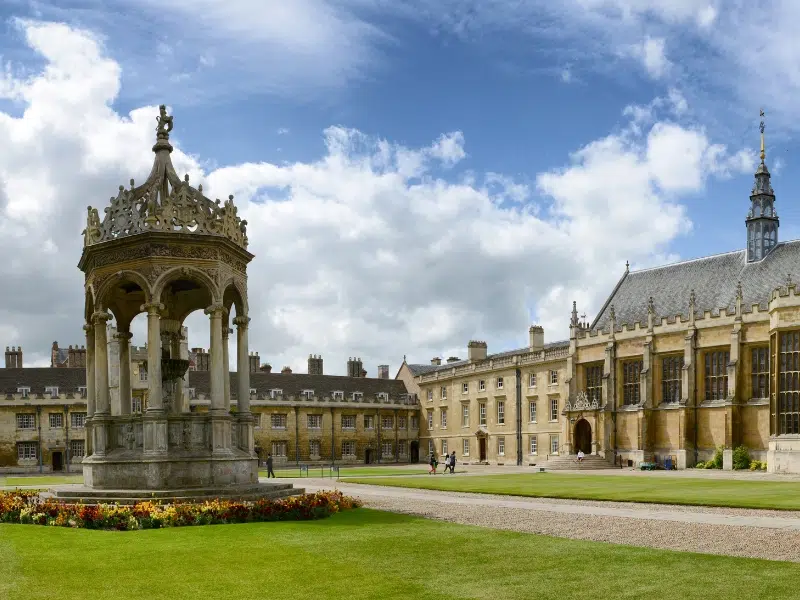
Behind the gate opens Great Court, often described as the largest enclosed court in Europe, with a Renaissance fountain in the middle. Students traditionally try to run around it while the clock strikes twelve, a challenge made famous by the film Chariots of Fire. On the river side stands the Wren Library, designed by Christopher Wren and completed in 1695.
- The statue of Henry VIII over the Great Gate: he holds a wooden chair leg instead of a sceptre, a student prank that the college has never undone.
- The small apple tree on the lawn outside the gate, said to descend from the tree at Newton's family home that inspired his thinking about gravity.
- The clock tower in Great Court, which strikes each hour twice, once in a low and once in a high note.
St John's College
Next door, St John's College was founded in 1511 on the wishes of Lady Margaret Beaufort, the mother of Henry VII, who had died two years earlier; her executors carried out the plan. The gate tower carries her coat of arms with mythical yales, goat-like beasts with swivelling horns. Among its students were William Wordsworth, William Wilberforce and the physicist Paul Dirac.
The college stretches across the River Cam, and its courts run from Tudor brick to the Gothic Revival New Court of the 1820s and 1830s. The two halves are linked by the covered Bridge of Sighs, built in 1831, one of the most photographed sights in Cambridge. Despite the name, it has little in common with its Venetian namesake apart from the covered passage over water.
- The gilded, painted carvings on the Great Gate, with the yales and the Tudor rose.
- The Bridge of Sighs, best seen from the older Kitchen Bridge next to it or from a punt on the river.
How to see them in one walk
Start at the Fitzwilliam Museum on Trumpington Street and walk north. The street becomes King's Parade, passing the Corpus Clock and King's College on the way to Great St Mary's. From the church, continue up Trinity Street to the Great Gate of Trinity College, and then a few steps further to the gate of St John's. If the colleges are open to visitors, the river side of both is where you see the Wren Library and the Bridge of Sighs. Colleges close to visitors at exam time and on some days, so check their websites before you go; the museum and the church are easier to drop into. If you have energy left, the riverside path known as the Backs gives the classic view of the colleges from behind.
See Cambridge with World City Trail
Our Cambridge scavenger hunt turns the historic centre into a game you play on your phone. The route links 10 stops, from Parker's Piece to St John's College, and all four places in this guide are stops: the Fitzwilliam Museum, Great St Mary's, Trinity College and St John's College. Along the way you also visit the Polar Museum, the Mathematical Bridge, the Corpus Clock and King's College. At each stop you solve a puzzle and learn a story, at your own pace.
There is also a self-guided walking tour and an outdoor escape game in Cambridge, for people who prefer a different format.
Play the Cambridge scavenger hunt →
Take the self-guided walking tour of Cambridge →
Play the outdoor escape game in Cambridge →
Facts checked in October 2026.