
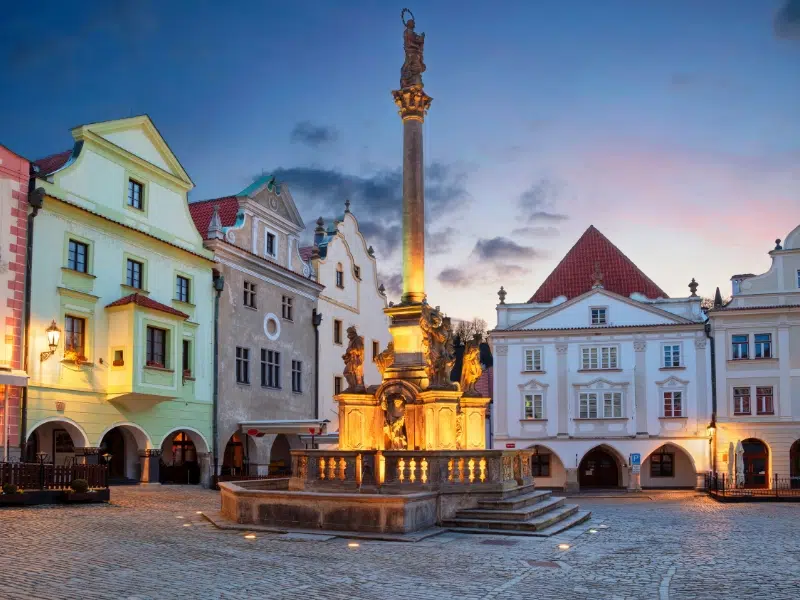
This guide covers six places in Český Krumlov, the small South Bohemian town in a double bend of the Vltava: the State Castle and its painted tower, the plague column on the main square, the Torture Museum, the Egon Schiele Art Centrum and the old monasteries. All of them lie inside the historic centre, a UNESCO World Heritage site since 1992, and five of the six are stops on our Český Krumlov scavenger hunt.
Český Krumlov State Castle
The castle on the rock above the river is the second-largest castle complex in the Czech Republic, after Prague Castle. A castle stood here by 1253, built by the Vítkovci family. The Rosenbergs took over in 1302 and turned it into a Renaissance residence; it then passed to the Eggenbergs and, in the 18th century, to the Schwarzenbergs, who held it until it went to the state after the Second World War.
The complex runs along the rock in a series of courtyards, from the oldest part around the tower to the gardens at the top. Its rarest treasure is the Baroque theatre, whose stage machinery and painted scenery from the 1760s survive, one of the best-preserved theatres of its kind in Europe; it can only be seen on a guided tour.
- The bear moat at the entrance, where brown bears have been kept for centuries as a nod to the Rosenbergs, whose family claimed descent from the Italian Orsini ('little bears').
- The Cloak Bridge, a five-storey covered bridge from 1764 that joins the upper castle to the theatre and the garden across a deep ravine.
Castle Tower
The round tower rising from the oldest part of the castle, the Little Castle (Hrádek), goes back to the 13th century. Its present look comes from the Renaissance remodelling of the late 16th century, when it got its colourful painted facade and an arcaded gallery near the top. You can climb it for the classic view over the red roofs of the town and the loop of the river.
- The painted decoration on the tower, with imitation architecture and figures painted onto the flat plaster.
Fountain and Plague Column
In the middle of Náměstí Svornosti, the main square, stands the plague column, put up in 1714–1716 to give thanks for the end of the plague of 1680–1682. The statues of saints are attributed to the Prague sculptor Matěj Václav Jäckel, and the Virgin Mary stands on top. The six-sided stone fountain around its base replaced an older town fountain in the 1840s; there had been a public fountain on the square since the 1570s.
- The two rows of saints: among them Wenceslas, Vitus, Sebastian and Roch, the last two traditionally called on against plague.
- The houses around the square, with Renaissance and Baroque facades, and the Town Hall with its arcades on one side.
Torture Museum
Below the Town Hall on the main square, the 15th-century cellars have been fitted out as a museum of punishment and torture. It shows around a hundred instruments and scenes with wax figures, old engravings and two audiovisual shows, one about a witch burning and one about an execution by the sword. It is a dark, theatrical place and not for small children, but it says a lot about how justice worked in the old town courts.
Egon Schiele Art Centrum
The Austrian painter Egon Schiele had a close bond with the town: his mother, Marie Soukupová, was born here. In 1911 he moved to Krumlov with his model Wally Neuzil, but the townspeople were scandalised by his way of life and his nude models, and he had to leave after a few months. Many of his views of the town, with its crooked roofs and houses by the river, date from his stays here.
The art centre named after him opened in 1993 in the former burgher brewery on Široká Street, a large old building near the river. It shows Schiele's life and work and holds changing exhibitions of modern and contemporary art.
Kláštery: the old monasteries
Across the river from the main square, in the Latrán district below the castle, lies a double monastery founded in 1350 by Peter I of Rosenberg and his wife Catherine: a friary of the Minorites and a convent of the Poor Clares, sharing one church. The Poor Clares were dissolved under the reforms of Emperor Joseph II in the 1780s, while the Minorites stayed until 1950. After a long restoration the complex is open again as a cultural site, with exhibitions, a garden and the monastery church.
- The Gothic cloister from around 1500, with its net-like rib vaulting.
- The chapel of St Wolfgang, consecrated in 1491, with paintings of the saint's life.
How to see them in one walk
Start at the monasteries in Latrán, then climb to the castle, passing the bear moat into the courtyards and the tower. Continue through the castle over the Cloak Bridge if you want a look at the garden, then come back down and cross the river over the Barber's Bridge (Lazebnický most) into the inner town. On Náměstí Svornosti you find the plague column and, under the Town Hall, the Torture Museum. Finish with a short walk to Široká Street and the Egon Schiele Art Centrum.
See Český Krumlov with World City Trail
Our Český Krumlov scavenger hunt turns the old town into a game you play on your phone. The route links 10 stops, from the monasteries to the State Castle, and five places in this guide are stops: the monasteries, the castle tower, the fountain and plague column, the Egon Schiele Art Centrum and the State Castle itself. It also takes in the Barber's Bridge, the Church of St Vitus, the Cloak Bridge and the castle garden. At each stop you solve a puzzle and learn a story, at your own pace.
There is also a self-guided walking tour and an outdoor escape game in Český Krumlov, for people who prefer a different format.
Play the Český Krumlov scavenger hunt →
Take the self-guided walking tour of Český Krumlov →
Play the outdoor escape game in Český Krumlov →
Facts checked in October 2026.