
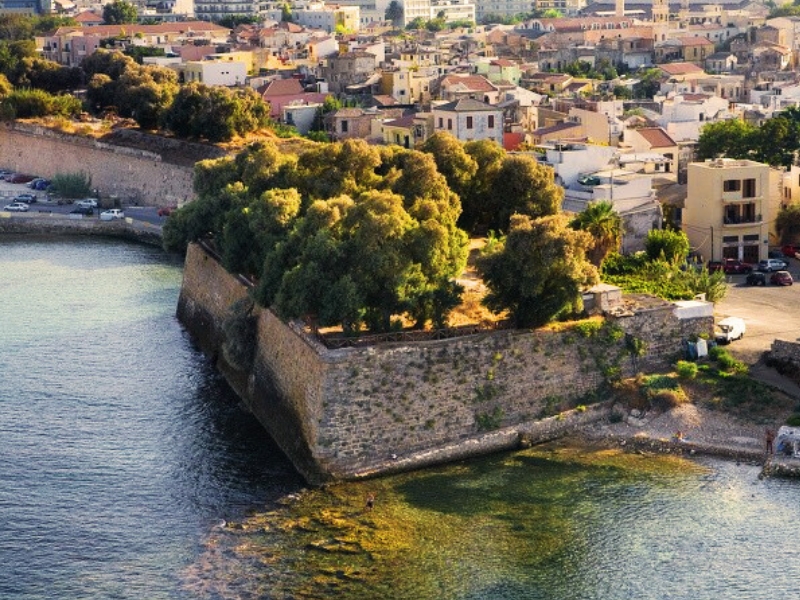
This guide follows the eastern side of Chania's old town, from the seafront district of Koum Kapi to the Venetian Sabbionara Rampart, the shipyards with the Museum of Ancient Shipbuilding, the harbour mosque of Küçük Hasan and the Church of Agios Nikolaos in Splantzia. They belong together because they tell the same story layer by layer: Venetian walls and shipyards, Ottoman mosques, and the neighbourhoods that grew up around them. Four of the five are stops on our Chania treasure hunt.
Koum Kapi
Koum Kapi takes its name from the Turkish Kum Kapısı, the 'Sand Gate'. This was the gate at the eastern end of the old city walls, which the Venetians called Sabbionara because it led out to a sandy beach. In the late Ottoman period, people from North Africa, many of them Bedouins, were brought to Chania to work at the harbour. The locals called them Halikoutes, and they settled on the empty land outside the gate in makeshift huts, so for decades the area was a poor shanty town.
After Crete joined Greece in 1913, most of these families left, and from the 1920s Greek refugees from Asia Minor settled here. Today Koum Kapi is a seafront neighbourhood of cafés and restaurants along a raised promenade, with views back towards the walls. It is a pleasant place to start or end a walk, especially in the late afternoon.
Sabbionara Rampart
The Sabbionara Rampart, also called the Mocenigo Bastion, is the north-eastern corner of the Venetian fortifications. The great walls of Chania were begun in 1536 to a design by the military architect Michele Sanmicheli, and this bastion was built in the later 16th century to guard the eastern approach and the gate beside it. The gate passage has been restored and is now used from time to time for exhibitions and events. After the Ottoman conquest the gate kept its role, and its Turkish name, Kum Kapı, passed to the district outside it.
- The large carved Venetian coat of arms with the winged Lion of Saint Mark on the bastion wall.
- The angled, sloping walls, shaped to deflect cannon fire, best seen from the promenade on the Koum Kapi side.
Museum of Ancient Shipbuilding
Chania's harbour was once lined with Venetian shipyards, the neoria, long vaulted halls where galleys were built and repaired, with tall arched openings facing the water so that ships could be pulled straight into the sea; several of them still stand along the eastern side of the harbour. The Museum of Ancient and Traditional Shipbuilding occupies the Moro shipyard, at the end of this row near the Sabbionara Rampart.
Its main exhibit is the Minoa, a full-size reconstruction of a Minoan ship of the 16th–15th century BC, built with ancient techniques and launched at the end of 2003. In 2004 it sailed from Chania to Piraeus as part of the Olympic Flame's journey to the Athens Games. Next to the ship, the museum shows tools and models from traditional Cretan boatbuilding.
- The Minoa itself, with its single mast, oars and curved hull, displayed whole inside the old shipyard hall.
- The stone arches and high vaults of the Venetian building, which is as much an exhibit as the boats.
Küçük Hasan Mosque
The domed building on the harbour front is the Küçük Hasan Mosque, also called the Yali Mosque, the 'shore mosque'. It was built in 1645, right after the Ottomans captured Chania from the Venetians, and is named after Küçük Hasan Pasha. With its cluster of small domes around one large dome, it is the most recognisable Ottoman building in the town.
It stopped working as a mosque after the population exchange of 1923, and its minaret was pulled down in the 20th century. During the Second World War it housed the archaeological museum; it has since been a store, a folk art museum and a visitor centre, and today it is used for exhibitions.
Church of Agios Nikolaos
A few lanes inland, on Splantzia Square, stands the Church of Agios Nikolaos. Dominican friars built it around 1320 as a Catholic church. After the conquest of 1645 the Ottomans turned it into the Hünkar Mosque, the 'Sultan's Mosque', in honour of Sultan Ibrahim, and Splantzia became the Muslim quarter. In 1918 it was consecrated as an Orthodox church.
- The tall cylindrical minaret with its two balconies, about 36 metres high, on one side of the church.
- The bell tower on the other side: it is often said to be the only building in Greece with both a minaret and a bell tower.
How to see them in one walk
Start in Koum Kapi on the seafront promenade and walk west towards the walls to the Sabbionara Rampart. From there, follow the water along the old shipyards to the Museum of Ancient Shipbuilding, then continue along the harbour front to the Küçük Hasan Mosque. Finish by turning inland through the lanes of Splantzia to the Church of Agios Nikolaos, where the plane tree in the square gives shade and the cafés invite a break. The whole route is flat, and afterwards you can easily add the Etz Hayyim Synagogue or the lighthouse at the end of the harbour wall.
See Chania with World City Trail
Our Chania treasure hunt turns the old town into a game you play on your phone. The route links 10 stops, from the Air Force Memorial Monument to the Küçük Hasan Mosque, and four places in this guide are stops: the Sabbionara Rampart, the Church of Agios Nikolaos, the Museum of Ancient Shipbuilding and the Küçük Hasan Mosque. The route also takes in the Etz Hayyim Synagogue, the Trimartiri Cathedral, Talos Square and the Firkas Fortress. At each stop you solve a puzzle and learn a story, at your own pace.
There is also a self-guided walking tour and an outdoor escape game in Chania, for people who prefer a different format.
Play the Chania scavenger hunt →
Take the self-guided walking tour of Chania →
Play the outdoor escape game in Chania →
Facts checked in October 2026.