
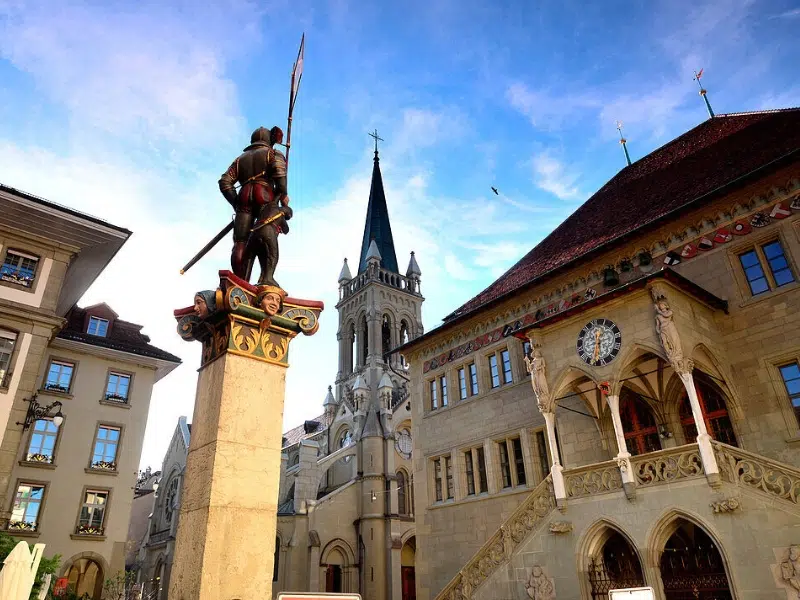
This guide covers five landmarks in Bern's Old Town: the Zytglogge clock tower, the City Hall, the Nydeggkirche, the Heiliggeistkirche and the Stadttheater. All five stand inside the UNESCO World Heritage site listed in 1983, along the chain of streets that runs from the railway station down to the loop of the Aare, so you can see them in one unhurried walk. Four of them are also stops on our Bern scavenger hunt.
Zytglogge
The Zytglogge (Bernese German for 'time bell') was built around 1218–1220 as the gate tower of the town's first western wall. When Bern grew further west in the 1340s, the tower lost its role as a gate and was used as a women's prison. The great fire of 1405 burnt it out. It was rebuilt, and a large hour bell cast that same year was hung in it, which made the Zytglogge one of the town's earliest public clocks.
The astronomical clock and the moving figures you see today go back to the clockwork rebuilt by Kaspar Brunner in 1527–1530. A few minutes before each full hour, a small show starts on the east side of the tower and ends when a gilded figure high above strikes the great bell with a hammer. Albert Einstein lived a few steps down the street, at Kramgasse 49, from 1903 to 1905, the years in which he published his special theory of relativity; his flat is now a small museum.
- The astronomical dial on the east face, which shows the hour, the signs of the zodiac and the phase of the moon.
- The parade of figures next to the dial, among them a crowing rooster, a jester and a procession of bears.
- The large clock face on the west side, towards Marktgasse, the view most photos of Bern show.
Bern City Hall (Rathaus)
Bern's City Hall was begun in 1406, the year after the great fire, and finished around 1415–1417. The grand outdoor staircase leading up to the entrance was added between 1430 and 1450. The building still does the job it was built for: the Grand Council and the government of the Canton of Bern meet here, and so does the parliament of the city.
Its look has changed with fashion. In the 1860s Friedrich Salvisberg gave it a neo-Gothic dress. In 1940–1942 the architect Martin Risch removed much of that decoration and brought the exterior back closer to its late medieval appearance, which is what you see today. The building stands on a small square near the river, a little away from the main shopping streets, so it is easy to miss.
- The double staircase on the south facade, with its pointed-arch vault in the middle.
- The rows of coats of arms of the old districts of the canton, on either side of the entrance.
Nydeggkirche
The Nydeggkirche stands on the spot where Bern began. Duke Berchtold V of Zähringen built Nydegg Castle here around 1190 to guard the crossing of the Aare, and founded the town next to it soon after. When the Zähringen line died out, the castle was pulled down, in the 1260s or early 1270s. A small church went up on the site in 1341–1346; the tower followed in 1480–1483 and a new nave in 1493–1504. The choir stands roughly where the castle once stood.
- The bronze reliefs by Marcel Perincioli on the doors, added in 1956, with scenes from the life of Jesus.
- The small Nydegghöfli square beside the church, with a monument to the Zähringen founders (1968) and a view down to the Untertorbrücke, the oldest bridge over the Aare in Bern.
Heiliggeistkirche
Right across from the railway station, the Heiliggeistkirche (Church of the Holy Spirit) was built in 1726–1729 to plans by Niklaus Schiltknecht and consecrated in November 1729. It is one of the largest Reformed churches in Switzerland, with room for about 2,000 people, and one of the finest Protestant baroque churches in the country. The site is much older: a chapel of the Holy Spirit hospital stood here, just outside the first town wall, by 1228.
- The bright hall-like interior, carried by 14 columns, each cut from a single block of sandstone.
- The free-standing pulpit in the nave, typical of Reformed churches, where the sermon is at the centre of the service.
Stadttheater
The Stadttheater on Kornhausplatz opened on 25 September 1903. René von Wurstemberger designed it in a neo-baroque style, at a time when Bern, the federal city since 1848, was adding grand public buildings; the Federal Palace was finished just a year earlier. It is the city's main stage for opera, drama and dance, run today by Bühnen Bern, which was called Konzert Theater Bern until 2021.
Even if you don't see a show, the facade is worth a look. It closes off one side of Kornhausplatz, a few steps from the Zytglogge and the Kornhausbrücke, and its columns and statues are a good contrast to the medieval arcades of the streets around it.
How to see them in one walk
Start at the Heiliggeistkirche by the station and walk down Spitalgasse and Marktgasse, passing the Käfigturm, the gate tower that took over from the Zytglogge on the western edge of town in the 13th century. Turn left onto Kornhausplatz for the Stadttheater, then come back to the Zytglogge; try to arrive a few minutes before the hour to catch the figures. Continue down Kramgasse past the Einstein House, turn left to the City Hall near the river, and end at the Nydeggkirche above the Nydegg Bridge. From there, the bear park is just across the bridge.
See Bern with World City Trail
Our Bern scavenger hunt turns the Old Town into a game you play on your phone. The route links 10 stops, from the Heiliggeistkirche to the Bern Historical Museum and Einstein Museum, and four places in this guide are stops: the Heiliggeistkirche, the Stadttheater, the City Hall and the Nydeggkirche. Along the way you also pass the Käfigturm, the Federal Palace, the Zähringer Fountain and the Cathedral. At each stop you solve a puzzle and learn a story, at your own pace.
There is also a self-guided walking tour and an outdoor escape game in Bern, for people who prefer a different format.
Play the Bern scavenger hunt →
Take the self-guided walking tour of Bern →
Play the outdoor escape game in Bern →
Facts checked in October 2026.