
Above the old lower town of Brussels lies a different city: the royal quarter on the Coudenberg hill and, just beyond it, the European quarter. This guide covers five places along that route, from the European Parliament's visitor centre to the Royal Palace and the fine art museums, plus one survivor of the medieval town walls back down in the old centre. Four of them are stops on our Brussels scavenger hunt.
Royal Palace of Brussels
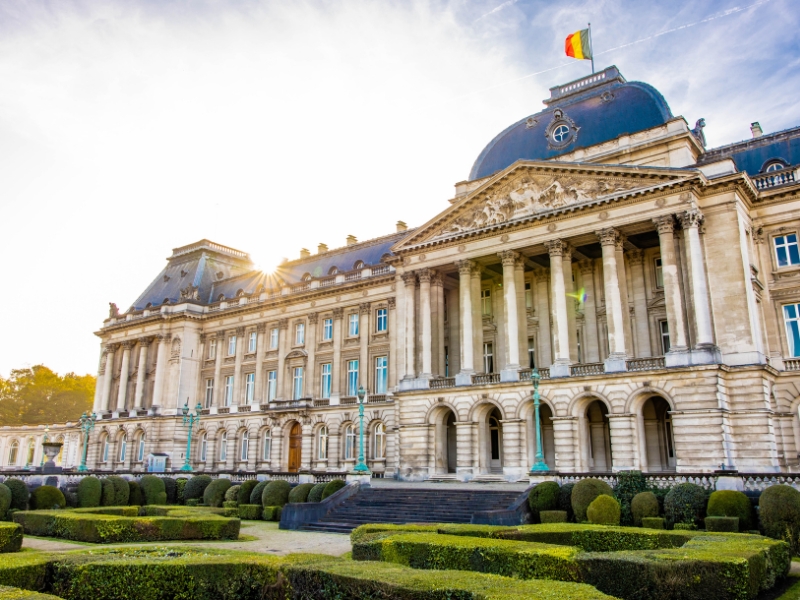
The Royal Palace faces Brussels Park on the Coudenberg, where the dukes of Brabant and later Emperor Charles V had their palace until it burned down in 1731. The present building grew out of 18th-century town houses and was given its long neoclassical front under King Leopold II; the facade was finished in 1904. It is the official palace of the King of the Belgians and is used for state occasions and audiences, but the royal family lives at the Royal Castle of Laeken in the north of the city.
For a few weeks each summer, from just after the national holiday on 21 July until early September, the state rooms are usually open to the public. One of the highlights is the Hall of Mirrors, where in 2002 the artist Jan Fabre covered the ceiling with the shiny green wing cases of more than a million jewel beetles. The palace is a stop on our scavenger hunt.
- The Belgian flag on the roof: by tradition it flies when the King is in the country.
- The remains of the old Coudenberg palace, now an archaeological site under Place Royale, which you can visit from the BELvue museum next door.
Luxembourg Square (Place du Luxembourg)
This small 19th-century square in the Leopold quarter was laid out as an elegant entrance to the new district. On one side stands the old Luxembourg railway station, whose little stone station building has been kept in front of the glass buildings of the European Parliament rising behind it. In the middle is a statue of John Cockerill, the British-born industrialist who built up Belgium's iron and steel industry, unveiled in 1872. On weekday evenings, especially Thursdays, the cafés around the square fill with people who work in the European institutions. It is a stop on our scavenger hunt.
- The view through the old station building towards the Parliament's main building, and the figures of workers around the base of Cockerill's statue.
Royal Museums of Fine Arts of Belgium
The fine art museums on Rue de la Régence go back to a collection founded in 1801, when Brussels was under French rule. The main building, a palace of art with a columned front, was designed by Alphonse Balat and opened in 1880. Today the institution is made up of several museums in one complex: the Oldmasters Museum, with Flemish painting from the 15th to the 18th century, and the Magritte Museum, opened in 2009, which has the world's largest collection of works by the Belgian surrealist René Magritte.
Among the most famous paintings are Pieter Bruegel the Elder's Fall of the Rebel Angels and his Census at Bethlehem, a large group of works by Rubens, and Jacques-Louis David's Death of Marat, painted in 1793. The Landscape with the Fall of Icarus, long attributed to Bruegel, also hangs here, though most experts now think it is an early copy of a lost original. The museums are a stop on our scavenger hunt.
- The grand columned facade on Rue de la Régence, crowned with statues, and the view from the steps towards Place Royale.
- The Bruegel room in the Oldmasters Museum, where you can spend a long time picking out details in his crowded scenes.
Parlamentarium
The Parlamentarium is the European Parliament's visitor centre, opened in 2011 in the Parliament complex just behind Place du Luxembourg. It explains how the European Union came about and how the Parliament works, with interactive screens, maps and films. Everything is available in all 24 official languages of the EU, and entry is free. It is the first stop of our scavenger hunt.
- The 360-degree panorama room, which surrounds you with images of the Parliament's daily work and debates.
- The interactive map of Europe, where you can explore the regions and what EU decisions mean for them.
Black Tower (Tour Noire)
Tucked behind Place Sainte-Catherine, the Black Tower is one of the few remains of Brussels' first city wall, built in the 13th century to protect the growing town. When the wall lost its purpose, most of it was pulled down or swallowed by houses. In the 1880s the tower was threatened with demolition, and the mayor Charles Buls, who fought for the city's old buildings, had it saved and restored in 1888. Today a modern hotel wraps around it, which makes the contrast of old stone and glass all the stranger. It is not a stop on our scavenger hunt.
- The dark stone walls of the tower against the hotel facade, and the pointed roof added during the 19th-century restoration.
How to see them in one walk
Start at the Parlamentarium and walk across the Parliament esplanade to Place du Luxembourg. From there, head west along Rue du Luxembourg and the edge of Brussels Park to the Royal Palace. Place Royale, with the entrance to the BELvue museum and the Coudenberg site, is at the corner, and the Royal Museums of Fine Arts are right beside it. Then walk down past the Mont des Arts into the lower town and across the Grand Place area to Place Sainte-Catherine for the Black Tower.
See Brussels with World City Trail
Our Brussels scavenger hunt turns the city centre into a game you play on your phone. The route links 10 stops, from the Parlamentarium to the Cathedral of St Michael and St Gudula. The Parlamentarium, Luxembourg Square, the Royal Palace and the Royal Museums of Fine Arts are all stops, along with the Grand Place, Manneken Pis and the Royal Galleries of Saint-Hubert. At each stop you solve a puzzle and learn a story, at your own pace.
There is also a self-guided walking tour and an outdoor escape game in Brussels, for people who prefer a different format.
Play the Brussels scavenger hunt →
Take the self-guided walking tour of Brussels →
Play the outdoor escape game in Brussels →
Facts checked in October 2026.