
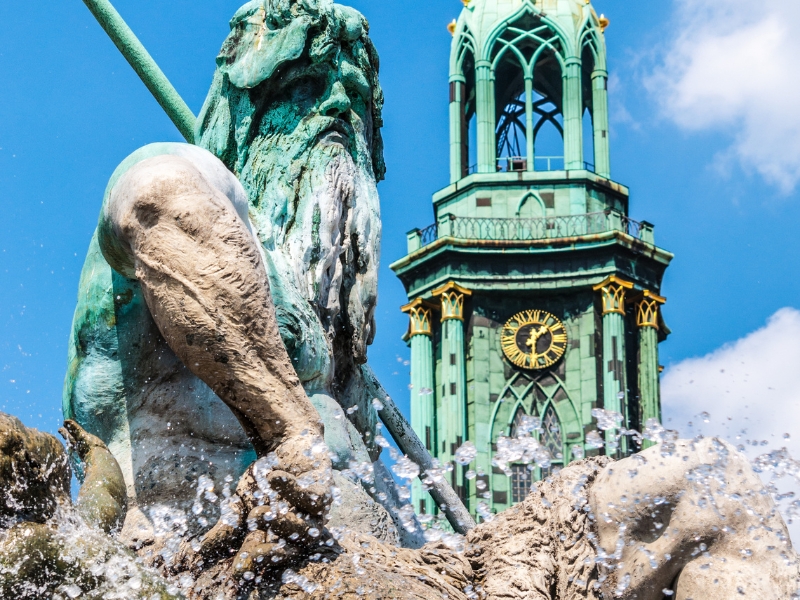
This guide follows the western half of central Berlin, from the Neptune Fountain near the TV tower to the Reichstag on the Spree. On the way you cross Schinkel's bridge to Museum Island, stop at the Altes Museum, take in the Gendarmenmarkt, walk through the Brandenburg Gate and look for Goethe in the Tiergarten. Seven of these places are stops on our Berlin scavenger hunt; the eighth, the Stolpersteine, are small memorials you will find in the pavement all along the way.
Neptune Fountain (Neptunbrunnen)
Reinhold Begas made this large bronze fountain, and it was unveiled in 1891 as a gift from the city to Emperor Wilhelm II. It first stood on the square south of the Berlin City Palace. After the East German government blew up the war-damaged palace in 1950, the fountain was taken down, restored and set up again in 1969 in its present place between St Mary's Church and the Red Town Hall. It is a stop on our scavenger hunt.
- Neptune himself, sitting on a giant shell held up by four tritons, with children and sea creatures around him.
- The four women on the rim, who stand for the rivers Rhine, Elbe, Oder and Vistula, the main rivers of Prussia at the time.
Schlossbrücke
The Palace Bridge carries Unter den Linden across the Spree Canal to Museum Island. Karl Friedrich Schinkel designed it, and it was built in the early 1820s. In the following decades eight white marble groups were added on granite plinths, showing goddesses guiding a young warrior from training to battle and death. In East German times the bridge was called the Marx-Engels-Brücke. The statues spent the post-war decades in West Berlin and only came back in 1981. It is a stop on our scavenger hunt.
- The cast-iron railings between the statues, with sea horses, tritons and dolphins, also designed by Schinkel.
Altes Museum
The Altes Museum was the first museum on Museum Island and one of the earliest purpose-built public museums in Germany. Schinkel designed it, and it opened in 1830 to show the royal art collections to the public. Its long front of 18 Ionic columns faces the Lustgarten, and inside, a domed rotunda inspired by the Pantheon in Rome holds classical statues. Today it shows the antiquities collection, with Greek, Etruscan and Roman art. Museum Island has been a UNESCO World Heritage Site since 1999. The museum is a stop on our scavenger hunt.
- The huge granite bowl in front of the steps, cut in 1831 by Christian Gottlieb Cantian from a single glacial boulder.
- The Lustgarten lawn, with Berlin Cathedral on one side and the rebuilt City Palace, now the Humboldt Forum, across the road.
Gendarmenmarkt
Many Berliners call this the most beautiful square in the city. It was laid out at the end of the 17th century as a market square in the new Friedrichstadt quarter and takes its name from the Gens d'armes, a cavalry regiment that kept its stables here in the 18th century. Two almost identical churches face each other: the French Church, built for the Huguenot refugees, and the German Church. The domed towers in front of both were added in the 1780s under Frederick the Great; they are why people speak of the French and German Dom, though neither is a cathedral. Between them stands Schinkel's Konzerthaus, opened as a theatre in 1821. The square reopened in 2025 after several years of renovation. It is a stop on our scavenger hunt.
- The marble Schiller monument by Reinhold Begas in front of the Konzerthaus.
Brandenburg Gate
Built between 1788 and 1791 by Carl Gotthard Langhans, the gate was modelled on the Propylaea, the entrance to the Acropolis in Athens. Johann Gottfried Schadow's Quadriga, a goddess in a chariot pulled by four horses, was put on top in 1793. Napoleon took the Quadriga to Paris in 1806; when it came back in 1814, the goddess was given a staff with the Iron Cross and the Prussian eagle. From 1961 the Berlin Wall ran right behind the gate, and nobody could pass through until it was opened on 22 December 1989. It is a stop on our scavenger hunt.
- The Quadriga, facing east towards Unter den Linden and the old city.
- Pariser Platz on the east side, with the embassies of France and the United States, and the Room of Silence in the gate's northern wing.
Reichstag Building
The Reichstag was built to designs by Paul Wallot and finished in 1894 for the parliament of the German Empire; the inscription Dem deutschen Volke, To the German people, was added in 1916. It burned in February 1933, a fire the Nazis used to suspend civil rights, and it was heavily damaged in 1945. In 1995 the artists Christo and Jeanne-Claude wrapped the whole building in fabric. After Norman Foster's rebuilding with a new glass dome, the German Bundestag has met here since 1999. It is the last stop of our scavenger hunt.
- The glass dome, with a spiral ramp around a cone of mirrors that reflects daylight into the chamber below; visits need to be booked in advance.
- The rows of iron plates in front of the building, a memorial to members of parliament murdered by the Nazis.
Goethe Monument
At the eastern edge of the Tiergarten, a few minutes south of the Brandenburg Gate, the poet Johann Wolfgang von Goethe stands in white marble on a high pedestal. The sculptor Fritz Schaper made the monument, and it was unveiled in 1880. Around the base sit three female figures, with small children, who stand for lyric poetry, drama and science, the fields in which Goethe worked. It is a stop on our scavenger hunt.
- The three seated figures at the base and the children beside them, best seen by walking all the way around the monument.
Stolpersteine
Stolpersteine, stumbling stones, are small brass plates set into the pavement in front of the last freely chosen homes of people persecuted by the Nazis. Each one gives a name, a date of birth and a fate, often deportation and murder. The artist Gunter Demnig started the project in the 1990s, and Berlin now has more stolpersteine than almost any other city, many thousands of them, with new ones added every year. They are not a stop on our route, but you will walk past them in many streets of Mitte.
- Plates that begin with Hier wohnte, Here lived; many people stop and read the names, and some polish the brass on anniversaries such as 9 November.
How to see them in one walk
Start at the Neptune Fountain below the TV tower and walk west past Berlin Cathedral to the Lustgarten and the Altes Museum. Cross the Schlossbrücke to Unter den Linden, then turn south to the Gendarmenmarkt. Come back up to Unter den Linden and follow it west to Pariser Platz and the Brandenburg Gate. Walk a short way south into the Tiergarten for the Goethe Monument, then head north to finish at the Reichstag. Keep an eye on the pavement throughout for stolpersteine.
See Berlin with World City Trail
Our Berlin scavenger hunt turns the city centre into a game you play on your phone. The route links 10 stops, from Alexanderplatz to the Reichstag Building. The Neptune Fountain, the Schlossbrücke, the Altes Museum, the Gendarmenmarkt, the Goethe Monument, the Brandenburg Gate and the Reichstag are all stops, along with St Mary's Church and Berlin Cathedral. At each stop you solve a puzzle and learn a story, at your own pace.
There is also a self-guided walking tour and an outdoor escape game in Berlin, for people who prefer a different format.
Play the Berlin scavenger hunt →
Take the self-guided walking tour of Berlin →
Play the outdoor escape game in Berlin →
Facts checked in October 2026.