
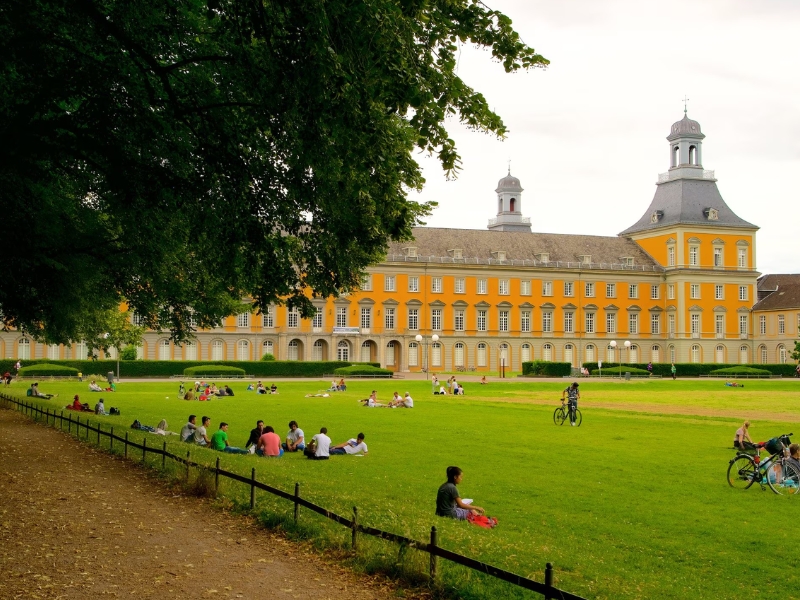
This guide covers the old court quarter of Bonn, the part of the city built for the prince-electors of Cologne, who ruled from here in the 18th century: the Electoral Palace, its park and gate, the palace church, the University's Egyptian Museum and the old Rhine bastion called the Alter Zoll. They sit side by side between the market and the river, so you can see them all on one easy walk.
The Electoral Palace (Kurfürstliches Schloss)
The long yellow palace on the edge of the old town was built from 1697 for the prince-elector Joseph Clemens of Bavaria, to designs by his court architect Enrico Zuccalli. An earlier palace on the site had been destroyed in the siege of Bonn in 1689. The French architect Robert de Cotte later added wings and laid out the gardens. In 1777 a fire broke out in the west wing, spread through the roof and set off an explosion, and parts of the building had to be rebuilt in reduced form.
The electors left when French revolutionary troops took Bonn in 1794. In 1818 the Prussian king Frederick William III gave the empty palace to the new university, and it has been the University of Bonn's main building ever since. Allied bombing destroyed it in 1944; it was rebuilt by 1951, with the outside restored and most of the inside simplified. The university has started a long renovation of the building, planned to last at least ten years, so expect fences and moved entrances around it.
- The main facade facing the Hofgarten, a long run of baroque windows that shows the scale of the electors' court.
- The arched passages through the palace wings, which still carry traffic and pedestrians between the old town and the Rhine side.
- The palace is one of the stops on our scavenger hunt route, between the palace church and the Egyptian Museum.
The Schlosskirche (Palace Church)
The palace church stands at the northeastern end of the palace. The court chapel that stood here was damaged in the fire of 1777, and the present church was finished in 1779 for the elector Max Friedrich; the contract for the work went to Johann Heinrich Roth. The young Ludwig van Beethoven took organ lessons here from the court organist Christian Gottlob Neefe. After Bonn passed to Prussia, the king gave the church to the Protestant community, and it later became the university's Protestant church. A bombing raid on 10 October 1944 left only the outer walls; the church was rebuilt and consecrated again in 1957.
- The restored stucco work, in a style between rococo and the plainer Louis XVI manner.
- The organ by the Klais workshop, installed in 2012, which has a glockenspiel stop recalling the bells that hung over the entrance before the 1777 fire. The church is one of the stops on our scavenger hunt route.
The Egyptian Museum (Ägyptisches Museum)
The University of Bonn has collected objects from ancient Egypt for two centuries. The first pieces were brought back in 1820–1821 by Johann Martin Augustin Scholz, a theology professor and orientalist who took part in an expedition to Egypt led by Heinrich Menu von Minutoli. The collection grew through the university's Egyptology department, founded in 1897, and opened to the public as a museum in 2001, in a former fencing hall in the palace next to the Koblenz Gate.
Today it has about 1,000 objects, which the university describes as the largest collection of Egyptian antiquities in North Rhine-Westphalia. Because of the palace renovation, the museum moved: since October 2024 it has been on the third floor of P26, a former department store at Poststraße 26 that the university turned into a museum building, a short walk from the main station. The Egyptian Museum is the last stop on our scavenger hunt route.
- A plaster cast of a battle scene from the temple of Karnak, the largest piece on show when the museum was at the palace.
- Models of Djoser's step pyramid and of the mortuary temple of Ramesses III at Medinet Habu, which help you picture the buildings the objects came from.
The Hofgarten and the Koblenz Gate
The Hofgarten is the wide lawn in front of the palace, once the court garden and now the place where students lie in the sun between lectures. It has also been a stage for politics while Bonn was the capital of West Germany: on 22 October 1981 about 250,000 people gathered here to protest against NATO's plans to station new nuclear missiles in Europe.
At the eastern end of the palace, the Koblenz Gate (Koblenzer Tor) was built in 1751–1755 by Michael Leveilly to designs by François de Cuvilliés. It is a late baroque gate in the form of a triumphal arch, and traffic still passes through it.
- The gilded statue of the Archangel Michael on top of the Koblenz Gate.
- The paths along the edge of the lawn; parts may be fenced off during the palace works, with a marked detour.
The Alter Zoll
The Alter Zoll (Old Customs Post) is a former bastion of Bonn's city walls on the bank of the Rhine, just below the Hofgarten. It was built in the 1640s, when the walls were strengthened, and takes its name from a customs house that, according to local records, stood on the site from the 16th century. Today it belongs to the university and is a protected monument and a public lookout.
From the top you look across the Rhine to the Siebengebirge, the volcanic hills on the far side, where the mountains of the Middle Rhine give way to the flat lowland around Cologne. It is a popular spot at sunset and is not on our scavenger hunt route, so it makes a good place to finish.
- The two French cannons, cast in 1803 and 1841, which Emperor Wilhelm I gave to the university after the war of 1870–1871. They have never fired a live shot.
- The monument to the writer Ernst Moritz Arndt by Bernhard Afinger, unveiled in 1865, with an inscription calling the Rhine Germany's river, not Germany's border.
How to see them in one walk
Start at the palace church on the northern corner of the palace, then walk along the Hofgarten facade of the Electoral Palace to the Koblenz Gate at the eastern end. From the gate it is a short walk down to the Rhine and up onto the Alter Zoll for the view. To see the Egyptian collection itself, head back through the old town to P26 on Poststraße, close to the main station.
See Bonn with World City Trail
Our Bonn scavenger hunt turns the city centre into a game you play on your phone. The route links 10 stops, from the main station past the Minster and the Beethoven monument to the Egyptian Museum. The Schlosskirche, the Electoral Palace and the Egyptian Museum are all stops; the Alter Zoll and the Hofgarten lie right next to the route.
There is also a self-guided walking tour and an outdoor escape game in Bonn, for people who prefer a different format.
Play the Bonn scavenger hunt →
Take the self-guided walking tour of Bonn →
Play the outdoor escape game in Bonn →
Facts checked in October 2026.