
Braga has been a religious centre for some two thousand years, and this guide follows that thread through four places: a Roman shrine carved into a granite rock, the cathedral, its treasury museum and the pilgrimage sanctuary of Bom Jesus do Monte on the hill above the city. The first three lie a few streets apart in the centre; Bom Jesus is a short trip out, and it is the one most visitors remember.
Braga Cathedral (Sé de Braga)
The Sé is usually described as the oldest cathedral in Portugal. Bishop Pedro had it built on the remains of a large Roman building, and it was consecrated in 1089, decades before Portugal existed as a kingdom. Its Romanesque core, with three naves and a wide transept, was altered in almost every century that followed: Gothic chapels in the 14th century, a new chancel by João de Castilho in the early 16th century, Baroque carving and gilded organs in the 18th. The result is a building in which you can read nearly a thousand years of Portuguese architecture.
The cathedral is closely tied to the birth of the country. In the Capela dos Reis, the Chapel of the Kings, built around 1374, lie Count Henry of Burgundy and his wife Teresa, the parents of Afonso Henriques, the first king of Portugal. The cathedral is one of the stops of our scavenger hunt.
- The galilee, the late Gothic entrance porch built between 1486 and 1501, with ribbed vaults, statues and gargoyles that served as rain spouts.
- The two gilded organs facing each other above the high choir, built in 1737 to 1738 by Frei Simon Fontanes and carved by Marceliano de Araújo; the choir can only be visited on a guided tour.
- In the Chapel of the Kings, the naturally mummified body of Archbishop Lourenço Vicente, who died in 1398 and had fought for King João I at the Battle of Aljubarrota.
Treasury Museum (Tesouro-Museu da Sé)
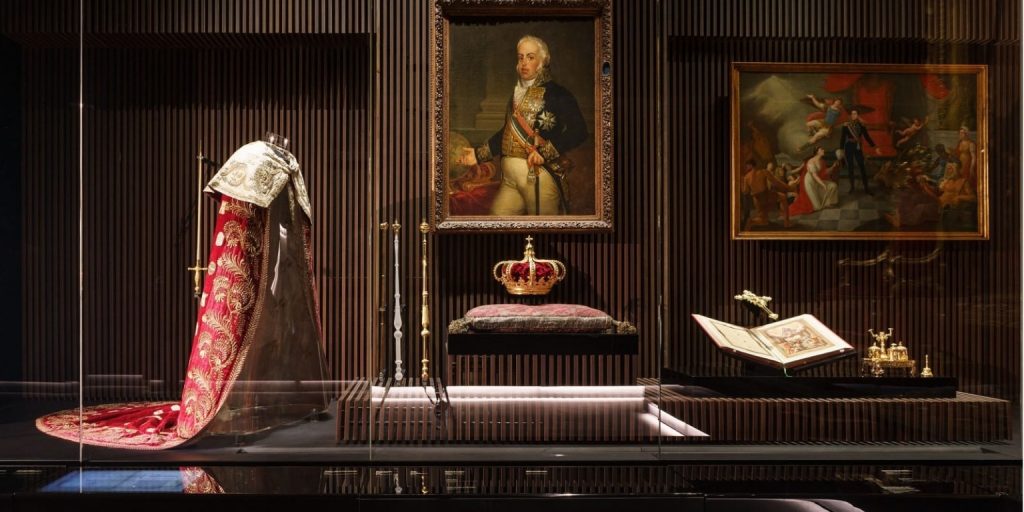
The cathedral's treasury became a museum of sacred art in 1930. It occupies the former chapter house, which Archbishop Rodrigo de Moura Teles had built in the early 18th century, and it was enlarged between 2003 and 2007 when five buildings attached to the cathedral were restored. The collections cover church silver and gold, vestments, missals and other liturgical objects, arranged around the history of the Church of Braga, and the visit also takes in several chapels of the cathedral.
Some of the objects here are among the oldest and most historic in Portugal. The treasury holds the cross carried by Pedro Álvares Cabral's fleet and used at the first Mass celebrated in Brazil in 1500, a reminder that Braga's archbishops ruled one of the most powerful dioceses on the Iberian Peninsula.
- The 11th-century Arab ivory casket, carved in the Islamic world and later kept as a church treasure.
- The chalice of Saint Gerald, dated to the 10th century, linked to the French monk who became archbishop of Braga around 1100.
- The Manueline chalice of Archbishop Diogo de Sousa from the early 16th century, bearing his coat of arms.
Fonte do Ídolo
Hidden among the houses of Rua do Raio is the oldest monument in this guide and one of the most unusual in Portugal. The Fonte do Ídolo, the Idol Fountain, is a sanctuary carved straight into a natural granite outcrop, probably in the 1st century AD, when Braga was the Roman city of Bracara Augusta, founded under Augustus around 16 BC. It is the only Roman monument of Bracara Augusta to survive relatively intact, and remains of masonry nearby suggest that it may once have been part of a temple.
The shrine was dedicated to Tongoenabiago, a local god linked to running water, and an inscription records that it was commissioned by Célico Fronto, a man from Arcobriga. That mix of a native deity and a Roman-style dedication makes it an important source for how pre-Roman cults lived on under Roman rule. It has been a national monument since 16 June 1910. It is not on our scavenger hunt route, but the Palácio do Raio, the route's final stop, is in the same street.
- The figure in a toga next to the main inscription, which probably represents the man who paid for the shrine.
- The worn bust in a classical niche with a dove in the pediment above it, probably an image of the god.
Bom Jesus do Monte
On a wooded hill in Tenões, just outside the city, stands Braga's most famous sanctuary. A chapel dedicated to the Holy Cross is recorded here in 1373, and a pilgrimage church of Bom Jesus followed in 1629. In 1722 Archbishop Rodrigo de Moura Teles, the same prelate who built the chapter house that now holds the cathedral treasury, began the great Baroque stairway. It climbs 116 metres up the hill in zigzags: first past chapels with terracotta scenes of the Passion, then the Stairway of the Five Senses, each sense with its own fountain, and finally the Stairway of the Three Virtues, Faith, Hope and Charity, added around 1781.
At the top stands the Neoclassical church designed by Carlos Amarante, begun in 1784 and consecrated in 1834, one of the first churches of its style in Portugal. In the 19th century the grounds around it were turned into a park. Since 7 July 2019 the sanctuary has been a UNESCO World Heritage Site. It is not part of our scavenger hunt, which stays in the old town, but it is the classic excursion from Braga.
- The fountains of the Five Senses on the landings of the middle stairway, each one devoted to a single sense.
- The view over Braga from the top of the stairway, in front of the church.
- The funicular, opened on 25 March 1882, the first in the Iberian Peninsula; it works by filling a water tank in the upper car so that its weight pulls the lower car up, and it is described as the oldest water-balanced funicular in the world still running.
How to see them
In the centre, start at the cathedral and give yourself time inside: the galilee, the Chapel of the Kings and then the Treasury Museum belong together. From there walk through the old streets to Rua do Raio for the Fonte do Ídolo and, while you are there, the tiled front of the Palácio do Raio.
Keep Bom Jesus for a separate outing. One good option is to ride the funicular up and walk down the stairway, passing the virtues, the senses and the Passion chapels on the way back to the bottom. If you have the energy, climbing the stairway on foot is the way pilgrims have done it for centuries.
See Braga with World City Trail
Our Braga scavenger hunt turns the old town into a game you play on your phone. The route links 10 stops, from the fountain on Praça da República to the Palácio do Raio. Of the places in this guide, the cathedral is a stop; the treasury is inside it, the Fonte do Ídolo is close to the final stop, and Bom Jesus lies outside the route. The route also takes in A Brasileira café, the Braga Tower, the Santa Barbara Garden, the City Hall, the Biscainhos Museum, the Arco da Porta Nova and the Santa Cruz church.
If you prefer a different format, there is also a self-guided walking tour and an outdoor escape game in Braga.
Play the Braga scavenger hunt →
Take the self-guided walking tour of Braga →
Play the outdoor escape game in Braga →
Facts checked in October 2026.