
This guide follows six places from the Gothic Quarter down to the waterfront: Barcelona Cathedral, Plaça Reial, Gaudí's Palau Güell, the Columbus Monument, Roy Lichtenstein's El Cap de Barcelona and the basilica of Santa Maria del Mar. They span more than seven centuries, from medieval churches to a pop art sculpture made for the 1992 Olympics, and they lie close enough together to see in one walk through the old city.
Barcelona Cathedral
The Cathedral of the Holy Cross and Saint Eulalia stands in the Gothic Quarter on the site of earlier churches. The Gothic building you see was begun on 1 May 1298 and built from east to west; the cloister was finished in 1448. The tall front, however, is much younger: the neo-Gothic facade and central spire were only completed in 1913, based on a 15th-century design and paid for by the Girona family. Saint Eulalia, the co-patron of Barcelona, is buried in the crypt.
Inside, the choir stalls carry the coats of arms of the knights of the Order of the Golden Fleece, who met here in 1519 at the invitation of Charles V. In a side chapel hangs the Christ of Lepanto, a crucifix said to have sailed on a galley at the battle of Lepanto in 1571; according to legend, the figure bent its body to dodge a cannonball.
- The cloister, where 13 white geese live. Tradition links the number to the age of Saint Eulalia when she was martyred.
- L'ou com balla, the dancing egg: at Corpus Christi an egg is set to bob on the jet of a fountain, a custom the cathedral still keeps.
Plaça Reial
Just off La Rambla, Plaça Reial is a large arcaded square with palm trees, laid out in the 19th century by the architect Francesc Daniel Molina on the site of a Capuchin convent that was demolished in 1835. It is busiest in the evening, when the restaurants under the arcades fill up and the clubs open, and it is a gathering place during the La Mercè festival in September. The square is not a stop on our scavenger hunt, but it is a short detour from La Rambla on the way to Palau Güell.
- The two six-armed lampposts: they were Antoni Gaudí's first work after he qualified as an architect, commissioned by the city council in 1878 and inaugurated in 1879. Look for the caduceus of Mercury, the symbol of commerce, on top.
Palau Güell
On Carrer Nou de la Rambla, on the Raval side of La Rambla, stands the town mansion that the young Antoni Gaudí built between 1886 and 1888 for the industrialist Eusebi Güell, his most important patron. From the street it looks dark and severe: a front of grey Garraf limestone with two big parabolic arches, through which guests arrived by carriage. Between them, a wrought-iron screen carries the Catalan coat of arms under a helmet topped with a phoenix. The palace is part of the UNESCO World Heritage listing of Gaudí's works.
The core of the house is a central hall three floors high, about 17.5 metres, under a double dome. The dome is pierced by small holes, and at night lamps were hung outside them so that the ceiling looked like a starry sky. Below the street, a spiral ramp led horses down to the stables in the basement. After structural problems the house closed in 2004, and restoration was finished in 2011.
- The roof terrace with its 20 chimneys, most of them covered in broken tile, glass or marble: an early sign of the colourful style Gaudí developed later.
- The ironwork of the entrance gates, which looks like twisted seaweed.
Columbus Monument
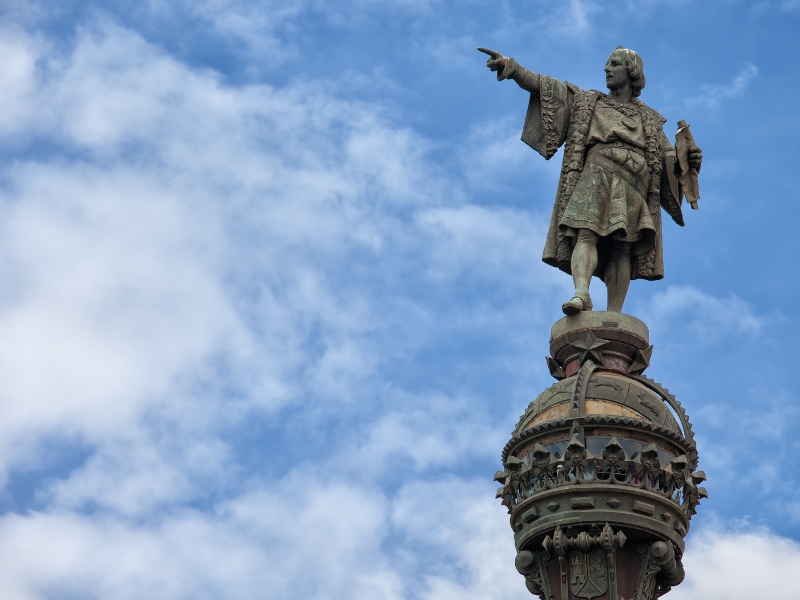
At the bottom of La Rambla, where the city meets the port, Christopher Columbus stands on top of a column 60 metres high. The monument was built from 1882 to 1888 for the Universal Exhibition of 1888, to honour his first voyage to the Americas. The design came from Gaietà Buïgas, who won a competition, and the statue of Columbus, over seven metres tall, is by Rafael Atché.
- Where Columbus points: he is often said to point towards America, but he actually points south-south-east, out to sea, roughly in the direction of North Africa.
- The eight bronze reliefs around the base, with scenes from the first voyage, and the pairs of lions beside the steps. A lift inside the column takes visitors up to a viewing platform just below the statue.
El Cap de Barcelona
On the waterfront a short walk east of the Columbus Monument, a giant colourful head rises over the promenade. El Cap de Barcelona, the Barcelona Head, is by the American pop artist Roy Lichtenstein, who made it in 1991 and 1992 for the Olympic Games. It is built of concrete covered with glazed ceramic tiles, and the face is drawn with the bold lines and grids of red dots that Lichtenstein used in his paintings based on comic strips.
- The tile surface, a nod to the trencadís, the broken-tile mosaic used by Gaudí and Josep Maria Jujol. The sculpture is one of the stops on our scavenger hunt, like the Rambla de Mar footbridge nearby.
Santa Maria del Mar
In the Ribera quarter, a few streets back from the old harbour, stands one of the purest examples of Catalan Gothic. King Alfonso IV of Aragon laid the first stone on 25 March 1329, and the last stone was set on 3 November 1383, a short building time for a church of this size, which explains its unity of style. The architects were Berenguer de Montagut and Ramon Despuig. It was the church of the seafaring quarter, and its local guilds took part in building it.
The most famous helpers were the bastaixos, the porters of the port, who carried the stone on their backs; you can see them in bronze on the main doors. Inside, the slender columns stand about 13 metres apart, said to be the widest spacing of any Gothic church in Europe, which makes the nave feel wide and open. In 1936, at the start of the Civil War, a fire burned inside for 11 days and destroyed the baroque altarpiece and most of the decoration, which is why the interior is so bare today.
- The rose window over the main door. The first one fell in the earthquake of 1428, and the one you see was finished by 1459.
How to see them in one walk
Start at the cathedral and walk down through the lanes of the Gothic Quarter to La Rambla. Cross over to Carrer Nou de la Rambla for Palau Güell, then come back and step into Plaça Reial on the other side. Walk down La Rambla to the Columbus Monument, follow the waterfront past the Rambla de Mar to El Cap de Barcelona, and turn inland into the Ribera to finish at Santa Maria del Mar. Palau Güell can be busy, so it is worth booking ahead.
See Barcelona with World City Trail
Our Barcelona scavenger hunt turns the old town into a game you play on your phone. The route links 10 stops, from Plaça de Catalunya to the Picasso Museum, and the cathedral, Palau Güell, the Columbus Monument, El Cap de Barcelona and Santa Maria del Mar are all stops, along with the Palau de la Música Catalana, the Liceu and the Rambla de Mar. At each stop you solve a puzzle and learn a story, at your own pace.
There is also a self-guided walking tour and an outdoor escape game in Barcelona, for people who prefer a different format.
Play the Barcelona scavenger hunt →
Take the self-guided walking tour of Barcelona →
Play the outdoor escape game in Barcelona →
Facts checked in October 2026.