
Palma's old town is small enough to cross on foot, and its best sights sit on one line from the market squares down to the sea. This guide covers six of them: three churches with very different stories, the cathedral on the waterfront, the merchants' exchange where Palma's trade was run, and the park of Sa Feixina at the edge of the old walls.
Santa Eulàlia
Santa Eulàlia, dedicated to Saint Eulalia of Barcelona, is a parish church close to the Plaça Major. Its place in Mallorcan history was fixed on 12 September 1276, when James II, son of James I the Conqueror, was crowned King of Mallorca here and swore to uphold the privileges and the charter of franchises of the kingdom.
Inside, the church has three naves, the central one the tallest, and an ambulatory ringed by seven chapels, among them the chapel of the Santo Cristo de la Conquista. The Baroque high altar was the work of a Dominican friar, Alberto de Burguny. The church has been a protected heritage site since 1931.
- Look up at the terraces around the outside: the gargoyles are a medieval bestiary of dragons, harpies and basilisks.
- The tall bell tower with its pointed spire is much younger than the church; it dates from the 19th century.
Basílica de Sant Francesc
Nearby, the Franciscan basilica of Sant Francesc was one of the great building projects backed by King James II of Mallorca, who also supported the Dominican church of Sant Domingo. It holds one of the most important tombs on the island.
Ramon Llull, the Mallorcan philosopher, mystic and writer who died in 1316, is buried here; his tomb was made in 1448. The convent also has a link to California: Junípero Serra, born in the Mallorcan village of Petra in 1713, studied philosophy with the Franciscans in Palma and later taught a three-year philosophy course at the Convento de San Francisco before leaving as a missionary. He was declared a saint in 2015.
- Inside, look for Ramon Llull's tomb, the main reason many Mallorcans come here.
Església de Monti-sion
Monti-sion is the church of Palma's Jesuit college, a short walk from Sant Francesc. Its best-known resident was Alphonsus Rodríguez, a Jesuit lay brother who arrived at the newly founded college as a novice and served as its porter for 46 years, receiving visitors, carrying messages and handing out alms. He died in Palma on 31 October 1617, aged 85, and was made a saint in 1888. The young Peter Claver lived with him in Mallorca for a time and, on his advice, asked to be sent to the missions in South America.
- The Jesuit college in Palma is the main shrine of Saint Alphonsus Rodríguez, so the church is a place of pilgrimage as well as a sight.
Catedral de Mallorca (La Seu)
The cathedral, known in Mallorca simply as La Seu, rises straight above the sea between the royal palace of La Almudaina and the Bishop's Palace. Work began after the Christian conquest of 1229, the site was consecrated in 1230 and the building took until 1601 to complete. The bell tower was finished in 1498, and the west front was redone in neo-Gothic style in the 19th century.
Two famous names changed the interior. Antoni Gaudí was invited in 1903 to lead a restoration: he moved the choir stalls to the side walls of the presbytery and designed the large canopy that hangs above the altar, until disputes with the authorities stopped the work in 1914. Between 2001 and 2006 the artist Miquel Barceló transformed the chapel of Sant Pere and the Holy Sacrament, covering its apse in Italian ceramic and adding grisaille stained glass.
- The great rose window, nearly 14 metres across, is often described as the second-largest Gothic rose window in the world after Strasbourg's.
- Gaudí's canopy over the high altar and Barceló's ceramic chapel are the two pieces of modern art in a medieval interior; try to see both.
La Llotja
Down by the old harbour stands La Llotja, the exchange of Palma's merchants. It was designed by Guillem Sagrera and built between 1426 and 1452 as the seat of the Merchants' College; Sagrera left in 1447 after a dispute with the contractors and went to Naples, and another master finished the work. Exchanges like this one appeared from the 14th century as sea trade grew, and in the 15th century this building also served as a seat of the island's government.
The inside is one great Gothic hall. Its vaults rest on six slender spiral columns without bases or capitals, which open out at the top so that the room looks like a grove of stone palm trees.
- Over the main door, find the Guardian Angel holding a banner that names him defender of trade, placed there to protect the merchants who paid for the building.
- Look for the doors on the sea side: they open onto a spiral staircase that climbs to the roof terrace.
Parc de Sa Feixina
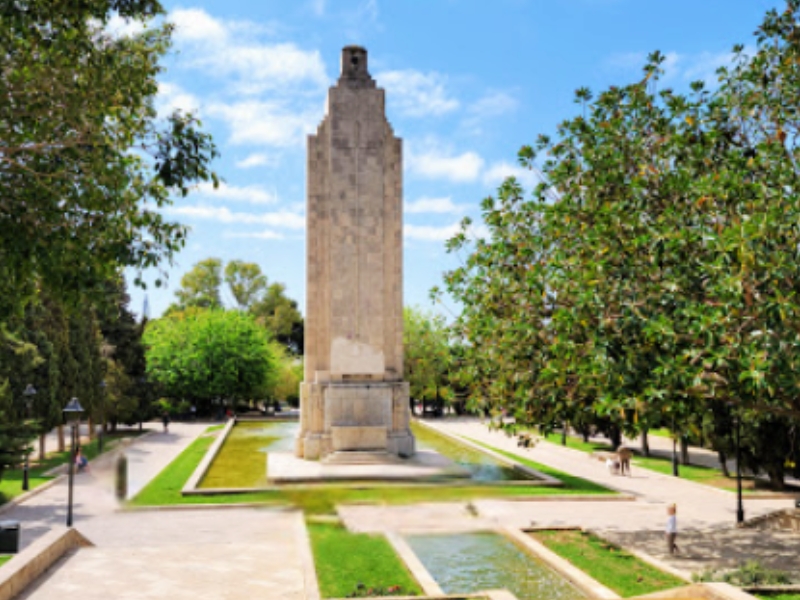
West of the old town, next to the Santa Catalina neighbourhood and close to the seafront, the park of Sa Feixina is one of Palma's main city parks. The site has had many lives: it became a barracks during the Spanish Civil War, hosted the island's official trade fair from 1963 to 1974 and was redesigned into its present form in 1991. Today it is a place where skaters, families, residents and visitors cross paths.
The tall monument in the park was inaugurated in 1947, during the Franco dictatorship, in memory of the sailors of the cruiser Baleares, sunk on 6 March 1938 in the Battle of Cape Palos during the Civil War; 765 of its crew of 1,206 were killed or went missing. It is a reminder of a hard chapter of Spanish history, so take a moment to read it with that in mind.
How to see them in one walk
Start at the Plaça d'Espanya, where the Sóller train, running since 1911, leaves from a station next to the park and a statue of James I stands in the middle of the square. Walk down to the arcaded Plaça Major, built on the site where the Inquisition had its headquarters until 1823, then go on to Santa Eulàlia, Sant Francesc and Monti-sion. From there head down to the cathedral and the Plaça de la Reina, follow the waterfront to La Llotja, and finish in the green of Sa Feixina.
See Palma with World City Trail
Our Palma scavenger hunt turns the old town into a game you play on your phone. The route links 10 stops, from the Sóller train and the Plaça d'Espanya to Sa Feixina, and Santa Eulàlia, Sant Francesc, Monti-sion, the cathedral, La Llotja and Parc de Sa Feixina are all stops, along with the Plaça Major and the Plaça de la Reina. At each stop you solve a puzzle and learn a story, at your own pace.
There is also a self-guided walking tour and an outdoor escape game in Palma, for people who prefer a different format.
Play the Palma scavenger hunt →
Take the self-guided walking tour of Palma →
Play the outdoor escape game in Palma →
Facts checked in October 2026.