
This guide follows a line through Aachen from the northern city gate to the spa quarter: the Ponttor, the church of Heilig Kreuz, the International Newspaper Museum, the Centre Charlemagne, the Couven Museum, the Hühnerdieb fountain, Aachen Cathedral and the money fountain known as Kreislauf des Geldes. It covers the city's churches, museums and bronze fountains rather than its town hall and spa pavilion, and it follows almost exactly the route of our scavenger hunt.
Aachen Cathedral
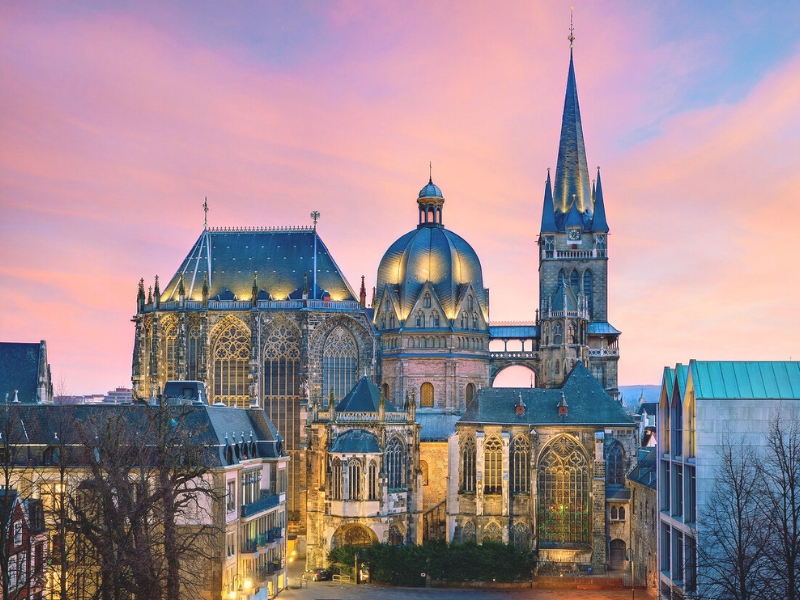
The core of the cathedral is the Palatine Chapel that Charlemagne had built for his palace from around 796. Its master builder is named as Odo of Metz, and Pope Leo III consecrated it in 805. The eight-sided central space, with its gallery and dome, was modelled on Byzantine churches such as San Vitale in Ravenna. Charlemagne was buried here in 814, and from 936 to 1531 around thirty German kings were crowned in the chapel and sat on his stone throne in the upper gallery afterwards.
Between 1355 and 1414 the city added a tall Gothic choir, so full of windows that it is often called a glass house; it was built to hold the relics that drew pilgrims, and they are still shown to the public every seven years, a custom that began in 1349. In 1978 the cathedral was one of the first twelve sites on the UNESCO World Heritage list. The treasury next door holds the Cross of Lothair and the bust of Charlemagne.
- The Barbarossa chandelier under the dome, a gift from Frederick Barbarossa and his wife Beatrice around 1165 to 1170.
- In the Gothic choir, the golden shrine of Charlemagne (1182 to 1215) and the shrine of the Virgin Mary (1220 to 1239), and the Pala d'Oro on the high altar.
Ponttor
The Ponttor is the start of our scavenger hunt and one of only two gates that survive from the eleven of Aachen's outer city wall. It was built in the early 14th century, when new quarters outside the old wall needed a second ring of defence, and the road north out of the city passed through it. The name comes from the Pont district, not from a bridge. Today youth and scout groups use the building.
- The portcullis and the opening for pouring pitch in the main gateway, and the forward gate with two towers on the far side of the old moat.
Heilig Kreuz
The Catholic church of Heilig Kreuz (Holy Cross) stands in the Pont quarter near the Ponttor and is the second stop of our scavenger hunt. Its story goes back to a chapel founded in 1363 by Gerard von Bongard and handed to the Crosiers, an order of canons. The church you see today was designed by Joseph Buchkremer in Gothic Revival style and built between 1898 and 1902. It was badly damaged in the Second World War and rebuilt, and it is still a working parish church.
- The Latin inscription on the facade, Stat crux dum volvitur orbis, the cross stands while the world turns, and the free-standing bell tower on the north side.
International Newspaper Museum
On Pontstraße stands the Großes Haus von Aachen, a late Gothic brick house built around 1495 for Heinrich Dollart, a merchant who was later executed for stealing silver. Over the centuries it served as the city's public weighhouse, a customs office, a police headquarters and a prison. Since 1931 it has housed the International Newspaper Museum, founded in 1886 from the collection of Oscar von Forckenbeck, which now holds more than 200,000 newspapers. The house was renovated from 2009 to 2011 and has a modern permanent exhibition. It is a stop on our scavenger hunt.
Centre Charlemagne
The Centre Charlemagne is Aachen's city history museum, opened on 19 June 2014 on the Katschhof, the square between the cathedral and City Hall. It occupies a former city administration building from 1958 to 1962 by Gerhard Graubner, now a listed building. The permanent exhibition walks you through the city's past in six parts: Celtic and Roman settlements, Charlemagne's palace, the coronation city, the baroque spa town, the industrial age and the 20th and 21st centuries. It is also the starting point of the Route Charlemagne, which links the city's key historic sites, and one of our scavenger hunt stops.
Couven Museum
The Couven Museum shows how well-off Aachen families lived in the 18th and early 19th centuries, in furnished rooms that run from Rococo to Empire and Biedermeier. It is named after the baroque architects Johann Joseph Couven and his son Jakob. The museum opened in 1929 in another house that was destroyed in the war, and since 1958 it has been in the Haus Monheim on the Hühnermarkt. It is one of the stops on our scavenger hunt.
- The old apothecary, the kitchen, the tile pictures and the Rococo cabinets with Meissen porcelain.
Hühnerdieb
On the Hühnermarkt, the same small square as the Couven Museum, a bronze thief runs off with a bird under his arm. The Berlin sculptor Hermann Joachim Pagels shows him at the moment he realises he has stolen a rooster rather than a hen, and the rooster's crowing is giving him away; the scene is invented, not based on a real event. The fountain was unveiled on Christmas Day 1913. In 1943 the figure was melted down, and only the ring of small water-spouting chicks, stored in time, survived. In 1950 Pagels, then 72, cast the thief again from his own plaster model, and the fountain returned to its old place in 1953.
Kreislauf des Geldes
At the end of the Elisengarten, on Hartmannstraße, the sculptor Karl-Henning Seemann made this fountain in 1976 for the Sparkasse Aachen, and it is often called the Geldbrunnen, the money fountain. Bronze figures stand around a flat basin, each showing a way people deal with money: greed, stinginess, condescending generosity and begging. The water flows anticlockwise, in the same direction as the money passed from hand to hand, and since it is warm water from Aachen's thermal springs, the fountain keeps running in winter. It is one of our scavenger hunt stops.
- The boy watching his father count coins, and the scene of money being handed over.
How to see them in one walk
Start at the Ponttor in the north and walk down Pontstraße, passing Heilig Kreuz and the Großes Haus with the Newspaper Museum. At the market square, pass City Hall to the Katschhof and the Centre Charlemagne, then go round to the Hühnermarkt for the Couven Museum and the Hühnerdieb. Continue to the cathedral, and finish south of it at the Elisengarten with the money fountain. If you want to see the cathedral treasury or a museum inside, plan your day around them.
See Aachen with World City Trail
Our Aachen scavenger hunt turns the old town into a game you play on your phone. The route links 10 stops, from the Ponttor to the Elisenbrunnen, and seven places in this guide are stops: the Ponttor, Heilig Kreuz, the Newspaper Museum, the Centre Charlemagne, the Couven Museum, the cathedral and the Kreislauf des Geldes. The Hühnerdieb is not a stop, but it stands on the same square as the Couven Museum. At each stop you solve a puzzle and learn a story, at your own pace.
There is also a self-guided walking tour and an outdoor escape game in Aachen, for people who prefer a different format.
Play the Aachen scavenger hunt →
Take the self-guided walking tour of Aachen →
Play the outdoor escape game in Aachen →
Facts checked in October 2026.