
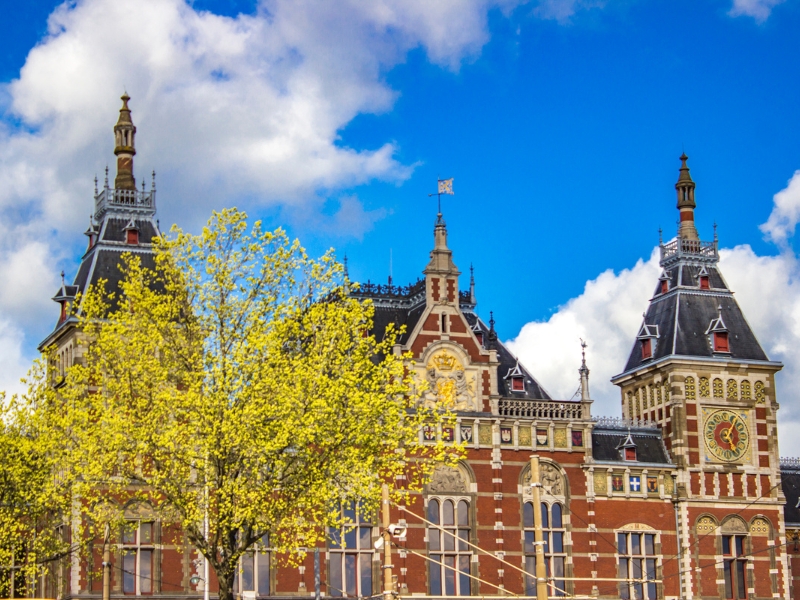
Amsterdam's centre is full of places that ask you to stop and remember, and they sit close to some of its liveliest streets. This guide covers five of them on one walk from the harbour to the canal ring: the Catholic basilica by the station, the war memorial on Dam Square, the statue of Anne Frank and the Homomonument on the Westermarkt, and the shopping streets known as De 9 Straatjes.
Basilica of St Nicholas
The big domed church you see soon after leaving Centraal Station is the Basilica of St Nicholas, on the Prins Hendrikkade between the street and the Oudezijds Kolk canal. It was designed by Adrianus Bleijs and built between 1884 and 1887 in a mix of revival styles, mostly Neo-Baroque and Neo-Renaissance.
Its status has grown in recent years. In 2012, the church's 125th year, it was made a minor basilica, and on 1 February 2025 Pope Francis raised it to co-cathedral of the Diocese of Haarlem-Amsterdam; Bishop Jan Hendriks took his ceremonial seat there on 8 March 2025.
- Outside, look at the two towers framing the rose window and the octagonal crossing tower with its Baroque-style dome and lantern.
- Inside, find the crown of Emperor Maximilian I painted above the high altar, the dome ringed by four levels of stained glass, and the Sauer organ of 1889 under the rose window.
The National Monument on Dam Square
The white stone pillar on Dam Square is the Netherlands' national memorial to the Second World War. Built from 1952 and unveiled by Queen Juliana on 4 May 1956, it is 22 metres tall and clad in white travertine over a concrete core. The architect was Jacobus Oud and the sculptor John Rädecker, who died four months before the unveiling; his sons Han and Jan Willem finished the figures.
The monument is full of symbols. Every year on 4 May the national Remembrance of the Dead is held here for the victims of the war and of later conflicts. It was restored in 1965 and again in 1997–1998, when it was taken apart completely and the brick inside the pillar was replaced with concrete, and it became a national heritage monument in 2009.
- The front relief: four chained men stand for wartime suffering, flanked by two resistance figures, one for the intellectuals and one for the workers, with weeping dogs at their feet for loyalty.
- Above them, a woman holding a child, with doves around her, stands for victory, peace and new life; on the back, rising doves stand for liberation. The two lions in front represent the Netherlands.
- The curved wall behind the pillar holds eleven urns with soil from wartime execution sites and war cemeteries in the Dutch provinces, and a twelfth with soil from the former Dutch East Indies, now Indonesia. Look for the poem by Adriaan Roland Holst on the wall.
The statue of Anne Frank on the Westermarkt
Beside the Westerkerk stands a statue of Anne Frank by the sculptor Mari Andriessen, who also made the Amsterdam statue De Dokwerker in 1952. Nearby, at Prinsengracht 263, is the house where she hid. Born in Frankfurt on 12 June 1929, Anne moved to Amsterdam with her family in 1934. In July 1942 they went into hiding in the rear annex of the building where her father worked, the Achterhuis, hidden from the street by the houses around its courtyard.
The group stayed hidden for two years and one month, until the Gestapo arrested them on 4 August 1944. Anne died in Bergen-Belsen in February or March 1945, aged 15. Her father Otto, the only member of the family to survive, returned to Amsterdam and saw her diary published in 1947 as Het Achterhuis. The Anne Frank House opened as a museum on 3 May 1960.
- The statue stands at street level beside the church, so it is easy to walk past; it is worth a pause before or after a visit to the museum.
Homomonument
On the same square, on the bank of the Keizersgracht, the Homomonument remembers gay men and lesbians who have been persecuted for their sexuality. It was designed by Karin Daan, whose plan was chosen from 137 entries in 1981, and it opened on 5 September 1987. Three triangles of pink granite, set into the square, form one large triangle together, so you only see the whole design when you look at how they connect.
- The triangle for the past lies flat in the square, with a line from a poem by Jacob Israël de Haan around its edge: "Such a boundless craving for friendship". The triangle for the present has steps down to the water, where people lay flowers and light candles; the one for the future is a raised platform.
- On 4 May there is a remembrance ceremony here in the evening, and on King's Day (27 April) and Liberation Day (5 May) the square hosts festivals with music and dancing.
De 9 Straatjes (the Nine Streets)
South of the Westermarkt, three short cross streets cut through the canal ring between the Prinsengracht and the Singel. Because each stretch between two canals has its own name, they add up to nine streets: Reestraat, Hartenstraat and Gasthuismolensteeg; Berenstraat, Wolvenstraat and Oude Spiegelstraat; Runstraat, Huidenstraat and Wijde Heisteeg. Several names recall the trades that processed hides here, from cattle to bears, wolves and roe deer.
The streets date from the city's third expansion, which began around 1612, though most of today's houses are from the 18th century. The name De 9 Straatjes is much younger: local shopkeepers chose it in the 1990s and founded their association on 12 November 1996. Nobody liked the name much at first, but it stuck.
- More than 140 buildings here are protected national or municipal monuments, so look up at the gables above the shop windows.
- Between the canals you also pass Huis Marseille, a photography museum at Keizersgracht 401, and Felix Meritis, a centre for art, culture and science on the Keizersgracht.
How to see them in one walk
Leave Centraal Station and turn towards the Prins Hendrikkade for the Basilica of St Nicholas. Walk on to Dam Square for the National Monument, then head west behind the Royal Palace along the Raadhuisstraat to the Westermarkt, where the Anne Frank statue and the Homomonument stand near the Westerkerk. From there it is a short walk south into De 9 Straatjes, a good place to end with a coffee by the canal.
See Amsterdam with World City Trail
Our Amsterdam scavenger hunt turns the old centre into a game you play on your phone. The route links 10 stops, from Centraal Station to De 9 Straatjes, and the Basilica of St Nicholas, the National Monument, the Anne Frank monument and De 9 Straatjes are all stops, along with the Westerkerk and the Royal Palace. At each stop you solve a puzzle and learn a story, at your own pace.
There is also a self-guided walking tour and an outdoor escape game in Amsterdam, for people who prefer a different format.
Play the Amsterdam scavenger hunt →
Take the self-guided walking tour of Amsterdam →
Play the outdoor escape game in Amsterdam →
Facts checked in October 2026.