
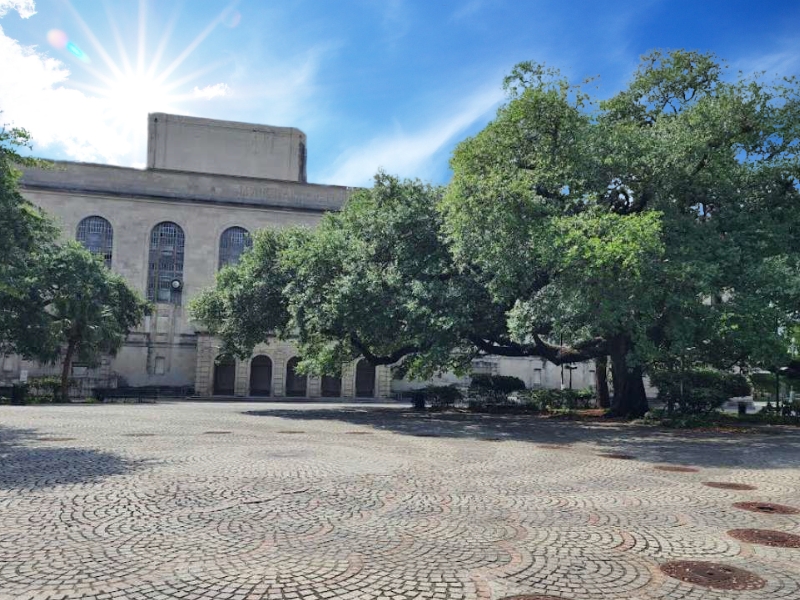
This guide covers the two ends of our New Orleans scavenger hunt: Spanish Plaza on the Mississippi at the foot of Canal Street, where the route begins, and Louis Armstrong Park with Congo Square on the edge of the Tremé neighbourhood, where it ends. Between them lies the French Quarter, but these places tell a different story, about the river trade that built the city and about the African and Creole music that grew up just outside its old walls.
Spanish Plaza
Spanish Plaza is an open square on the riverfront where Canal Street meets the Mississippi. Its name recalls the decades when Louisiana belonged to Spain: France secretly handed the colony to Spain in the Treaty of Fontainebleau in 1762, and Spanish officials ran New Orleans until the formal transfer back to France at the Cabildo on 30 November 1803, only three weeks before the territory passed to the United States in the Louisiana Purchase. Spanish rule left more on the city than a name. After great fires in 1788 and 1794 destroyed most of the wooden town, the French Quarter was rebuilt with stone walls, courtyards, arcades and slate roofs in a Spanish manner.
Today the plaza is a place to watch ships and ferries on the Mississippi, and it is used for concerts and seasonal events. Right behind it stands the Outlet Collection at Riverwalk. The building opened in 1986 as Riverwalk Marketplace on land along the river that had been opened up by the 1984 Louisiana World Exposition, and it reopened as an outlet mall in 2014. On 14 December 1996 a cargo ship, the Bright Field, lost power and crashed into it; no one was killed, but dozens of people were injured, and a plaque at the mall marks the spot.
- The tower at 2 Canal Street, designed by Edward Durell Stone and dedicated in 1968 as the International Trade Mart. For decades it was the World Trade Center of New Orleans, and since 2021 it has been a Four Seasons hotel.
- The Canal Street Ferry landing nearby, with boats across the river to Algiers Point, an 18th-century neighbourhood on the west bank.
Louis Armstrong Park
Louis Armstrong Park covers about 32 acres in Tremé, across Rampart Street from the French Quarter. Its history is not a happy one. In the 1960s an urban renewal project tore down a large part of the old neighbourhood here, and after about a decade of debate the city turned the cleared land into a park, designed by the New Orleans architect Robin Riley and named after the trumpeter Louis Armstrong, who was born in the city. Residents still argue about it: some would like the tall fence around the park removed and the large parking lots at the back turned into green space.
The park holds two big performance halls. The New Orleans Municipal Auditorium was built in the 1920s, before the park existed. The Mahalia Jackson Theater, named after the New Orleans-born gospel singer, opened in 1973 with Verdi's Requiem and seats around 2,100 people. Hurricane Katrina flooded it in 2005 under about 14 feet of water, and it reopened in January 2009; it is now the home stage of the New Orleans Ballet Association and the New Orleans Opera. Several buildings in the park belong to the New Orleans Jazz National Historical Park, set up in 1994. The park is the last stop but one on our scavenger hunt.
- The 12-foot statue of Louis Armstrong by the sculptor Elizabeth Catlett.
- The bust of the clarinettist and saxophonist Sidney Bechet, another New Orleans jazz pioneer.
- The figure of Buddy Bolden, the cornet player from the earliest days of jazz.
Congo Square
Congo Square is the open space in front of the Municipal Auditorium, at the corner of Rampart and St. Peter Streets, and it is the final stop of our scavenger hunt. Under the French Code Noir of 1724, enslaved Africans had Sundays off, and in 1817 a city ordinance limited their gatherings to this one place. On Sundays hundreds of people met here to trade at a market, sing, drum and dance the bamboula, the calinda and other dances with African roots; some earned money that helped them buy their freedom. In 1819 the architect Benjamin Latrobe estimated 500 to 600 people at one gathering. The square was later called Place des Nègres, Place Publique and Circus Square, but most people simply said Congo Square, after the many Bakongo people among the enslaved.
The Sunday dances faded away before the Civil War, and in 1893 the city renamed the square after the Confederate general P. G. T. Beauregard, partly to discourage large gatherings. Locals kept the old name, and in 2011 the City Council officially restored it. The square was listed on the National Register of Historic Places in 1993, and in 1970 it hosted the first New Orleans Jazz and Heritage Festival, before the festival moved to the Fairgrounds. The composer Louis Moreau Gottschalk used its rhythms in his piano piece Bamboula.
- On Sundays the Congo Square Preservation Society, founded by the percussionist Luther Gray, holds drum circles and dancing here, keeping the old tradition alive.
- Folklore, not documented history, says the voodoo priestess Marie Laveau led dances on the square in the 1830s, and that people poured offerings at its four corners at midnight under a dark moon.
Tremé around the park
The streets around the park belong to the Faubourg Tremé, laid out in the 1810s on land owned by Claude Tremé and named after him. It is one of the oldest neighbourhoods in New Orleans and was at first the main district of the city's free people of color. Some sources call it the oldest Black-majority neighbourhood in the United States. St. Augustine Church here is described as the oldest African-American Catholic parish in the country.
Tremé is not part of our scavenger hunt route, but it is worth a look once you finish at Congo Square. Storyville, the city's old red-light district, was carved out of the upper part of Tremé at the end of the 19th century and torn down in the 1940s. The neighbourhood also gave its name to the television series Treme, set in the years after Hurricane Katrina.
How to see them in one walk
Begin at Spanish Plaza and look out over the river, then walk up Canal Street. Turn into the French Quarter and follow the riverside parks and streets to Jackson Square and the French Market, then turn inland and head for Rampart Street. Louis Armstrong Park lies just across Rampart; Congo Square is the open space in front of the Municipal Auditorium, and the statues and the Mahalia Jackson Theater are in the park around it. If you have time afterwards, walk on into Tremé. Visit the park in daylight, and if you can, come on a Sunday afternoon for the drumming on Congo Square.
See New Orleans with World City Trail
Our New Orleans scavenger hunt turns the city into a game you play on your phone. The route links 10 stops, starting at Spanish Plaza by the river and finishing at Congo Square, with Louis Armstrong Park as the stop before it. In between it passes Caesars New Orleans, the Audubon Aquarium, Woldenberg Park, Jackson Square, St. Louis Cathedral, the French Market and Lafitte's Blacksmith Shop Bar. At each stop you solve a puzzle and learn a story, at your own pace.
There is also a self-guided walking tour and an outdoor escape game in New Orleans, for people who prefer a different format.
Play the New Orleans scavenger hunt →
Take the self-guided walking tour of New Orleans →
Play the outdoor escape game in New Orleans →
Facts checked in October 2026.