
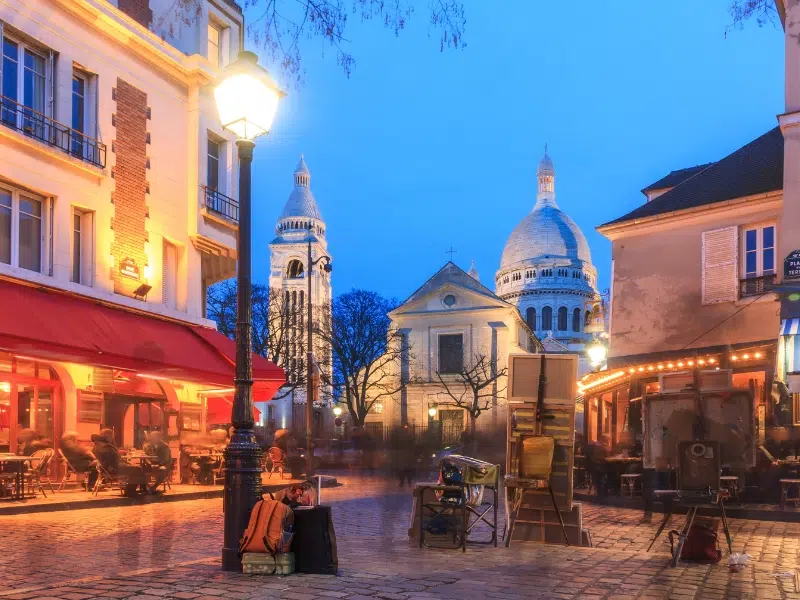
This guide climbs Montmartre from the Abbesses metro to the top of the hill and back down the other side, through seven places that every first visit should include: the Wall of Love, the Bateau-Lavoir, the Place du Tertre, La Maison Rose, the Clos Montmartre vineyard, the Sacré-Cœur and the Square Louise-Michel. All seven are stops on our scavenger hunt, and between them they cover the village, the artists and the basilica that made the hill famous.
The Wall of Love
In the small Square Jehan-Rictus on Place des Abbesses, a wall of tiles is covered in handwriting: the words I love you, written more than 300 times in around 250 languages. The artists Frédéric Baron and Claire Kito created it in 2000. Baron collected the phrase from people in many languages, and Kito, a calligrapher, arranged it on 612 tiles of enamelled lava over about 40 square metres. The square itself dates from 1936 and stands on the site of an old town hall building. The wall is the first stop of our scavenger hunt.
- The red splashes between the words: they stand for the pieces of a broken heart, which could be put back together into a whole one.
- Your own language: finding it among the scripts is half the fun.
Le Bateau-Lavoir
At 13 Place Émile-Goudeau, a modest building on a sloping square was once a piano factory and then a warren of artists' studios. Pablo Picasso arrived in 1904, lived here until 1909 and kept a studio until 1912, and it was here that he showed Les Demoiselles d'Avignon in 1907, the painting usually seen as the start of Cubism. Kees van Dongen, Juan Gris and Amedeo Modigliani lived in the building, Georges Braque was a regular visitor, and in 1908 the artists held a famous banquet here in honour of the painter Henri Rousseau, known as the Douanier.
The name is usually credited to the poet Max Jacob; one explanation compares the building to the wooden laundry boats then moored on the Seine, another points to the washing hung outside. A fire in 1970 left only the facade standing, and the building was rebuilt in concrete in 1978 in the same form. It still contains 25 artists' studios.
- The facade on the square, the only part of the original building to survive the fire.
Place du Tertre
The Place du Tertre, at about 130 metres above sea level, was the centre of the old village of Montmartre before the hill became part of Paris. In 1790 the village's first town hall was set up in the house of its first mayor, Félix Desportes, at number 3. Today the square is filled with easels: since the 1990s the city has divided it into 140 spots of one square metre each for painters, portraitists and silhouette cutters, who pay a yearly fee. Restaurant terraces now take up much of the space. The square is a stop on our scavenger hunt.
- La Mère Catherine at number 6, a restaurant founded in 1793.
- The church of Saint-Pierre de Montmartre a few steps away, with the domes of the Sacré-Cœur rising just behind it.
La Maison Rose
At 2 rue de l'Abreuvoir, where the lane meets rue des Saules, stands a small pink house. It was founded by Germaine and Ramon Pichot, and many painters have depicted it: Maurice Utrillo's La Maison Rose à Montmartre now hangs in the San Francisco Museum of Modern Art. A little further down rue des Saules is the Lapin Agile, a cabaret in a building from 1795 that was a favourite meeting place of Picasso, Max Jacob and their friends in the early 20th century, and was once known as the Cabaret des Assassins. La Maison Rose is one of the stops on our scavenger hunt.
Vigne du Clos Montmartre
On the north slope of the hill, between rue Saint-Vincent and rue des Saules, rows of vines grow in the middle of Paris. Vines had grown on Montmartre since the Middle Ages, but this vineyard is younger: in 1929 the illustrator Francisque Poulbot laid out a small square here, in 1930 residents and the Vieux Montmartre society fought off plans to build apartment blocks, and in 1933 the City of Paris planted the vineyard. The first vines were gamay and pinot noir; today there are around 30 varieties.
Every October since 1934, the harvest has been celebrated with the Fête des Vendanges, a festival with a parade of Montmartre associations and visiting wine brotherhoods. City gardeners pick the grapes, the wine is pressed in the cellars of the town hall of the 18th arrondissement, and the wine is auctioned for social causes on the hill. The vineyard is a stop on our scavenger hunt; it is usually closed to visitors, but you can see it well from the street.
The Sacré-Cœur
The basilica at the top of the hill was proposed in 1870, after France's defeat in the Franco-Prussian War. Paul Abadie won the design competition against 77 other proposals, building began in 1875 and the church was finished in 1914, but it was only consecrated in 1919, after the First World War. Its stone, travertine from Château-Landon, is very hard and turns whiter when it rains, as calcite forms on the surface. Many on the French left have long seen the building as a symbol of the repression of the Paris Commune of 1871, and it only became a listed historic monument in December 2022.
Inside, the apse mosaic, dedicated in 1923, covers about 475 square metres made of 25,000 pieces, showing Christ with the Virgin Mary, the Archangel Michael and Joan of Arc. The bell called La Savoyarde weighs around 19 tonnes and is the largest in France. The basilica is the second most visited site in Paris after the Eiffel Tower and is one of the stops on our scavenger hunt.
- The bronze equestrian statues of Joan of Arc and Saint Louis by Hippolyte Lefebvre above the entrance.
- The view over Paris from the steps in front of the basilica, and from the dome if you climb it.
Square Louise-Michel
Below the basilica, terraced gardens with stairways, ramps and a fountain run down the slope to Place Saint-Pierre. They were begun in 1889 on the site of former gypsum quarries, worked on by Adolphe Alphand, Paul Abadie and Jean Camille Formigé, and finished in 1927, when they opened as the Square Willette. They were later renamed after Louise Michel, one of the leading figures of the Paris Commune of 1871, because of Willette's antisemitism. The square is the last stop of our scavenger hunt.
- The fountain by Paul Gasq from 1932, with tritons and a naiad in three niches.
- The Montmartre funicular, running since 1900 along the west side of the gardens, and the two-level carousel at the foot of the stairs.
How to see them in one walk
Start at Place des Abbesses with the Wall of Love, then climb rue Ravignan to Place Émile-Goudeau and the Bateau-Lavoir. Continue up to the Place du Tertre, then take rue des Saules down the north side to La Maison Rose and the vineyard. Climb back up via rue du Chevalier-de-la-Barre or rue du Mont-Cenis to the Sacré-Cœur, and finish by walking down through the Square Louise-Michel. The streets are steep and cobbled, so wear good shoes, and the hill is quieter early in the morning.
See Montmartre with World City Trail
Our Montmartre scavenger hunt turns the hill into a game you play on your phone. The route links 10 stops, from the Wall of Love to the Square Louise-Michel, and all seven places in this guide are stops, along with the Passe-Muraille, the bust of Dalida and the Musée de Montmartre. At each stop you solve a puzzle and learn a story, at your own pace.
There is also a self-guided walking tour and an outdoor escape game in Montmartre, for people who prefer a different format.
Play the Montmartre scavenger hunt →
Take the self-guided walking tour of Montmartre →
Play the outdoor escape game in Montmartre →
Facts checked in October 2026.