
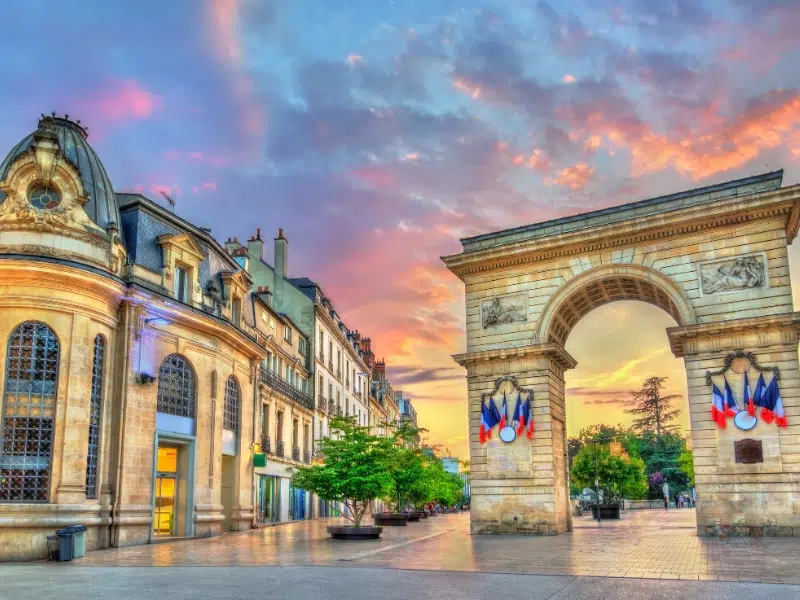
Dijon was the capital of the Dukes of Burgundy, and its old centre still runs along one line from the western gate to the covered market. This guide covers seven places on that line: Place Darcy with its garden and grand hotel, the Porte Guillaume, Saint-Bénigne Cathedral, the Place de la Libération, the Palace of the Dukes with the Museum of Fine Arts, the Church of Notre-Dame with its owl, and the Halles. You can walk them in order in a morning, with time for lunch at the market.
Place Darcy: the Jardin Darcy and the Hôtel de la Cloche
Place Darcy is named after Henry Darcy, the Dijon engineer who brought running water to the city in 1838. His reservoir lies under the Jardin Darcy, a small neo-Renaissance garden laid out in 1880 by the architect Félix Vionnois, with terraces, basins and cascades on top of the water supply that once fed fountains all over town. Across the square stands the Hôtel de la Cloche, the 'Bell' hotel, built between 1881 and 1884 as the most luxurious hotel in Dijon. In November 2015 its facade was lit in the French tricolour after the attacks in Paris.
- The white polar bear at the garden entrance, a 1937 copy of François Pompon's sculpture; the original is in the Musée d'Orsay in Paris.
- The cascades and balustrades of the garden, listed as a historic monument since 2015.
Porte Guillaume
This triumphal arch at the end of Place Darcy was built between 1786 and 1788 by the architect Jean-Philippe Maret, on the site of a gate in the 12th-century city wall. It was first called the Porte Condé, after the Prince of Condé, governor of Burgundy, became the Arch of Liberty during the Revolution, and in the 19th century took its present name from Guillaume de Volpiano, the abbot of Saint-Bénigne around the year 1000.
- The way the arch now stands alone in the traffic, marking the start of Rue de la Liberté, the main shopping street that leads to the palace.
Saint-Bénigne Cathedral
Saint-Bénigne was an abbey church before it became Dijon's cathedral in 1792. It is named after Benignus, a Christian martyr of the 2nd century. Abbot Guillaume de Volpiano began a great new church here in 1001, with a round church, or rotunda, consecrated in 1018. Only the lower level of that rotunda survives, as the crypt. The Gothic church above it was rebuilt between 1280 and 1393.
- The roof of glazed tiles in the Burgundian pattern of coloured diamonds, and the spire of 93 metres, rebuilt in the 1880s.
- The crypt, with the round columns of the 11th-century rotunda.
Place de la Libération
The half-moon square in front of the palace was designed in 1685 by Jules Hardouin-Mansart, Louis XIV's first architect, as the Place Royale, and laid out in the following years. A bronze equestrian statue of the king stood in the middle until the Revolution, when part of it was sent to be melted for cannon. The square took its present name in 1944. In 2005 and 2006 the architect Jean-Michel Wilmotte made it pedestrian, paved it in pale Comblanchien stone and added fountains set into the ground.
- The three fountains set into the paving and the curved arcades that frame the square facing the palace.
Palace of the Dukes and the Museum of Fine Arts
The Palace of the Dukes and States of Burgundy grew from the 14th century onward around the residence of the Valois dukes, and was rebuilt in classical style around the new Place Royale. Today it houses Dijon's town hall, which moved in during the 1830s, and the Museum of Fine Arts. The Tour Philippe le Bon, about 46 metres tall, was built in the mid-15th century for Duke Philip the Good. The ducal kitchens he rebuilt in 1433 are a square hall with huge double fireplaces.
The Museum of Fine Arts was founded on 30 November 1787 which puts it among the older public museums in France; it opened to visitors in 1799. After a long renovation, it reopened in full on 17 May 2019, with about 1,500 works in 50 rooms. Its best-known room is the Salle des Gardes, the great hall of the ducal palace, where the tombs of Philip the Bold and John the Fearless with Margaret of Bavaria were set up in 1827. They came from the Chartreuse de Champmol, the monastery the dukes founded outside the city.
- The mourners, the small hooded figures in procession around the bases of the ducal tombs.
- The Tour de Bar, from the original 14th-century palace, named after René of Anjou, Duke of Bar, who was held prisoner there.
Church of Notre-Dame and the owl
Notre-Dame was built from about the 1220s to the 1250s in the Gothic style of Burgundy, on the site of a Romanesque chapel. Its facade has 51 gargoyles that drain no water at all: they are purely decorative, carved between 1880 and 1882 to replace originals removed in the Middle Ages. Above the facade, the Jacquemart clock was brought back from Kortrijk in Flanders by Philip the Bold after he took the town in 1382, and has been ringing the hours in Dijon since 1383.
- The Jacquemart family on the clock: Jacquemart and Jacqueline strike the hours, and their children Jacquelinet and Jacquelinette the quarters.
- The owl (la chouette), a small carving on a buttress in Rue de la Chouette, worn smooth by people stroking it with the left hand to make a wish; it was damaged by a vandal in 2001 and repaired.
- Inside, Notre-Dame de Bon-Espoir, a wooden statue of the Virgin from the 11th or 12th century, linked to the city's deliverance in 1513 and 1944.
Les Halles
Dijon's covered market was built between 1873 and 1875, after the city decided on it in 1868, on the site of a former Dominican monastery. The iron and glass structure was made by the Fourchambault foundries, with a roof strongly inspired by the old market halls of Paris. It has been listed as a historic monument since 1975, and it is still a working food market.
- The iron columns and decorations, and the stalls of Burgundy produce, from cheese to mustard.
How to see them in one walk
Start in the Jardin Darcy and cross Place Darcy to the Porte Guillaume. Make a short detour south to Saint-Bénigne Cathedral, then walk along Rue de la Liberté past Place François Rude to the Place de la Libération and the Palace of the Dukes. Visit the museum, step through to the Place des Ducs behind the palace, and continue to Notre-Dame and the owl around the side of the church. From there the Halles are only a few streets away.
See Dijon with World City Trail
Our Dijon scavenger hunt turns the old town into a game you play on your phone. The route links 10 stops and ends at the Halles, and the Porte Guillaume, Saint-Bénigne Cathedral, the Place de la Libération, the Palace of the Dukes, the Museum of Fine Arts, Notre-Dame and the Halles are all stops, along with Place François Rude and the Place des Ducs. At each stop you solve a puzzle and learn a story, at your own pace.
There is also a self-guided walking tour and an outdoor escape game in Dijon, for people who prefer a different format.
Play the Dijon scavenger hunt →
Take the self-guided walking tour of Dijon →
Play the outdoor escape game in Dijon →
Facts checked in October 2026.