
Leipzig's old town is small enough to cross on foot, and four of its most important buildings line the way: St Thomas Church, where Johann Sebastian Bach worked and is buried, St Nicholas Church, where the peaceful revolution of 1989 began, the Museum of Fine Arts on the former Sachsenplatz and the New Town Hall with the tallest town hall tower in Germany. This guide takes them one by one: music, protest, painting and civic pride, all within the old ring road.
St Thomas Church (Thomaskirche)
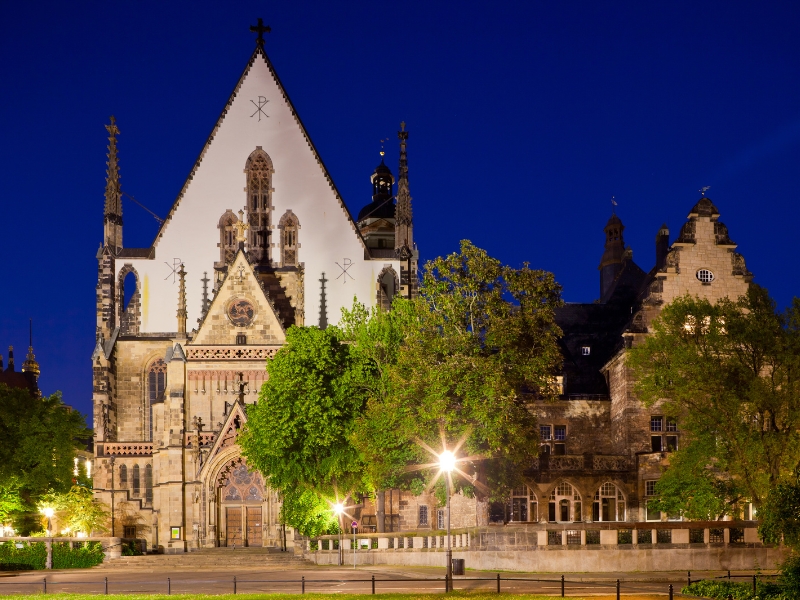
There has been a church on this site since at least the 12th century, and the Augustinian canons founded the St Thomas college here between 1212 and 1222. The boys' choir, the Thomanerchor, probably dates from the same year, 1212, and it still sings in the church today. The present late Gothic hall church was built between 1482 and 1496 and consecrated on 10 April 1496. Its roof is unusually steep, with a pitch of 63 degrees, so it looks almost like a tent from the side.
Johann Sebastian Bach was cantor of St Thomas, the Thomaskantor, from 1723 until his death in 1750. He was buried at the nearby churchyard of St John, and his remains were moved into St Thomas only in 1950; his grave in the chancel was inaugurated on 28 July of that year. The church has other famous visitors too: Martin Luther preached here at Pentecost in 1539, and Mozart played the organ here on a tour in 1789.
- Bach's grave, a bronze plate in the floor of the chancel.
- The Bach monument by Carl Seffner beside the church, unveiled in 1908.
- The bronze statue of Felix Mendelssohn Bartholdy opposite the church: the first version, unveiled in 1892, was removed by the Nazis in 1936, and a new one was dedicated in 2008.
St Nicholas Church (Nikolaikirche)
St Nicholas is the older of the two great churches, begun around 1165 in Romanesque style and extended in the 16th century into a Gothic hall church. From outside it looks plain, with a Baroque main tower added in 1730. The surprise is inside: between 1784 and 1797 Johann Carl Friedrich Dauthe turned the Gothic piers into fluted classical columns that end in palm fronds, with pale green leaves spreading into the vault. Bach's St John Passion had its first performance here in 1724.
In the early 1980s the church began to hold prayers for peace on Monday evenings. In the autumn of 1989, the gatherings that started here grew into the Monday demonstrations, with tens of thousands of people, sometimes more than 100,000, marching around the ring road. Those peaceful protests were one of the steps that led to the fall of the Berlin Wall a few weeks later.
- The palm-frond capitals on the columns and the pink and green colours of the interior.
- The column on the Nikolaikirchhof outside, a copy of one of Dauthe's columns put up in 1999 by the Leipzig artist Andreas Stötzner to remember the peaceful revolution.
Museum of Fine Arts (Museum der bildenden Künste)
The museum goes back to the Leipzig Art Association, founded in 1837 by local citizens, and it first opened in 1848. Its present building, on the former Sachsenplatz, opened on 4 December 2004. The design by the architects Hufnagel Pütz Rafaelian is a large, plain block set inside a frame of lower buildings that follows the lines of the street block that stood here before the war.
The collection runs from the late Middle Ages to the present. Caspar David Friedrich represents Romanticism, and there is a whole floor for two artists linked to Leipzig, Max Klinger, who was born in the city, and Max Beckmann. The museum is also the place to see the Leipzig School, the painters such as Werner Tübke, Bernhard Heisig and Wolfgang Mattheuer who made the city's name in East German art.
- Max Klinger's Beethoven, a seated figure made of marble, bronze, ivory and other materials, the highlight of the sculpture collection.
- The rooms of the Leipzig School, with large figurative paintings from the East German decades.
New Town Hall (Neues Rathaus)
The New Town Hall stands on the site of the Pleissenburg, the old castle at the south-west corner of the city. The city bought the site from the Kingdom of Saxony in 1895, and in 1897 the city architect Hugo Licht won the design competition. The foundation stone was laid in 1899, and the building opened in October 1905. The sculptor Georg Wrba made much of its decoration.
Its tower, almost 115 metres high, is the tallest town hall tower in Germany. Licht kept the old tower of the Pleissenburg and built the new one on top of it, so the castle survives inside the town hall. Guided tours climb the 250 steps from the fourth floor to the upper gallery, which gives one of the best views over the city.
- The clock with the Latin motto Mors certa, hora incerta: death is certain, the hour uncertain.
- The bridge that links the town hall across the street to the Stadthaus, its extension, opened in 1912.
How to see them in one walk
Start at St Nicholas Church, just west of Augustusplatz, and then walk north to the Museum of Fine Arts on the old Sachsenplatz. From there it is a few minutes to the Markt, where you can cut through to St Thomas Church and the Bach monument. Finish by walking south to the New Town Hall and, if a tour is running, go up the tower to see the whole route from above.
See Leipzig with World City Trail
Our Leipzig scavenger hunt turns the old centre into a game you play on your phone. The route links 10 stops, from Augustusplatz to the New Town Hall, and all four places in this guide are stops, along with the Kroch high-rise, the Markt, the Old Town Hall, the Naschmarkt and Auerbachs Keller. At each stop you solve a puzzle and learn a story, at your own pace.
There is also a self-guided walking tour and an outdoor escape game in Leipzig, for people who prefer a different format.
Play the Leipzig scavenger hunt →
Take the self-guided walking tour of Leipzig →
Play the outdoor escape game in Leipzig →
Facts checked in October 2026.