
Most visitors to Dinant see the collegiate church and the saxophone bridge and leave. This guide goes a little further, to six places that tell the rest of the town's story: the statue of Adolphe Sax on his bench, the Triumph of Light by the painter Antoine Wiertz, the citadel on the cliff, the Rocher Bayard and its legend, the Abbey of Leffe, and, for a short trip up the Lesse valley, the forgotten royal railway halt that King Leopold II built for his guests. Two of them are on our scavenger hunt route; the others are easy extras.
The Adolphe Sax statue
Adolphe Sax was born in Dinant on 6 November 1814, the son of the instrument maker Charles-Joseph Sax. He moved to Paris in 1842, developed the saxhorn family of brass instruments, and on 28 June 1846 patented the instrument that carries his name, which he meant for orchestras and military bands. He died in Paris in 1894 and is buried in Montmartre Cemetery. On Rue Adolphe Sax, a statue shows him sitting on a bench in front of the house where he was born, with his saxophone beside him.
- The free space on the bench: the statue is made for sitting next to the inventor for a photo.
- The house behind him, now the small museum La Maison de Monsieur Sax.
The Triumph of Light
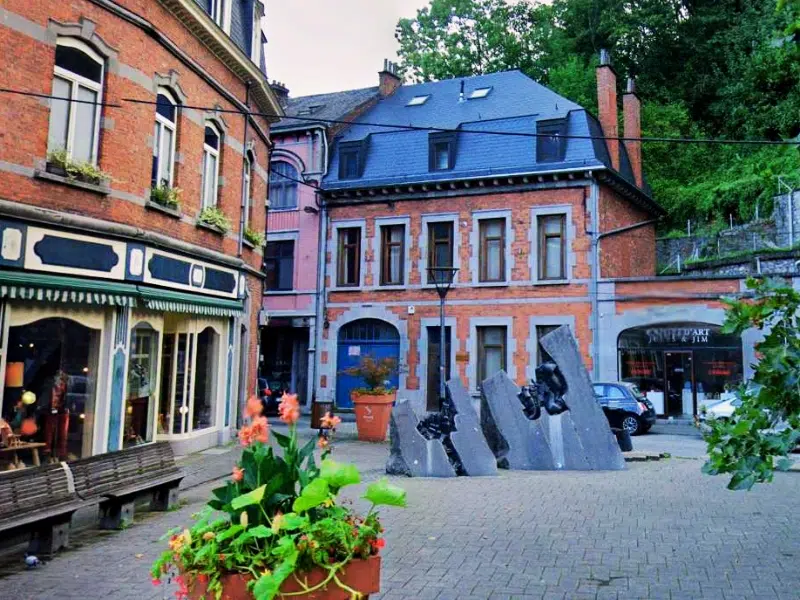
In the Square Lion stands a reproduction of a sculpture by Antoine Wiertz, the Romantic painter and sculptor who was born in Dinant on 22 February 1806 and became known in Brussels for huge allegorical canvases. The Triumph of Light shows a figure holding up a torch, and Wiertz imagined it towering over the rock of Dinant. It is often said that the figure inspired Bartholdi's Statue of Liberty in New York, but this is a story, not an established fact. Another copy was given to San Francisco in 1887 and stood there until it disappeared in the 1950s.
- The torch held high, and the street named after Wiertz in his home town.
The citadel
The citadel stands on the cliff about 100 metres above the Meuse, right behind the collegiate church. The first castle here was built in the 11th century by the prince-bishops of Liège; it was destroyed and rebuilt several times, and French troops destroyed it in 1703. The fortress you see today was built by the Dutch between 1818 and 1821, when Belgium was part of the United Kingdom of the Netherlands.
In August 1914 French troops held the citadel during the Battle of Dinant, and in May 1940 German artillery fired on it while Rommel's 7th Panzer Division crossed the Meuse at Leffe. Today it is a museum, reached by a cable car or by steps from the town, with a First World War section, a reconstructed trench and old cells.
- The view straight down onto the onion-shaped tower of the collegiate church and the bridge.
- Outside, the monument L'Assaut by Alexandre Daoust and the French military cemetery from the Battle of Dinant.
The Rocher Bayard
South of the town, on the right bank of the Meuse between Dinant and Anseremme, a needle of rock about 40 metres high stands apart from the cliff, with the road running through the gap. According to legend, the four Aymon brothers fled from Charlemagne on their magic horse Bayard, which leapt across the Meuse and split the rock with its hoof. The real story is less heroic: soldiers of Louis XIV cut the passage when they occupied Dinant, and the road was later widened for cars.
- The memorial at its foot to Maurice Defoin, a motorcycle racer and founder of the Union Motor company, who died in 1927.
Abbey of Leffe
At the northern edge of town, the Abbey of Notre-Dame de Leffe was founded in 1152 as a priory of the Premonstratensian canons and became an abbey in 1160. Its history is a long run of disasters: it was burned when Philip the Good sacked Dinant in 1466, plundered in later wars, and closed and sold off after the French Revolution, when its church was demolished. It served as a glassworks, a paper mill and a linen factory before French canons bought it back in 1902.
A community of canons still lives here. The abbey name has been used on beer since 1954, when the brewing tradition was revived, but the beer is now brewed by a large brewing group, not by the monks.
- The abbey church with its great wooden vault, and the organ built in 1996.
The Royal Halt of Ardenne
Up the Lesse valley from Dinant, near Houyet, the railway line 166 passes a small station in the woods. In 1874 King Leopold II had the Royal Château of Ardenne built nearby by the architect Alphonse Balat, and later had it run as a luxury hotel. The halt opened around 1898 as a private stop for the hotel's guests, who went on to the château by carriage.
It closed for good in 1909, after the king's death, and today belongs to the Royal Trust, which keeps it standing. It is not on our route and the trains no longer stop there, but it is a curious sight for anyone exploring the valley.
How to see them in one walk
Start at the citadel, going up by cable car or on foot, and come back down to the collegiate church. Walk along the river to Rue Adolphe Sax and the statue on its bench, then find the Triumph of Light in the Square Lion. For the Rocher Bayard, follow the right bank south towards Anseremme; for the Abbey of Leffe, walk north along the river instead. Leave the royal halt near Houyet for a separate trip up the Lesse valley.
See Dinant with World City Trail
Our Dinant scavenger hunt turns the town into a game you play on your phone. The route links 10 stops, from the memorial to the victims of 23 August 1914 to the Regional Cultural Centre, and the Adolphe Sax monument and the Triumph of Light on the Square Lion are stops, along with the collegiate church, the Charles de Gaulle bridge and statue, the Maison de Monsieur Sax and the saxophone monuments. At each stop you solve a puzzle and learn a story, at your own pace.
There is also a self-guided walking tour and an outdoor escape game in Dinant, for people who prefer a different format.
Play the Dinant scavenger hunt →
Take the self-guided walking tour of Dinant →
Play the outdoor escape game in Dinant →
Facts checked in October 2026.