
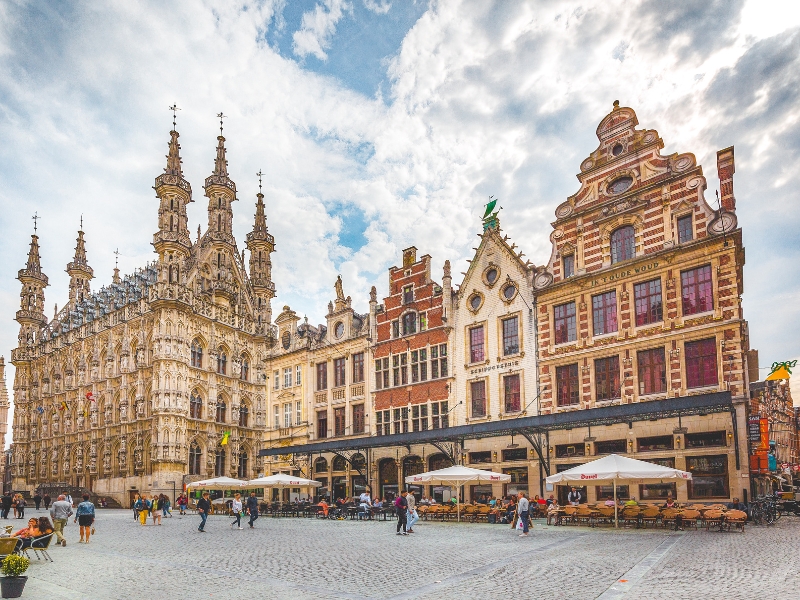
Leuven is a university town before it is anything else, and the places in this guide all carry the mark of that: a Jesuit church built for a college, a square named after the American who fed Belgium in the First World War, a statue of a student with his head full of wisdom, the walled beguinage the university saved, and the castle it was given. Three of them are stops on our scavenger hunt, and all of them sit a little away from the Grote Markt and the Oude Markt, so they make a good second walk once you have seen the main squares.
St Michael's Church (Sint-Michielskerk)
The Jesuits arrived in Leuven in 1542, and their college here trained priests until the order was suppressed in 1773. Their church on Naamsestraat was begun in 1650 and finished in 1671, to designs by the Jesuit father Willem van Hees. The church is an elegant example of Baroque, and its tall facade rises straight from the narrow street, so you have to tilt your head back to take it in.
The church has had a hard time since. Bombs in the Second World War brought down the vault of the nave in 1944, and it was rebuilt between 1947 and 1950. By 1983 it was in such poor condition that it had to close, and it only reopened in 1998 after a full restoration.
- The facade, best seen from the opposite side of Naamsestraat.
- The vault of the nave, rebuilt after it collapsed in the bombing of 1944.
Herbert Hooverplein
This square takes its name from Herbert Hoover, who later became president of the United States. In 1914, when Belgium was occupied, he led the Commission for Relief in Belgium, a mostly American organisation run on voluntary work that shipped about 5.7 million tons of food to occupied Belgium and northern France until 1919. It bought the food abroad, got the ships through under safe-conduct agreements and supervised how the food was handed out inside the country, feeding around 9.5 million civilians. Leuven's link to him is close: the university library on the nearby Ladeuzeplein, burned by German troops in 1914, was rebuilt in the 1920s largely with American money.
- The open space itself, a meeting point between the library quarter and the shopping streets; it is one of the scavenger hunt stops.
Fonske
Fonske is the nickname of Fons Sapientiae, the 'fountain of wisdom': a student reading a book while he pours a glass of liquid over his own head. Students like to say it is beer. The statue is by the artist Jef Claerhout and was given to the city in 1975 for the 550th anniversary of the university, which was founded in 1425.
Like the Manneken Pis in Brussels, Fonske is sometimes dressed up in costumes by student associations for special occasions. It stands on the Rector De Somerplein, just off the Grote Markt, and it is the last stop of our scavenger hunt, so it is a good place to finish a walk with a drink in one of the cafés nearby.
- The open book and the stream of water falling from the glass into his head.
Groot Begijnhof
The Great Beguinage is a small walled town of its own in the south of the city centre, beside the river Dyle. Beguines were religious women who lived in a community without taking lifelong vows. The oldest written records of the Leuven beguinage date from 1232, though the community is probably a few decades older. It has almost 100 houses, with some 300 apartments, set along cobbled streets and around small squares.
In 1962 the university bought the whole beguinage from the city's welfare commission and restored it between 1964 and 1989; today students and guest researchers live in the houses. In 1998 it was added to the UNESCO World Heritage list together with other Flemish beguinages, and it is often called one of the best preserved in the world.
- The church, an early Gothic basilica with Romanesque elements.
- The Dyle flowing through the beguinage, crossed by small bridges between the rows of houses.
Arenberg Castle
South of the centre, in Heverlee, Arenberg Castle was built in the 16th century in Renaissance style and heavily remodelled in neo-Gothic style in the 19th century. In 1916 the Duke of Arenberg gave the estate to the university, and it now stands at the centre of a campus for science and engineering. The grounds are open to the public, and it is a pleasant walk or bike ride out of town. If you want one more view from a hill, the Keizersberg on the north side of the centre is where Leuven's own castle stood until it was demolished in 1782; a Benedictine abbey in neo-Romanesque style was founded there in 1888 and is still home to monks.
- The castle and the park around it, now part of the university campus.
How to see them in one walk
Start on the Grote Markt and step around the corner to Fonske on the Rector De Somerplein. Walk south along Naamsestraat to St Michael's Church, then continue to the Groot Begijnhof by the river. For Herbert Hooverplein, head back north and east towards the Ladeuzeplein and the university library. Arenberg Castle is further out, in Heverlee: keep it for a separate trip by bike or on foot through the park.
See Leuven with World City Trail
Our Leuven scavenger hunt turns the old centre into a game you play on your phone. The route links 10 stops, from M Leuven to the Fonske statue, and Herbert Hooverplein, St Michael's Church and Fonske are all stops, along with the Ladeuzeplein, Sint-Donatus Park, the Oude Markt, the Grote Markt, the Town Hall and St Peter's Church. At each stop you solve a puzzle and learn a story, at your own pace.
There is also a self-guided walking tour and an outdoor escape game in Leuven, for people who prefer a different format.
Play the Leuven scavenger hunt →
Take the self-guided walking tour of Leuven →
Play the outdoor escape game in Leuven →
Facts checked in October 2026.