
Most visitors to Carcassonne head straight up to the walled Cité. This guide covers five places that complete the picture, mostly in the lower town, the Bastide Saint-Louis: Square André Chénier by the Canal du Midi, the Musée des Beaux-Arts, the Church of Saint-Vincent, the Porte d'Aude on the western side of the Cité, and the dark chapter of the Inquisition in Carcassonne. It follows on from our first Carcassonne guide, which covers the ramparts, the Château Comtal, Saint-Nazaire, the Pont Vieux, Place Carnot and Saint-Michel.
Square André Chénier
Square André Chénier is a public garden on the northern edge of the Bastide, between the old town and the railway station, with the Canal du Midi running between the garden and the station. It is named after André Chénier, the French poet who was guillotined in Paris in 1794, during the Terror, at the age of 31. For most people arriving by train it is the first green space they cross on the way into town, and it is the first stop of our scavenger hunt.
The canal beside the garden is worth a look in its own right. The Canal du Midi, built between 1666 and 1681 under the engineer Pierre-Paul Riquet, links Toulouse with the Mediterranean, and together with the Garonne it gave France a waterway between the Atlantic and the Mediterranean. It has been a UNESCO World Heritage Site since 1996. Barges and boats still use it, and you can walk along the towpath.
Musée des Beaux-Arts
Carcassonne's fine arts museum was founded in 1836 by local lovers of art, history and archaeology, and it stands on rue de Verdun in the Bastide, in the former présidial, the old royal court building. Its facade was completed in 1900 and fully restored in 2015. The collection is mainly paintings from the 16th to the 20th century, by European painters. It is one of the scavenger hunt stops.
- Chardin's La Table d'office, painted in 1756, a still life of a table prepared for a meal; its companion piece, The Kitchen Table, is in the Museum of Fine Arts in Boston.
- A large group of works by Jacques Gamelin, the 18th-century painter who was born in Carcassonne.
- Paintings by José de Ribera, Salvator Rosa, Jan Brueghel the Elder, Hubert Robert, Ingres, Corot and Courbet, and faience from Moustiers, Marseille and Delft.
Church of Saint-Vincent
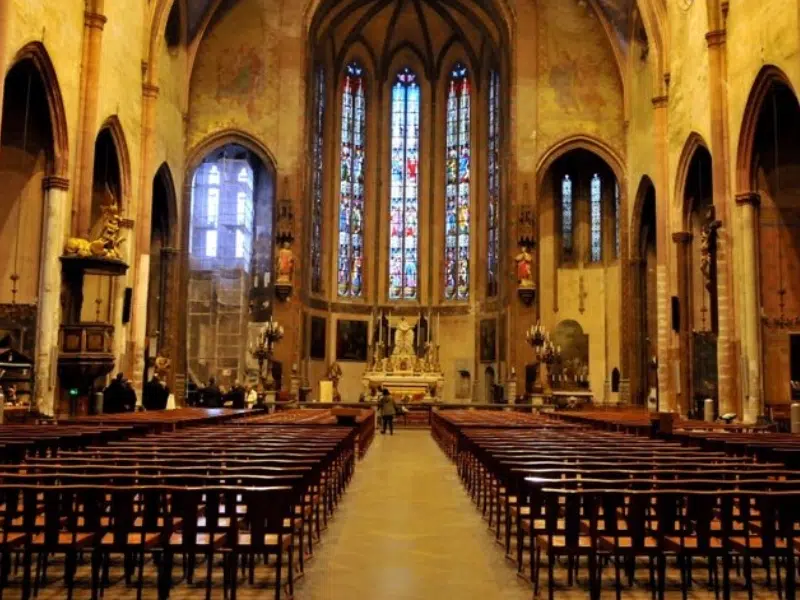
From almost anywhere in the Bastide you can see the bell tower of Saint-Vincent, about 54 metres high. The church was begun in the 1320s, and the nave took about sixty years to finish. It is built in the southern Gothic style of Languedoc: a single huge nave with no aisles and no pillars in the middle. At 20.15 metres wide, it was for a century the widest Gothic nave in the world and for five and a half centuries the widest in France; today it is listed as the second widest in France.
The tower also played a part in science. The Cassini family used it for their map of France, and in 1798 the astronomers Pierre Méchain and Jean-Baptiste Delambre used it as a survey point while measuring the meridian between Dunkirk and Barcelona, the measurement on which the original metre was based.
- The width of the nave: stand at the back by the entrance and look at the span of the vault, with nothing to hold it up in the middle.
- The carillon in the tower, with 54 bells, and the great organ inside, a listed historic monument since 1984.
Porte d'Aude
The Porte d'Aude is the western gate of the Cité, facing the river Aude, next to the Château Comtal. It was the way up from the river side of the hill. From the site of the former Aude barbican at the bottom, a ramp climbs the steep western slope in zigzags and passes two gates before reaching the walls. The gate is partly Visigothic, and the large bretèche, the projecting box above the gate from which defenders could drop objects, was added by Viollet-le-Duc. It is a stop on our scavenger hunt.
- High arcades along the climb that hide false doors, built to mislead attackers.
- The zigzag passages and landings near the top, designed to slow down and trap anyone forcing their way in.
The Inquisition in Carcassonne
Carcassonne was at the centre of the struggle against the Cathars in the 13th century. Saint Dominic preached here during Lent in 1213, and in 1234 a tribunal of the Inquisition was set up in the town, to track down people suspected of heresy. Inside the Cité, the house of the Inquisition can still be seen.
Not everyone in Carcassonne accepted it. Around 1299 Bernard Délicieux, a Franciscan friar and prior of the town's Franciscan convent, led a revolt that stopped the arrest of two suspected heretics sheltered there, and in 1300 he accused the inquisitors of falsifying their registers. In 1303, after one of his sermons, a riot broke out and the prisoners were moved from the inquisitor's prison to the royal one. The story ended badly for him: in 1319 he was tried in Carcassonne and sentenced to life in solitary confinement, and he died in early 1320.
How to see them in one walk
Start at Square André Chénier and walk south into the Bastide to the Musée des Beaux-Arts. Continue through the grid of streets to the Church of Saint-Vincent, then head for the river and the Pont Vieux. On the far side, follow the path up the western slope to the Porte d'Aude and enter the Cité, where you can look for traces of the Inquisition's history among the old streets. The climb to the Porte d'Aude is steep, so take your time.
See Carcassonne with World City Trail
Our Carcassonne scavenger hunt turns the Bastide and the Cité into a game you play on your phone. The route links 10 stops, starting at Square André Chénier and finishing at the Porte Narbonnaise, and the Musée des Beaux-Arts and the Porte d'Aude are on it too. The other stops are Place Carnot, Saint-Michel, the Pont Vieux, the Basilica of Saint-Nazaire, the Château Comtal and the ramparts. At each stop you solve a puzzle and learn a story, at your own pace.
There is also a self-guided walking tour and an outdoor escape game in Carcassonne, for people who prefer a different format.
Play the Carcassonne scavenger hunt →
Take the self-guided walking tour of Carcassonne →
Play the outdoor escape game in Carcassonne →
Facts checked in October 2026.