
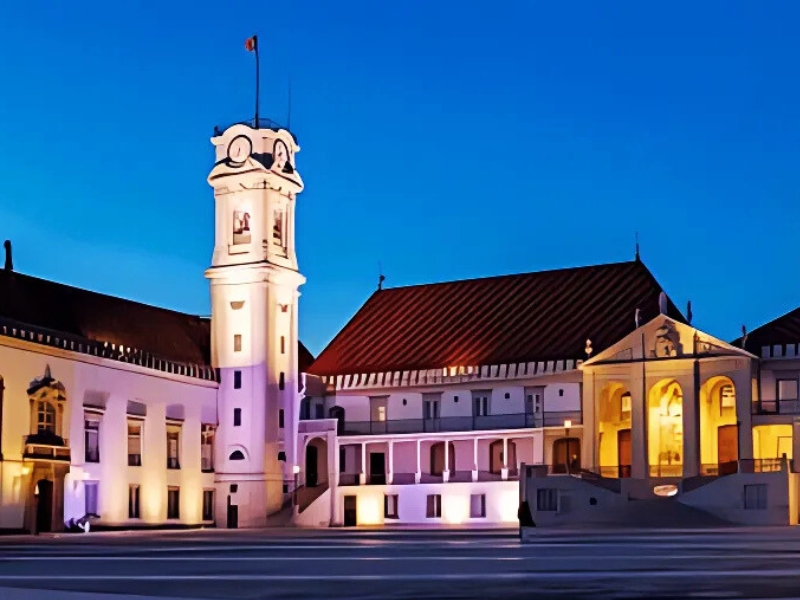
The top of the hill in Coimbra belongs to the university. Founded in 1290 and settled here for good in 1537, it fills the old royal palace and the streets around it, and since 2013 the University of Coimbra, Alta and Sofia, has been a UNESCO World Heritage Site. This guide covers the places on and around that hilltop: the palace courtyard and its tower, the Joanina Library, the Great Hall and the Chapel of São Miguel, Praça Dom Dinis, the National Museum Machado de Castro, the Botanical Garden and the aqueduct that runs past it. For the cathedrals and the lower town, see our guide to Coimbra's old town.
The University of Coimbra and the Paço das Escolas
King Dinis founded Portugal's first university in 1290 in Lisbon. For more than two centuries it moved back and forth between Lisbon and Coimbra, until King João III moved it to Coimbra for good in 1537 and installed it in the royal palace on the hilltop, the old Moorish citadel. The university bought the palace from the crown in 1597, and it has been known since as the Paço das Escolas, the Palace of the Schools.
The buildings stand around one large courtyard, the Pátio das Escolas, open on one side to a view over the river. It is the setting for the ceremonies of the academic year, and you will often see students in their black capes crossing it.
- The Porta Férrea, the main gate into the courtyard, a double-faced triumphal arch from 1634 with figures of King Dinis and King João III, the two kings who founded and settled the university.
- The Via Latina, the long colonnade on the main facade, in its present form since 1773; its name recalls Latin, the language of teaching until the reforms of 1772.
- The University Tower, built between 1728 and 1733 to a design by the Italian architect António Cannevari. Of its four bells, the best known is nicknamed the Cabra (the goat), and you can climb the tower for views over Coimbra.
The Joanina Library
The Biblioteca Joanina was built between 1717 and 1728 and is named after King João V, who paid for it. Its three rooms, divided by decorated arches, are lined with two-storey bookcases, gilded or painted to look like exotic woods, with Chinese-style motifs painted by Portuguese artists. At the end hangs a large portrait of João V by Domenico Duprà, dated 1725. The walls are more than two metres thick, and with its heavy teak door the building keeps a steady, cool temperature that protects the books.
The library is also known for its bats. A colony lives inside and eats the insects that would damage the books at night; staff cover the tables with leather every evening and clean them every morning. The floor below once held the academic prison, where students who broke university rules were locked up.
- The wooden ladders and balconies of the upper shelves, and the portrait of the king at the far end of the rooms.
The Great Hall and the Chapel of São Miguel
The Sala dos Capelos, also called the Sala Grande dos Atos, was the palace's throne room. In the 1380s the Cortes met in the palace and proclaimed João, Master of Avis, king of Portugal. The hall is still used for doctoral exams and the solemn opening of the academic year, under a painted ceiling and rows of portraits of Portuguese kings. The Chapel of São Miguel next to it was built in the 16th century under King Manuel I and has a Manueline portal.
- The Baroque organ in the Chapel of São Miguel, from 1733, which still works.
Praça Dom Dinis and the Monumental Stairs
Praça Dom Dinis is the square near the top of the hill, close to the Porta Férrea, named after the king who founded the university. Below it, the Monumental Stairs climb the slope in five flights of 25 steps, 125 in all. The square and the faculty buildings around it belong to the 20th-century rebuilding of the university district, which replaced many of the old streets of the Alta.
The National Museum Machado de Castro
The museum, which opened in 1913, is named after Joaquim Machado de Castro, an 18th-century sculptor. It fills the former Bishop's Palace, built from the Middle Ages onwards roughly on the site of the forum of Aeminium, the Roman town under Coimbra. Its sculpture collection is the largest of any Portuguese national museum, and most of its works of art come from churches and convents in and around Coimbra.
The biggest surprise is underground. To build the forum on the sloping hill, the Romans raised it on a cryptoporticus, a set of vaulted galleries, and you can walk through them on the museum's lower floors. A renovation between 2004 and 2012 added a new building and won the Piranesi Prix de Rome in 2014.
- The Roman cryptoporticus, a maze of stone galleries under the museum.
The Botanical Garden
The Marquis of Pombal founded the university's Botanical Garden in 1772 as part of his reform of the university, so that students of natural science could study living plants. Its first director was the Italian naturalist Domingos Vandelli, and from 1791 the Portuguese botanist Félix Avelar Brotero ran it. It covers about 13 hectares on the slope below the university.
The garden has two parts: formal terraces at the top, with the Central Square, its oldest area, and order beds where plants are grouped by family, and the Mata, a wooded valley below. The greenhouses hold tropical and subtropical plants, including the giant water lily Victoria cruziana.
- The Central Square, with its fountain from the 1940s and trees planted in Brotero's time.
- The bamboo forest in the Mata and a large Moreton Bay fig (Ficus macrophylla).
The Aqueduct of São Sebastião
Right in front of the Botanical Garden, on Calçada Martim de Freitas, the Aqueduct of São Sebastião crosses the dip between two hills on 21 arches. Locals call it the Arcos do Jardim. It was built in the late 16th century, in the reign of King Sebastião, to a design by the Italian Filippo Terzi, probably along the line of a Roman aqueduct that supplied the upper town. On top of its main arch stand statues of St Roch and St Sebastian. It is not one of our scavenger hunt stops, but you pass it on the way to the garden.
How to see them in one walk
Start at the National Museum Machado de Castro, then walk up to Praça Dom Dinis and through the Porta Férrea into the Pátio das Escolas. Visit the Joanina Library, the Great Hall and the Chapel of São Miguel, and climb the tower if you have the energy. Leave the hilltop past the Monumental Stairs and follow the streets downhill to the Aqueduct of São Sebastião and the gate of the Botanical Garden, which is a good place to end.
See Coimbra with World City Trail
Our Coimbra scavenger hunt turns the old town into a game you play on your phone. The route links 10 stops, from the Church of Santa Cruz to the Botanical Garden, and the National Museum Machado de Castro, the University of Coimbra, the Minerva Stairs, Praça Dom Dinis and the Botanical Garden are all stops, along with Praça do Comércio, the Barbican Gate, the Old Cathedral and the New Cathedral. At each stop you solve a puzzle and learn a story, at your own pace.
There is also a self-guided walking tour and an outdoor escape game in Coimbra, for people who prefer a different format.
Play the Coimbra scavenger hunt →
Take the self-guided walking tour of Coimbra →
Play the outdoor escape game in Coimbra →
Facts checked in October 2026.