
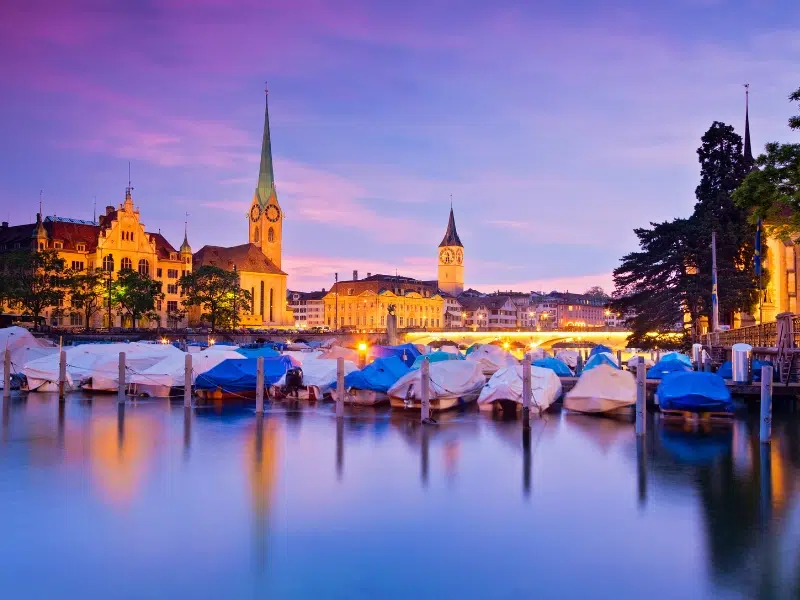
Zurich's old town lines both banks of the Limmat, the river that flows out of Lake Zurich, and its best-known buildings stand close to the water. This guide covers six of them: the church of St. Peter with its giant clock, the Town Hall built over the river, the twin-towered Grossmünster, the Opera House, the lake shore and the lanes of the Niederdorf. All six are stops on our scavenger hunt, and they fit into one walk.
St. Peter
St. Peter stands on a small rise on the left bank, and you notice its tower before anything else: the clock faces measure about 8.7 metres across, the largest church clock faces in Europe. All four sides of the tower have had dials since 1538. Curiously, church and tower have different owners. The tower belongs to the city, which once used it as a lookout, and a fire watch lived up there until 1911. The nave belongs to the Reformed parish.
Before the Reformation St. Peter was Zurich's only parish church, and churches stood on this spot from around the year 1000. The present nave was consecrated in 1706, the first church built in Zurich under Protestant rule. Leo Jud, a friend of the reformer Zwingli who worked on the Zurich Bible translation, was its first Reformed pastor, and the writer and thinker Johann Kaspar Lavater served here from 1778 to 1801.
- The clock faces themselves: stand in the little square in front of the church to take in their size.
- Lavater's gravestone, set into the wall of the church.
Zurich Town Hall (Rathaus)
The Town Hall stands on the right bank, its foundations anchored in the Limmat itself, so the river flows right along its walls. It was built between 1694 and 1698 to replace a council hall from 1397, which in turn had replaced a 13th-century courthouse. For about 300 years the building has been the seat of Zurich's two parliaments, the cantonal council (Kantonsrat) and the city council (Gemeinderat).
For now, both parliaments meet in a temporary hall elsewhere in the city while a renovation of the old building is planned. The plans have been delayed by a legal dispute with heritage groups, so the outside, seen from the river bank and from the Rathausbrücke, is what most visitors will see.
Grossmünster
The Grossmünster's twin towers are the symbol of Zurich. The church was begun around 1100 and was in use by about 1220. According to legend, Charlemagne founded it: his horse knelt down on the spot where the city's patron saints Felix and Regula were buried. The same legend says the two martyrs, beheaded by the Romans, carried their heads up the hill to the place of their grave.
This is also where the Swiss Reformation began. Huldrych Zwingli became the people's priest of the Grossmünster at the start of 1519, and from his pulpit he preached the ideas that turned Zurich Protestant. The towers were built in the late 15th century; after a fire destroyed their wooden spires in 1763, they received their present neo-Gothic tops in 1787.
- The seated figure of Charlemagne on the south tower, the Karlsturm; the 15th-century original is kept in the crypt.
- The stained glass: the choir windows by Augusto Giacometti from 1932, and a modern series by Sigmar Polke from 2009, some made of thin slices of agate.
- The bronze doors by Otto Münch on the north and south portals, from 1935 and 1950, covered with relief scenes.
Zurich Opera House
The Opera House stands at the edge of the lake on Sechseläutenplatz. An earlier theatre on the site, the Aktientheater, opened in 1834 and burned down in 1890. Its replacement was designed by the Viennese firm Fellner & Helmer, who built theatres all over Central Europe, and it opened in 1891 as the Stadttheater with Wagner's Lohengrin. It has been called the Opera House since 1964.
The building was renovated from 1982 to 1984. The project was controversial: in May 1980, protests against the large public money spent on the opera, while young people lacked places of their own, grew into the youth riots known as the Opernhauskrawalle. Today the house seats around 1,100 people.
- The busts on the neoclassical facade: the composers Weber, Wagner and Mozart, and the writers Schiller, Shakespeare and Goethe.
Lake Zurich and the quays
Zurich did not always face its lake. Until the 1880s most of the shore was private land, and a writer of the time noted that Zurich had a lake but did not see it. Between 1881 and 1887 the city built the Quaianlagen, a long row of public promenades along the shore, under the engineer Arnold Bürkli. The square where the Limmat leaves the lake, Bürkliplatz, is named after him.
Today the quays form a continuous promenade on both sides of the lower lake, linked by the Quaibrücke at the outflow of the river. On the right bank, the Utoquai leads past the Seebad Utoquai, a bathing house on stilts that opened in 1890 and was the first place in Zurich where men and women could swim together.
- Bürkliplatz, where the passenger boats leave for trips on the lake.
- The Quaibrücke, with views down the lake on one side and up the Limmat to the old town on the other.
Altstadt and the Niederdorf
On the right bank, the lanes between the Central square and the Grossmünster form the Niederdorf, the liveliest part of the old town, with the Niederdorfstrasse as its main street. Behind the shops are some remarkable addresses. On the Spiegelgasse, at number 1, Hugo Ball and Emmy Hennings opened the Cabaret Voltaire on 5 February 1916, where the art movement Dada was born.
A few doors up, at number 14, Lenin lived from February 1916 until he left for Russia in April 1917; a plaque marks the house. The playwright Georg Büchner died at number 12 in 1837, and the writer Gottfried Keller grew up at Rindermarkt 9.
- The Cabaret Voltaire at Spiegelgasse 1, still a venue for art and events.
- The Polybahn, a small funicular that climbs from the old town to ETH Zurich.
How to see them in one walk
Start at St. Peter, then walk down to the river and cross the Rathausbrücke to see the Town Hall from the water. Follow the river south to Bürkliplatz and the lake, cross the Quaibrücke to the Opera House on Sechseläutenplatz, and walk back along the Limmatquai to the Grossmünster. From there it is only a few steps up into the Niederdorf and the Spiegelgasse.
See Zurich with World City Trail
Our Zurich scavenger hunt turns the old town into a game you play on your phone. The route links 10 stops, and all six places in this guide are among them: St. Peter, the Town Hall, the lake shore, the Opera House, the Grossmünster and the old town. The route starts near the main station at the Swiss National Museum and also takes in Bahnhofplatz, the Pestalozzianlage and the Lindenhof. At each stop you solve a puzzle and learn a story, at your own pace.
There is also a self-guided walking tour and an outdoor escape game in Zurich, for people who prefer a different format.
Play the Zurich scavenger hunt →
Take the self-guided walking tour of Zurich →
Play the outdoor escape game in Zurich →
Facts checked in October 2026.