
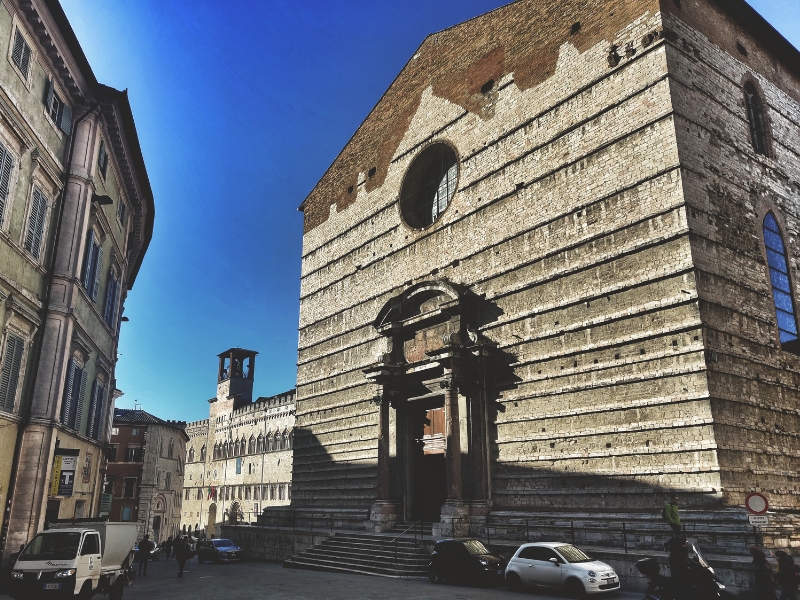
Once you have seen Perugia's great medieval square, there is a second layer to the old town: the paintings, the Baroque churches, the theatre and the long main street where the whole city goes for its evening stroll. This guide covers four of them, the National Gallery of Umbria, the Church of San Filippo Neri, the Teatro Morlacchi and Corso Vannucci with Piazza della Repubblica, all stops on the same walk across the hilltop.
The National Gallery of Umbria (Galleria Nazionale dell'Umbria)
Umbria's main art museum fills the upper floors of the Palazzo dei Priori, with its entrance halfway along Corso Vannucci, where Via dei Priori leaves the main street. The collection goes back to the Accademia del Disegno founded in Perugia in the mid-16th century, which started gathering paintings and drawings. It grew enormously when religious houses were suppressed, first under Napoleon and then under the Kingdom of Italy, and much of the art from Umbria's churches passed to the state. In 1863 the civic collection was named after Pietro Vannucci, the painter better known as Perugino, and in 1878 it moved into the palace; from 1918 it was the Regia Galleria Vannucci, the royal gallery.
The strength of the museum is Umbrian and central Italian painting from the 13th to the 16th century, shown roughly in date order. You walk from early painted crosses through Gothic gold-ground altarpieces to the Renaissance, and you end up with a clear picture of how painting developed in this part of Italy. The tour also passes through the Cappella dei Priori, the chapel of the city's magistrates, frescoed by the Perugian painter Benedetto Bonfigli between 1454 and 1480.
- A large painted Cross by the Master of Saint Francis, dated 1272, and a Madonna and Child by the Sienese painter Duccio di Buoninsegna.
- Piero della Francesca's Polyptych of Sant'Antonio, painted between 1467 and 1469, and a polyptych by Fra Angelico dated 1447.
- Perugino's own works, including the Polyptych of Sant'Agostino, and Pinturicchio's altarpiece of Santa Maria dei Fossi from 1496–1498.
- Benedetto Bonfigli's paintings of Perugia itself, including the Taking of Perugia by Totila: they show the medieval city, its walls and towers, as painters saw it in the 15th century.
The Church of San Filippo Neri (Chiesa Nuova)
Perugia's grandest Baroque church is dedicated to the Immaculate Conception but known as San Filippo Neri or simply the Chiesa Nuova, the New Church. The first stone was laid in May 1627, and the church was finished in 1665 to designs by the Roman architect Paolo Maruscelli. To make room, nine houses, shops and cellars were cleared, together with an early church, the 11th-century baptistery of San Giovanni Rotondo. The travertine facade on Piazza Ferri was built between 1647 and 1663: two orders divided by Corinthian pilasters, a triangular pediment, and a wide double staircase up to the door.
Inside, the high altar holds a large Immaculate Conception by Pietro da Cortona, painted in 1662. The dome was frescoed by Francesco Mancini in 1728 with the Coronation of the Virgin, and the nave vault is by Francesco Appiani, from 1762. The church once owned more: Guido Reni's Assumption was taken during Napoleon's seizures and is now in Lyon, while Pietro da Cortona's Nativity and Andrea Sacchi's Purification went to the National Gallery, where you can see them today.
- From the square, the double flight of steps and the two-storey travertine front, where the coat of arms of the Degli Oddi family once stood until it was removed in the Napoleonic period.
- Look up into the dome for Mancini's Coronation of the Virgin, then down the nave to Pietro da Cortona's altarpiece above the high altar.
The Teatro Morlacchi
Perugia's main theatre was built between June 1778 and April 1780 and opened on 15 August 1781. It was designed by the Perugian architect Alessio Lorenzini for a society of ninety families who wanted a theatre of their own, and it was first called the Teatro Civico del Verzaro. After a renovation by Guglielmo Calderini, it reopened in 1874 under its present name, in honour of Francesco Morlacchi, a celebrated composer born in Perugia.
The auditorium is a classic Italian horseshoe with five tiers of boxes, 27 boxes in each tier. Lorenzini set the whole structure at a slight diagonal, so that every one of the founding families could have its box. The painters Mariano Piervittori and Francesco Moretti worked on the decoration, and today the theatre seats 785 people and is still used for performances.
- If you can, go to a performance: the way to see the inside of an 18th-century box theatre is from one of the boxes, looking across the horseshoe at the tiers opposite.
Corso Vannucci and Piazza della Repubblica
Corso Vannucci is Perugia's main street, running along the top of the hill from Piazza IV Novembre to Piazza Italia. It was once simply the Via del Corso and now bears the name of Pietro Vannucci, Perugino, who was born in nearby Città della Pieve. The street links two hills of the old town, the Colle del Sole and the Colle Landone, across a valley that was filled in long ago, and it has been fully pedestrian since the second half of the 20th century. Perugians call it the city's salotto buono, its best living room, and walking up and down it in the evening is known locally as fare una vasca, doing a length, as in a swimming pool.
Along the way are the Palazzo dei Priori with the entrance to the National Gallery, the 15th-century house of the medieval jurist Baldo degli Ubaldi, the deconsecrated church of Sant'Isidoro and the Palazzo Donini, built in 1716. Roughly halfway along, the Corso widens into Piazza della Repubblica, a natural place to stop and watch the evening stroll go by. At the southern end, Piazza Italia was rebuilt after Umbria joined the Kingdom of Italy in 1861 and became the seat of the regional and provincial governments, which only strengthened the Corso's role as the city's main axis.
- Via dei Priori leads off the Corso into a tangle of medieval alleys with names like Via della Luna and Via delle Streghe, the Street of the Witches.
- On the other side, Via Fani, Via Mazzini and Via Danzetta drop down to Piazza Matteotti, which the street reached in the Middle Ages.
How to see them in one walk
Start at the Teatro Morlacchi, then walk to Piazza Ferri and the Church of San Filippo Neri. Continue up to Corso Vannucci, where the National Gallery's entrance is at the corner of Via dei Priori; give the museum a good part of your visit. Afterwards, stroll down the Corso to Piazza della Repubblica and on to Piazza Italia at the end.
See Perugia with World City Trail
Our Perugia scavenger hunt turns the old town into a game you play on your phone. The route links 10 stops, and five of them are in this guide: the Teatro Morlacchi, the Church of San Filippo Neri, the National Gallery, Corso Vannucci and Piazza della Repubblica. It starts at the Etruscan Arch, also takes in the Cathedral of San Lorenzo, the Palazzo dei Priori and the Fontana Maggiore, and finishes in Via della Viola.
If you prefer a different format, there is also a self-guided walking tour and an outdoor escape game in Perugia.
Play the Perugia scavenger hunt →
Take the self-guided walking tour of Perugia →
Play the outdoor escape game in Perugia →
Facts checked in October 2026.