
This guide covers seven landmarks in central Ottawa that tell the story of the country more than the city: Parliament Hill with the Centennial Flame, the Library of Parliament, the Famous Five monument, the National War Memorial, the Notre-Dame Cathedral Basilica, the Royal Canadian Mint and the statue of Samuel de Champlain. They line the same walk from the Hill along Sussex Drive to the point above the Ottawa River.
Parliament Hill
Canada's Parliament stands on a limestone bluff above the Ottawa River. Its centrepiece, the Centre Block, is not the original: the first building burned down on 3 February 1916 in a fire that killed seven people. It was rebuilt on the same site, and Parliament first sat in the new building on 26 January 1920. The Peace Tower in the middle of its facade was dedicated on 1 July 1927 and is a memorial to Canadians who died in the First World War.
Since the end of 2018 the Centre Block has been closed for a major renovation, expected to last into the 2030s. During the works the House of Commons meets in the West Block and the Senate in the former Union Station on Rideau Street, so you see the Centre Block from the lawn, often behind construction fencing. Parliament Hill and the Centennial Flame are both stops on our scavenger hunt; the Hill is where the route begins.
- The Peace Tower clock and its carved Gothic stonework, which you can see from anywhere on the front lawn.
- The Centennial Flame at the foot of the lawn, first lit on 1 January 1967 for the hundredth anniversary of Confederation, in the presence of Prime Minister Lester B. Pearson. It burns on water inside a fountain ringed by the shields of the provinces and territories; Nunavut's was added in 2017. Coins thrown into the fountain are collected for a research award for people with disabilities.
The Library of Parliament
The round building with the lantern roof behind the Centre Block is the Library of Parliament, the only part of the original Parliament building to survive the 1916 fire. Designed by Thomas Fuller and Chilion Jones and finished in 1876, it was inspired by the round Reading Room of the British Museum. On the night of the fire a clerk, Michael MacCormac, shut its heavy iron doors, and the flames stopped there. The library was restored between 2002 and 2006, and it is closed to visitors while the Centre Block is renovated.
- The sixteen-sided Gothic shape with its flying buttresses, best seen from behind the Hill or from Kìwekì Point across the water.
- Inside, when it reopens: white pine panelling carved with flowers, masks and mythical creatures, and a white marble statue of Queen Victoria by Marshall Wood from 1871.
The Famous Five monument
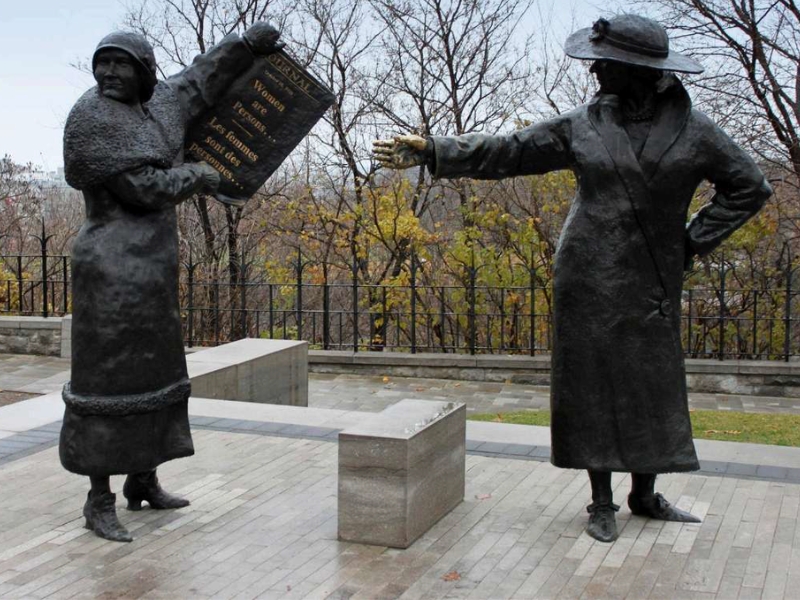
On the east side of Parliament Hill, five bronze women celebrate a legal victory. In 1927 Emily Murphy, Nellie McClung, Irene Parlby, Louise McKinney and Henrietta Muir Edwards asked the courts whether women counted as 'persons' who could be appointed to the Senate. The Supreme Court of Canada said no in 1928, but on 18 October 1929 the Judicial Committee of the Privy Council in London overturned that decision, describing Canada's constitution as 'a living tree capable of growth and expansion'. The monument, Women Are Persons! by Barbara Paterson, was placed on the Hill in 2000, a year after its twin was unveiled in Calgary. It is one of our scavenger hunt stops.
- The empty chair beside Emily Murphy: visitors are invited to sit down and join the celebration.
The National War Memorial
The tall granite arch in Confederation Square is the National War Memorial, also called The Response. It was designed by the British sculptor Vernon March, who won a competition in 1926; after his death in 1930 his brothers and sister finished the work. King George VI dedicated it on 21 May 1939 in front of a crowd of about 100,000. First built for the First World War, it was rededicated in 1982 to include the Second World War and the Korean War, and in 2014 the South African War and the mission in Afghanistan. It is one of the stops on our scavenger hunt.
- The 22 bronze figures pushing through the arch, soldiers, sailors, airmen, nurses and others, with figures of Peace and Freedom on top.
- The Tomb of the Unknown Soldier in front, holding an unidentified Canadian soldier of the First World War brought from a war cemetery in France, dedicated on 28 May 2000. Sentries stand guard here in the warmer months; in 2014 Corporal Nathan Cirillo was shot dead while on duty at the memorial.
The Notre-Dame Cathedral Basilica
Across Sussex Drive from the National Gallery, the twin silver spires of Notre-Dame mark Ottawa's oldest surviving church and its largest. A small wooden church stood here from 1832, and the present stone church was built in the 1840s, with its main structure finished in 1846; the Gothic Revival interior followed between 1876 and 1885. Pope Leo XIII made it a minor basilica in 1879, and it has been a National Historic Site since 1990. It is one of the stops on our scavenger hunt.
- The gilded statue of the Madonna on the facade, which can be seen from Parliament Hill.
- Inside, the deep blue vault and the carved wooden statues around the choir by Louis-Philippe Hébert, one of Quebec's best-known sculptors.
The Royal Canadian Mint
The castle-like stone building further along Sussex Drive is the Royal Canadian Mint. It opened on 2 January 1908 as the Ottawa branch of Britain's Royal Mint, when the Governor General, Earl Grey, and Lady Grey started the presses; the first coin struck was a 50-cent piece. It was declared a National Historic Site in 1979 as a symbol of Canada taking control of its own currency. Today the Ottawa plant makes collector coins, while everyday circulation coins are struck in Winnipeg. It is one of our scavenger hunt stops.
- The Tudor-Gothic facade with its battlements; in 2007 the mint produced a 100-kilogram coin of 99.999 per cent pure gold with a face value of one million dollars.
The statue of Samuel de Champlain
At the top of Kìwekì Point, the hill between the National Gallery and the Alexandra Bridge, stands a bronze of Samuel de Champlain, the French explorer who travelled up the Ottawa River in the early 17th century. It was made by Hamilton MacCarthy in 1915. The hill was called Nepean Point until 2022, when it was renamed to highlight the Algonquin language and culture; the name means 'returning to one's homeland'. It was closed for redevelopment from 2019 and reopened in May 2025. The statue is the last stop of our scavenger hunt.
- Champlain's astrolabe, the navigation instrument he holds up high: the sculptor put it in his hand upside down. The kneeling Anishinaabe scout who once sat at his feet was moved to Major's Hill Park and renamed Kitchi Zibi Omàmìwininì in 2013.
How to see them in one walk
Start on the front lawn of Parliament Hill at the Centennial Flame, then walk east across the Hill to the Famous Five monument. Leave the Hill for Confederation Square and the National War Memorial. Cross the Rideau Canal and head north on Sussex Drive to the Notre-Dame Cathedral Basilica, then on to the Royal Canadian Mint. Walk back to the National Gallery and climb Kìwekì Point to Champlain, where you can also look back at the Library of Parliament across the water.
See Ottawa with World City Trail
Our Ottawa scavenger hunt turns the city centre into a game you play on your phone. The route links 10 stops, from Parliament Hill to the statue of Samuel de Champlain, and Parliament Hill, the Centennial Flame, the Famous Five, the National War Memorial, Notre-Dame, the Mint and Champlain are all stops, along with the Rideau Canal locks, Major's Hill Park and the National Gallery of Canada. At each stop you solve a puzzle and learn a story, at your own pace.
There is also a self-guided walking tour and an outdoor escape game in Ottawa, for people who prefer a different format.
Play the Ottawa scavenger hunt →
Take the self-guided walking tour of Ottawa →
Play the outdoor escape game in Ottawa →
Facts checked in October 2026.