
This guide covers seven places in Warsaw that line up along one natural walk: the New and Old Towns on the escarpment above the Vistula, the Royal Castle at their southern edge, and the Tomb of the Unknown Soldier with the Saxon Garden a little further south-west. Almost all of it was destroyed in the Second World War and rebuilt with great care, which is why the Old Town is on the UNESCO World Heritage List. Taken together, these places tell the city's story from its medieval beginnings to its rebirth after 1945.
Church of the Visitation of the Blessed Virgin Mary
The brick Church of the Visitation stands on the edge of the escarpment in the New Town, looking out over the river. Its foundation stone was laid in 1409 by Duke Janusz I the Old of Masovia and his wife Danutė, and it is one of the few Gothic buildings left in Warsaw. German forces wrecked it during the Second World War, bringing down the roof and blowing up the top of the tower, and it was rebuilt between 1947 and 1966. It is the first stop of our scavenger hunt.
- The free-standing bell tower, added in 1518, which already appears in the oldest views of the city.
- The small park behind the church, with steps leading down the slope towards the Vistula.
New Town Market Square
Despite its name, the New Town is old: it grew up around 1400 just north of the walled Old Town and remained a separate town, with its own town hall, until 1791. Its market square is calmer and greener than the Old Town square and is a scavenger hunt stop. On its eastern side stands the domed Church of St Kazimierz of the Sacramentine Sisters, designed by Tylman van Gameren and built in the late 17th century. A few steps away, at Freta Street 16, Marie Skłodowska-Curie was born in 1867.
- The white façade and dome of St Kazimierz, one of the most elegant Baroque churches in the city.
- The house at Freta 16, marked with a plaque and now a small museum about the Nobel Prize winner.
Krasiński Garden
West of the New Town lies Krasiński Garden, laid out from 1676 as the Baroque garden of the Krasiński Palace, built for the voivode Jan Dobrogost Krasiński to a design by Tylman van Gameren. The state bought the estate in the 1760s and opened the garden to the public on 1 April 1768. Its present look, with winding paths and a pond, dates from a redesign in the 1890s by the city gardener Franciszek Szanior, and it was restored again in 2012–2014. The garden is one of the scavenger hunt stops.
- The long façade of the palace, which now holds special collections of the National Library; the reliefs in its pediments are by Andreas Schlüter.
- The pond with its sculpture of fishermen, and just outside the garden, on Krasiński Square, the Warsaw Uprising Monument unveiled in 1989.
Old Town Market Square
For centuries this square was the centre of Warsaw's life, surrounded by the tall houses of rich merchants. After the Warsaw Uprising in 1944, German troops blew up the Old Town street by street. It was rebuilt in the late 1940s and early 1950s with the help of old prints, photographs, measurements made by students before the war and the 18th-century city views painted by Bernardo Bellotto. UNESCO listed the Old Town in 1980 as an exceptional example of near-total reconstruction. The square is a stop on the scavenger hunt.
- The Warsaw Mermaid with sword and shield in the middle of the square; the original bronze by Konstanty Hegel from 1855 is kept in the Museum of Warsaw and a copy stands outside.
- The names of the four sides, each honouring an 18th-century figure: Dekert, Barss, Kołłątaj and Zakrzewski.
- The Museum of Warsaw, which occupies a whole row of houses on the Dekert side.
The Royal Castle
The Royal Castle closes the Old Town on its southern side, facing Castle Square. A castle of the Dukes of Masovia stood here from the 14th century; after King Sigismund III Vasa moved his court from Kraków around 1600, it became the residence of the kings and the meeting place of parliament. The Constitution of 3 May 1791, often called the first modern written constitution in Europe, was adopted here. The castle burned after German shelling on 17 September 1939 and was blown up in 1944. Rebuilt from 1971, largely with donations from Poles at home and abroad, it is now a museum and a scavenger hunt stop.
- The clock on the Sigismund Tower: it stopped at 11:15 when the castle was hit in 1939, and was set going again at the same time on 19 July 1974, during the rebuilding.
- Sigismund's Column in Castle Square, raised in 1644 in honour of King Sigismund III Vasa.
- Two paintings by Rembrandt inside the castle, given to it by Karolina Lanckorońska in 1994.
Tomb of the Unknown Soldier
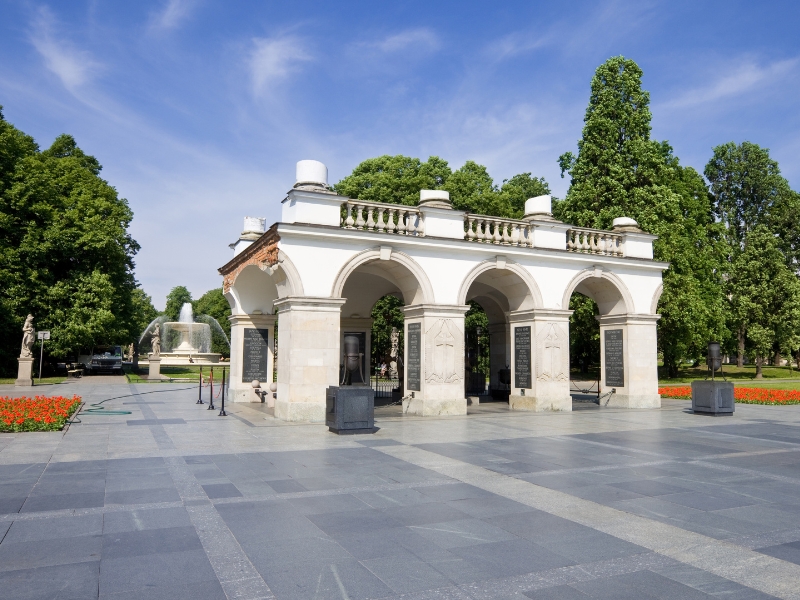
The Tomb of the Unknown Soldier was unveiled on 2 November 1925 beneath the colonnade of the Saxon Palace. It holds the remains of an unknown soldier who fell defending Lwów in the fighting of 1918–1920. In December 1944 the Germans blew up the palace, and only the central arches with the tomb survived, which is why the monument looks like a fragment of a building standing alone on the square. An eternal flame burns there and soldiers keep watch. The tomb is a scavenger hunt stop.
- The urns containing soil from battlefields where Polish soldiers fought.
- The tablets on the pillars, listing battles from the Middle Ages to the Second World War and later.
Saxon Garden
Behind the tomb spreads the Saxon Garden, laid out for King Augustus II the Strong beside his Saxon Palace. It opened to the public in 1727, which makes it one of the first public parks anywhere. In the 19th century its formal Baroque design was turned into an English-style landscape park to plans by Henryk Marconi. It is a scavenger hunt stop, and the route ends close by at the obelisk known as Drogowskaz.
- The fountain in the middle of the garden, built in 1855, and Marconi's round water tower of 1852, modelled on the Temple of Vesta in Tivoli.
- The 18th-century sandstone statues along the paths, allegories of virtues, sciences and the elements.
How to see them in one walk
This order follows the scavenger hunt. Begin at the Church of the Visitation on the escarpment and walk up to the New Town Market Square, then go west to Krasiński Garden. Come back along the old city walls to the Barbican, the red-brick gate between the two towns, and step into the Old Town Market Square. Continue to Castle Square and the Royal Castle, then follow Senatorska Street to Theatre Square, past the Grand Theatre – Polish National Opera. From there it is a short walk to the Tomb of the Unknown Soldier and the Saxon Garden behind it.
See Warsaw with World City Trail
Our Warsaw scavenger hunt turns these streets into a game you play on your phone. The route links 10 stops, from the Church of the Visitation to the Drogowskaz obelisk, and all seven places in this guide are among them, together with the Barbican and the Grand Theatre. At each stop you solve a puzzle and hear a short story, at your own pace.
If you prefer a different format, there is also a self-guided walking tour and an outdoor escape game in Warsaw.
Play the Warsaw scavenger hunt →
Take the self-guided walking tour of Warsaw →
Play the outdoor escape game in Warsaw →
Facts checked in October 2026.