
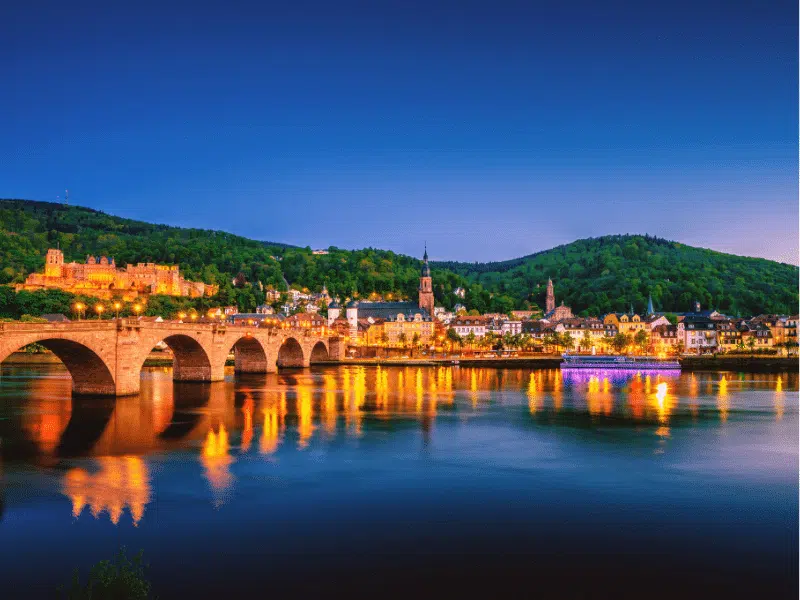
Heidelberg is a university town on the Neckar, with a red sandstone castle ruin above its rooftops and wooded hills on both banks. It came through the Second World War largely unscathed, and in the 19th century its ruins made it a symbol of German Romanticism. Here are the facts and stories that make it special.
10 fun facts about Heidelberg
- Germany's oldest university: Heidelberg University was founded in 1386 by Elector Palatine Ruprecht I, which makes it the oldest university in present-day Germany.
- A castle ruined twice: French troops blew up and burned much of Heidelberg Castle in 1689 and 1693, during the War of the Palatine Succession. In 1764 lightning set fire to the parts that had been restored, and it has been a ruin ever since.
- A barrel the size of a room: the Great Tun in the castle cellar, built in 1751 for Elector Charles Theodore, held about 220,000 litres of wine. A dance floor was built on top of it.
- A monkey with a mirror: by the Old Bridge sits the Bridge Monkey, a bronze by Gernot Rumpf installed in 1979. It recalls a monkey figure that stood at the bridge by the 15th century. Tradition says touching the mirror brings wealth and touching the fingers brings you back to Heidelberg.
- A bridge built to last: the Old Bridge, officially the Karl-Theodor-Brücke, was built in stone between 1786 and 1788, replacing earlier wooden bridges that floods and ice had repeatedly damaged.
- Students behind bars: from 1778 until 1914 the university locked up rowdy students in its own Student Prison. Inmates covered the walls with drawings, names and verses that can still be seen.
- A chocolate with a message: the Heidelberger Studentenkuss, the 'student kiss', comes from Café Knösel, opened by Fridolin Knösel in 1863. Students used it to pass discreet notes to young women.
- Mark Twain was here: the American writer spent part of 1878 in Heidelberg and described its students and their duels in A Tramp Abroad (1880).
- A 600,000-year-old jaw: a human lower jaw found in a sandpit at Mauer, near Heidelberg, in 1907 gave its name to Homo heidelbergensis, an early human species.
- A library taken to Rome: in 1623, during the Thirty Years' War, the famous Bibliotheca Palatina was carried off from Heidelberg and given to the Pope. Only part of it has come back, including a large group of German manuscripts returned in 1816.
The legend of Perkeo
Opposite the Great Tun stands a wooden figure of Perkeo, the barrel's legendary guardian. His real name was Clemens Pankert, a jester of very small stature from Salorno in South Tyrol, who served Elector Charles III Philip in the 18th century. Legend says that when he was asked whether he could empty the giant barrel on his own, he answered in Italian 'Perché no?', 'Why not?', and the phrase became his name. He is said to have drunk wine every day since childhood, and the story goes that when a doctor finally told him to drink water instead, he did so and died the next day.
The castle and the Romantics
In the early 19th century poets and painters fell for the ruined castle above the Neckar. Clemens Brentano and Achim von Arnim published much of their famous folk song collection Des Knaben Wunderhorn while living in Heidelberg, and Joseph von Eichendorff studied here. A French émigré, Count Charles de Graimberg, spent decades campaigning to preserve the ruin and recording it in drawings. On a few summer evenings each year the castle is lit up red and fireworks rise over the river, in memory of the fires of 1689 and 1693.
What to eat in Heidelberg
- Heidelberger Studentenkuss: a chocolate-covered praline wrapped in paper showing a student couple, still made in Heidelberg.
- Spargel: white asparagus from around nearby Schwetzingen, in season in spring and served with ham, new potatoes and hollandaise.
- Flammkuchen: a thin, crisp tart with crème fraîche, onions and bacon, shared across the Upper Rhine.
- Wine from the Bergstraße: Heidelberg's own hillsides belong to the Badische Bergstraße wine area, known for Riesling and Pinot.
Good to know before you go
- The Bergbahn funicular runs from the Kornmarkt up to the castle and on to the Königstuhl; the upper section, with historic cars, dates from 1907.
- For the classic view of the old town, the bridge and the castle, cross the river and climb the Philosophers' Walk, ideally in the late afternoon.
- Schwetzingen Palace, with its formal gardens, is an easy half-day trip, and boats run up the Neckar valley past hilltop castles in summer.
Explore Heidelberg with World City Trail
Our Heidelberg scavenger hunt turns these sights into a game you play on your phone. The route links 10 stops and takes around two hours, with about 38 minutes of walking, and its stops include Bismarckplatz and the Bridge Monkey on the Old Bridge.
At each stop you solve a puzzle and hear a short story, at your own pace. You can start whenever you like.
Play the Heidelberg scavenger hunt →
Facts checked in October 2026.