
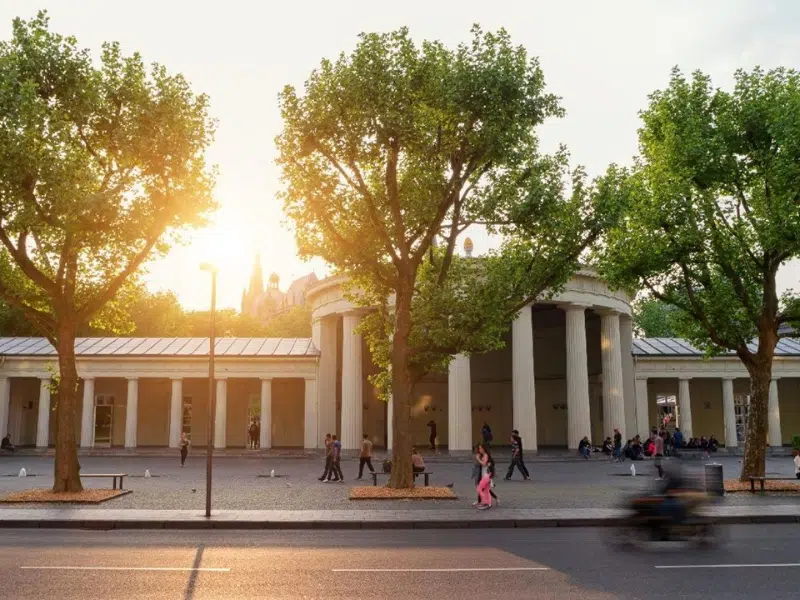
The Elisenbrunnen is the white neoclassical colonnade on Friedrich-Wilhelm-Platz in the centre of Aachen, built in the 1820s as a drinking hall for spa guests. In its round central hall, two fountains still run with thermal water from one of the city's hot springs. You will probably smell it before you see it: the water comes out at around 52 °C and is strongly sulphurous, with an unmistakable whiff of rotten eggs.
The Elisenbrunnen at a glance
- Where: Friedrich-Wilhelm-Platz in Aachen's city centre, with the Elisengarten park directly behind it, a few minutes' walk from the cathedral.
- Built: 1822–1827; destroyed in an air raid in 1943 and rebuilt in its original form in the 1950s.
- By: the architect Johann Peter Cremer, with plans revised by Karl Friedrich Schinkel.
- What it is today: the only place in Aachen's inner city where you can taste the thermal water, a meeting point and the home of the Aachen tourist information office.
- Time needed: 15–20 minutes, longer if you add a stroll through the Elisengarten.
A drinking hall for a spa town
Aachen's hot springs are the reason the town exists. The Romans built baths here, Charlemagne loved to swim in the warm water, and by the 18th century Aachen was one of Europe's fashionable spas. More than 30 springs rise in the area, some of them among the hottest in Central Europe. The Elisenbrunnen was built so that guests on a drinking cure could take the water in style: the foundation stones were laid in November 1822 and the building was finished in 1827. Johann Peter Cremer designed it, and the Prussian master builder Karl Friedrich Schinkel reworked his plans. The water is piped from the Kaiserquelle, the Emperor's Spring, about 180 metres away below the Büchel street.
The hall was named after Elisabeth Ludovika of Bavaria, the crown princess of Prussia and wife of the future King Friedrich Wilhelm IV. On 14 July 1943 bombs almost completely destroyed it, leaving only parts of the walls and columns standing. It was rebuilt faithfully in the 1950s, and today its pavilions house the tourist information and a restaurant.
What to look for
- The two drinking fountains in the round central hall. Try a sip if you dare: the water is hot, salty and sulphurous, and most people do not ask for a second one.
- The stone plaques on the walls, put up in 1883, honouring famous spa guests including Peter the Great, Frederick the Great, Giacomo Casanova and George Frideric Handel.
- The bust of Elisabeth Ludovika, the princess who gave the fountain its name; a copy of the marble bust by Christian Friedrich Tieck has stood here since the opening.
- The façade: Doric columns, two open arcaded wings and a pavilion at each end, a textbook example of Prussian neoclassicism.
- The steam rising from the fountains on cold days, when the hot water meets winter air.
Why it smells of eggs
Aachen's thermal water rises from deep underground, where it picks up minerals and hydrogen sulphide. That gas is what gives the Elisenbrunnen its famous smell. For 19th-century spa guests the smell was part of the cure: drinking the hot, mineral-rich water was believed to help with rheumatism, gout and skin complaints. Today nobody prescribes it, but the fountains keep running, and tasting a sip has become a small Aachen ritual for visitors.
Tips for your visit
- Come on a cold morning to see the fountains steaming and the hall at its quietest.
- Take a cup or simply cup your hands, but go slowly: the water is genuinely hot.
- Walk round to the back and continue into the Elisengarten, then on to the cathedral and the Town Hall, which are all within a short walk of each other.
Nearby
- Elisengarten: the park behind the fountain, with a glass archaeological window showing Roman and medieval foundations found during excavations in 2008–2009.
- Aachen Cathedral: Charlemagne's palace chapel at its core, Germany's first UNESCO World Heritage Site, a few minutes' walk away.
- Aachen Town Hall: the Gothic town hall on the Markt, built on the foundations of Charlemagne's palace hall.
- Kreislauf des Geldes: the bronze fountain nearby showing the circulation of money with lively, slightly mocking figures.
See Aachen with World City Trail
Our Aachen scavenger hunt turns the old town into a game you play on your phone. The route links 10 stops and takes around 2 hours, with about 24 minutes of walking. It includes places such as Aachen Cathedral and the Town Hall.
If you prefer a different format, there is also a self-guided walking tour and an outdoor escape game in Aachen.
Play the Aachen scavenger hunt →
Take the self-guided walking tour of Aachen →
Play the outdoor escape game in Aachen →
Facts checked in October 2026.