
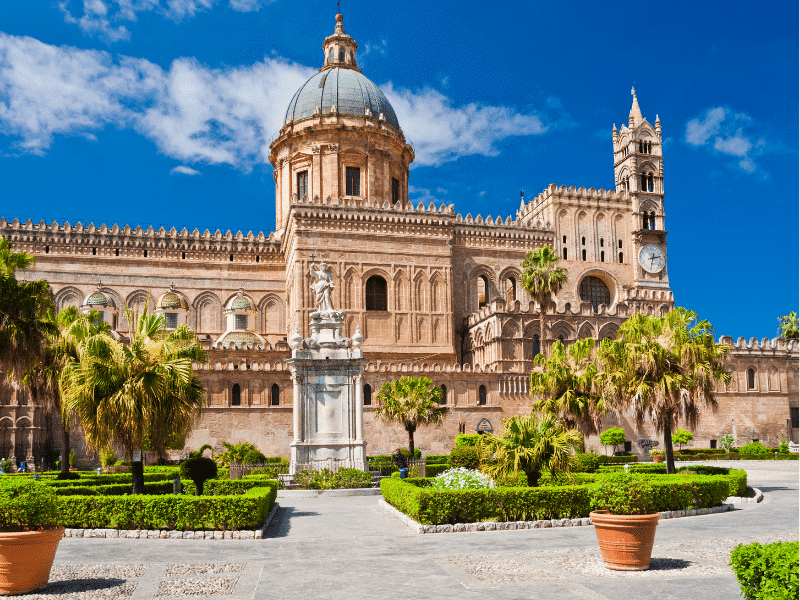
Palermo wurde von Phöniziern, Römern, Byzantinern, Arabern, Normannen, Deutschen, Franzosen und Spaniern regiert, und alle haben etwas hinterlassen. Das Ergebnis ist eine Stadt, in der eine einzige Kathedrale Normannisches, Gotik und Barock vereint und in der die Märkte noch immer wie ein Souk klingen. Hier sind die Fakten und Geschichten, die sie besonders machen.
10 spannende Fakten über Palermo
- Eine Stadt, die ganz Hafen ist: Die Phönizier gründeten Palermo im 8. Jahrhundert v. Chr., und die Griechen nannten sie Panormos, ganz Hafen.
- Eine arabische Hauptstadt: Unter arabischer Herrschaft, vom 9. bis zum 11. Jahrhundert, war Palermo eine der größten Städte Europas, bekannt für Moscheen, Gärten und Märkte.
- Arab-Norman World Heritage: in 2015, nine buildings in Palermo, Monreale and Cefalù were added to UNESCO's World Heritage List for their blend of Western, Byzantine and Islamic art.
- Eine Kapelle aus Gold: Die Cappella Palatina im Normannenpalast wurde 1140 unter König Roger II. geweiht. Ihre byzantinischen Mosaiken liegen unter einer Holzdecke, die im islamischen Muqarnas-Stil geschnitzt und bemalt ist.
- Italy's largest opera house: the Teatro Massimo opened in 1897, later closed for more than twenty years and reopened in 1997. Its front steps appear in the final scene of The Godfather Part III.
- An emperor's tomb: Frederick II, Holy Roman Emperor and King of Sicily, who died in 1250, lies in a porphyry tomb in Palermo Cathedral, beside other members of the royal family.
- Ein Brunnen für Florenz: Die Fontana Pretoria mit 48 Statuen wurde in Florenz geschaffen und 1574 in 644 Teilen nach Palermo verschifft. Ihre nackten Figuren brachten dem Platz den Spitznamen Piazza della Vergogna ein, Platz der Schande.
- Four corners, four of everything: the Quattro Canti crossroads, laid out in the early 17th century, has four curved Baroque façades with statues of the four seasons, four Spanish kings and the city's four patron saints.
- Tausende Mumien: In den Kapuzinergruften liegen die konservierten Körper von rund 8.000 Menschen, darunter die zweijährige Rosalia Lombardo, die 1920 einbalsamiert wurde.
- Ein weiblicher Snack: In Palermo heißt die frittierte Reiskugel arancina, weiblich und rund, während sie im Osten Siziliens meist arancino heißt und oft kegelförmig ist.
Die heilige Rosalia und die Pest von 1624
Rosalia was a 12th-century noblewoman who, according to tradition, left court life to live as a hermit in a cave on Monte Pellegrino, the mountain above the city. In 1624 plague struck Palermo. That summer, bones said to be hers were found in the cave, and when they were carried in procession through the streets the following year, the epidemic is said to have ended. Rosalia became the city's main patron saint. Every July the Festino brings a huge decorated float through the old centre towards the sea, with fireworks to follow, and on 4 September many people walk up Monte Pellegrino to her sanctuary.
Palermo's markets, explained
Palermo's historic street markets, Ballarò, the Capo and the Vucciria, still trade fish, fruit, spices and street food in narrow lanes of the old town. Ballarò, between the station and the Norman Palace, is the liveliest, and its vendors still call out their goods in a sing-song style known as abbanniata. Go in the morning to see the market at full speed, and come back at lunchtime for street food.
Was man in Palermo essen sollte
- Arancina: eine frittierte Reiskugel, meist mit Ragù und Erbsen oder mit Schinken und Käse gefüllt.
- Panelle: dünne Kichererbsenfladen, oft in einem Sesambrötchen mit Crocchè, kleinen Kartoffelkroketten, serviert.
- Pani ca' meusa: a soft bun filled with veal spleen and lung cooked in lard, served plain or topped with ricotta and caciocavallo cheese.
- Sfincione: Palermo's thick, spongy pizza, topped with tomato, onion, anchovies and breadcrumbs.
- Cannolo: a crisp fried pastry tube filled with sweetened sheep's milk ricotta. The best are filled to order, so the shell stays crunchy.
Gut zu wissen vor dem Besuch
- Der Dom von Monreale mit seinen riesigen Goldmosaiken liegt nur eine kurze Fahrt den Hügel hinauf und ist einen halben Tag wert.
- Du kannst auf das Dach der Kathedrale von Palermo steigen und über die Altstadt blicken; dafür brauchst du ein eigenes Ticket.
- Bedecke Schultern und Knie für die Cappella Palatina und andere Kirchen.
- Mondello, the city's beach, is easy to reach by bus from the centre and makes a good break from sightseeing.
Palermo mit World City Trail entdecken
Unsere Schnitzeljagd in Palermo macht aus diesen Sehenswürdigkeiten ein Spiel auf deinem Handy. Die Route verbindet 10 Stationen und dauert etwa zwei Stunden, davon rund 34 Minuten zu Fuß, und führt unter anderem zum Normannenpalast mit der Cappella Palatina und zur Kathedrale von Palermo.
An jeder Station löst du ein Rätsel und hörst eine kurze Geschichte, in deinem eigenen Tempo. Du kannst starten, wann du willst.
Die Schnitzeljagd in Palermo spielen →
Fakten geprüft im Oktober 2026.