
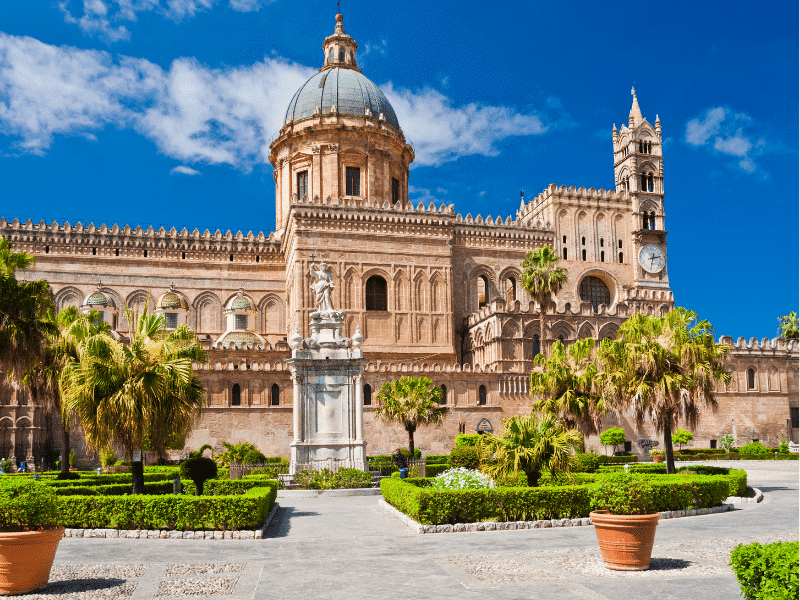
Palermo has been ruled by Phoenicians, Romans, Byzantines, Arabs, Normans, Germans, French and Spaniards, and each of them left something behind. The result is a city where one cathedral mixes Norman, Gothic and Baroque, and where the street markets still sound like a souk. Here are the facts and stories that make it special.
10 fun facts about Palermo
- An all-harbour city: the Phoenicians founded Palermo in the 8th century BC, and the Greeks called it Panormos, meaning all harbour.
- An Arab capital: under Arab rule, from the 9th to the 11th century, Palermo was one of the largest cities in Europe, known for its mosques, gardens and markets.
- Arab-Norman World Heritage: in 2015, nine buildings in Palermo, Monreale and Cefalù were added to UNESCO's World Heritage List for their blend of Western, Byzantine and Islamic art.
- A chapel of gold: the Palatine Chapel inside the Norman Palace was consecrated in 1140 under King Roger II. Its Byzantine mosaics sit beneath a wooden ceiling carved and painted in the Islamic muqarnas style.
- Italy's largest opera house: the Teatro Massimo opened in 1897, later closed for more than twenty years and reopened in 1997. Its front steps appear in the final scene of The Godfather Part III.
- An emperor's tomb: Frederick II, Holy Roman Emperor and King of Sicily, who died in 1250, lies in a porphyry tomb in Palermo Cathedral, beside other members of the royal family.
- A fountain made for Florence: the Fontana Pretoria, with 48 statues, was carved in Florence and shipped to Palermo in 644 pieces in 1574. Its nude figures earned the square the nickname Piazza della Vergogna, the Square of Shame.
- Four corners, four of everything: the Quattro Canti crossroads, laid out in the early 17th century, has four curved Baroque façades with statues of the four seasons, four Spanish kings and the city's four patron saints.
- Thousands of mummies: the Capuchin Catacombs hold the preserved bodies of around 8,000 people, among them two-year-old Rosalia Lombardo, embalmed in 1920.
- A feminine snack: in Palermo the fried rice ball is arancina, feminine and round, while in eastern Sicily it is usually arancino and often cone-shaped.
Santa Rosalia and the plague of 1624
Rosalia was a 12th-century noblewoman who, according to tradition, left court life to live as a hermit in a cave on Monte Pellegrino, the mountain above the city. In 1624 plague struck Palermo. That summer, bones said to be hers were found in the cave, and when they were carried in procession through the streets the following year, the epidemic is said to have ended. Rosalia became the city's main patron saint. Every July the Festino brings a huge decorated float through the old centre towards the sea, with fireworks to follow, and on 4 September many people walk up Monte Pellegrino to her sanctuary.
Palermo's markets, explained
Palermo's historic street markets, Ballarò, the Capo and the Vucciria, still trade fish, fruit, spices and street food in narrow lanes of the old town. Ballarò, between the station and the Norman Palace, is the liveliest, and its vendors still call out their goods in a sing-song style known as abbanniata. Go in the morning to see the market at full speed, and come back at lunchtime for street food.
What to eat in Palermo
- Arancina: a fried rice ball, usually filled with ragù and peas, or with ham and cheese.
- Panelle: thin chickpea-flour fritters, often served in a sesame bun with crocchè, little potato croquettes.
- Pani ca' meusa: a soft bun filled with veal spleen and lung cooked in lard, served plain or topped with ricotta and caciocavallo cheese.
- Sfincione: Palermo's thick, spongy pizza, topped with tomato, onion, anchovies and breadcrumbs.
- Cannolo: a crisp fried pastry tube filled with sweetened sheep's milk ricotta. The best are filled to order, so the shell stays crunchy.
Good to know before you go
- Monreale Cathedral, with its vast gold mosaics, is a short trip up the hill from the city and well worth half a day.
- You can climb onto the roof of Palermo Cathedral for views over the old town; it needs a separate ticket.
- Cover your shoulders and knees for the Palatine Chapel and other churches.
- Mondello, the city's beach, is easy to reach by bus from the centre and makes a good break from sightseeing.
Explore Palermo with World City Trail
Our Palermo scavenger hunt turns these sights into a game you play on your phone. The route links 10 stops and takes around two hours, with about 34 minutes of walking, and includes the Norman Palace and Palatine Chapel and Palermo Cathedral.
At each stop you solve a puzzle and hear a short story, at your own pace. You can start whenever you like.
Play the Palermo scavenger hunt →
Facts checked in October 2026.