
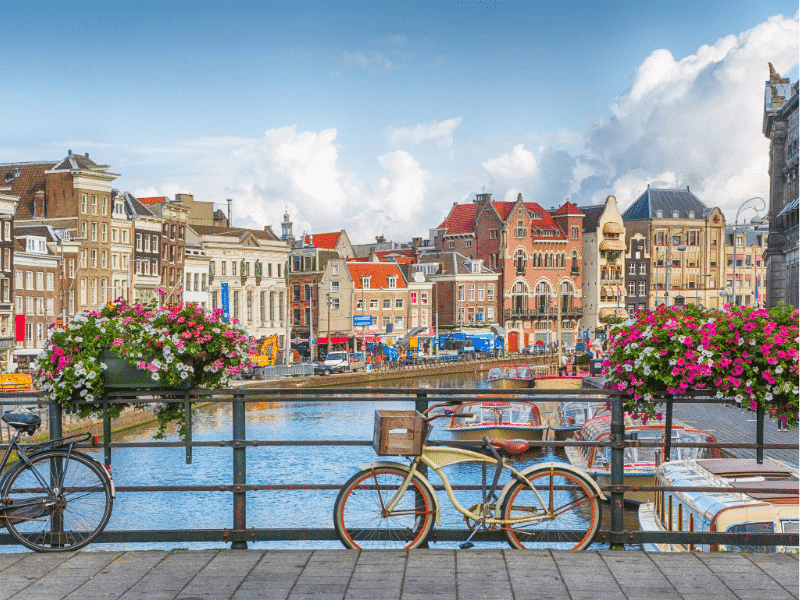
Amsterdam began as a dam on the River Amstel and, in the 17th century, became one of the richest cities in the world, when its merchants dug the ring of canals that still shapes the centre. Almost everything here stands on wooden piles driven into soft ground. Here are the facts and stories that make the city special.
10 fun facts about Amsterdam
- 750 years and counting: the oldest known document naming Amsterdam is a toll privilege from Count Floris V dated 27 October 1275, which is why the city celebrated its 750th birthday in 2025.
- A palace on 13,659 piles: the Royal Palace on Dam Square was built from 1648 as the city hall, designed by Jacob van Campen, and rests on 13,659 wooden piles. It became a royal palace in 1808 under Louis Bonaparte, Napoleon's brother.
- A station on artificial islands: Amsterdam Centraal opened in 1889 and stands on three artificial islands in the IJ, supported by 8,687 wooden piles.
- Twin buildings: the station's architect, Pierre Cuypers, also designed the Rijksmuseum, opened in 1885, so the two red-brick landmarks look strikingly alike.
- The city's tallest church tower: the Westerkerk opened in 1631, and its 85-metre tower is topped by the imperial crown that Emperor Maximilian granted Amsterdam in 1489.
- Rembrandt's lost grave: Rembrandt was buried in the Westerkerk in 1669, but nobody knows exactly where; a memorial inside the church remembers him.
- Anne Frank's bells: from her hiding place in the Secret Annex nearby, Anne Frank wrote in her diary about the chimes of the Westerkerk clock.
- A World Heritage canal ring: the 17th-century ring of canals inside the Singelgracht was added to UNESCO's World Heritage List in 2010.
- Houses with hooks: many narrow canal houses have a hoisting beam at the top of the gable, because furniture and goods were lifted up the outside and through the windows. Some facades lean forward on purpose so that loads do not hit the walls.
- Capital, but not the seat of government: Amsterdam is the capital of the Netherlands under the constitution, but the parliament and government sit in The Hague.
The Miracle of Amsterdam
In March 1345, the story goes, a dying man in a house on Kalverstraat received communion and could not keep it down. The host was thrown into the fire, but the next morning it was found unharmed among the flames. A chapel was built on the spot, and Amsterdam became a place of pilgrimage. Among the pilgrims, it is said, was the future Emperor Maximilian, who later granted the city his crown. After the Reformation, Catholic processions were banned, so since 1881 believers have walked the Stille Omgang instead, a silent procession through the night streets every March.
The Jordaan, explained
The Jordaan was laid out in the 17th century just west of the canal ring, as a district for workers, craftsmen and immigrants. Its narrow streets and small canals are named after flowers and trees, such as Rozengracht and Lindengracht, and the Westerkerk stands at its edge. Its name is often said to come from the French word jardin, garden, though nobody is sure. Today it is known for its brown cafés, small galleries and the market on the Noordermarkt.
What to eat in Amsterdam
- Raw herring: lightly salted herring, best as 'Hollandse Nieuwe' from early summer, served with onions and pickles from street stalls.
- Bitterballen: crisp deep-fried balls of meat ragout, dipped in mustard and eaten with a beer in a brown café.
- Stroopwafel: two thin waffles glued together with caramel syrup. They come from Gouda, but street markets sell them warm.
- Appeltaart: deep Dutch apple pie with cinnamon, served with a generous spoon of whipped cream.
- Jenever: Dutch gin, the ancestor of English gin. It is poured into a tulip glass filled to the brim, so the first sip is taken bending over the glass.
Good to know before you go
- Tickets for the Anne Frank House are sold online only and go quickly. Book as soon as you know your dates.
- Watch out for cycle lanes, usually marked in red: bikes have priority and move fast. Do not walk or stand on them.
- Smoking cannabis in the street in the Red Light District has been banned since 2023.
- Haarlem is a quick train ride away, and the windmills of the Zaanse Schans make an easy half-day trip.
Explore Amsterdam with World City Trail
Our Amsterdam scavenger hunt turns these sights into a game you play on your phone. The route links 10 stops and takes around three hours, with about 52 minutes of walking, from Amsterdam Centraal to the Royal Palace and the Westerkerk.
At each stop you solve a puzzle and hear a short story, at your own pace. You can start whenever you like.
Play the Amsterdam scavenger hunt →
Facts checked in October 2026.