
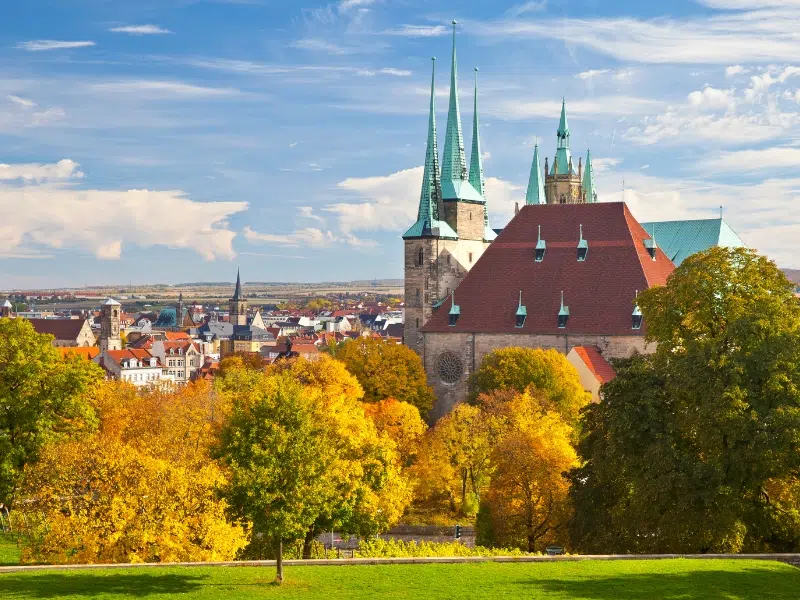
Erfurt, la capital de Turingia, se hizo rica en la Edad Media con el comercio y con un tinte azul, y sobre su casco antiguo se alzan tantas torres de iglesia que la apodaron la Roma de Turingia. Gran parte de su centro medieval sobrevivió a la Segunda Guerra Mundial. Estos son los datos y las historias que hacen especial a la ciudad.
10 curiosidades sobre Erfurt
- Casas sobre un puente: el Krämerbrücke, un puente de piedra terminado en 1325, está flanqueado por 32 casas que siguen habitadas, con tiendas en la planta baja. A menudo se le llama el puente habitado más largo de Europa.
- Seventy steps to two churches: St Mary's Cathedral and the Church of St Severus stand side by side on a hill above Domplatz, reached by a broad flight of 70 steps.
- A giant medieval bell: the Gloriosa, cast in 1497 by Gerhard van Wou and hanging in the cathedral's central tower, is one of the largest free-swinging medieval bells in the world. It rings only on major feast days.
- A synagogue from the 11th century: the oldest parts of Erfurt's Old Synagogue date from 1094, making it one of the oldest preserved synagogue buildings in Europe. Today it is a museum.
- A treasure in the wall: in 1998, building work uncovered the Erfurt Treasure, more than 3,000 silver coins and over 700 pieces of goldsmiths' work, probably hidden by a Jewish family during the massacre of 1349. It is on show in the Old Synagogue.
- Patrimonio Mundial desde 2023: la Antigua Sinagoga, una mikve medieval (baño ritual) cerca del Krämerbrücke y la Casa de Piedra se convirtieron juntas en Patrimonio Mundial de la UNESCO en 2023.
- Luther's university town: Martin Luther studied at the University of Erfurt from 1501. Founded by papal charter in 1379, the university was closed in 1816 and refounded in 1994.
- Oro azul: el glasto, una planta que da un tinte azul, hizo rica a la Erfurt medieval. Sus comerciantes lo vendían por toda Europa hasta que el índigo de ultramar lo desplazó, y sus grandes casas siguen bordeando las calles.
- Una caída poco gloriosa: en 1184 el suelo de una sala se hundió durante una asamblea de nobles convocada por el rey Enrique VI, y decenas de ellos cayeron al pozo de la letrina y murieron. El suceso se conoce como el desastre de la letrina de Erfurt.
- Willy Brandt to the window: on 19 March 1970 West German Chancellor Willy Brandt met East Germany's Premier Willi Stoph at the Erfurter Hof hotel, the first meeting of the two German heads of government. The crowd outside chanted for Brandt to come to the window.
Lutero y la tormenta
On 2 July 1505, the young law student Martin Luther was walking back to Erfurt when a violent thunderstorm caught him near the village of Stotternheim. Lightning struck close by, and in terror he cried out to Saint Anne, promising to become a monk if he survived. About two weeks later, against his father's wishes, he knocked on the door of Erfurt's Augustinian monastery. He was ordained a priest in Erfurt Cathedral in 1507. The monastery, with the cloister and church Luther knew, can still be visited and also works as a guest house.
La Domplatz y el Petersberg, explicados
Below the cathedral steps spreads Domplatz, the stage for Erfurt's Christmas market and, in summer, for open-air performances on the steps themselves. Behind it rises the Petersberg, a hill crowned by one of the largest baroque citadels in Central Europe, built from 1665. You can walk its walls and bastions freely, and they give the best view over the city's towers.
Qué comer en Erfurt
- Thüringer Rostbratwurst: la salchicha de Turingia asada al carbón y servida en un panecillo. La primera mención escrita de una bratwurst de Turingia es de 1404.
- Born mustard: Erfurt's own mustard, made by the Born company since 1820, is the classic partner for a bratwurst.
- Thüringer Klöße: grandes bolas de patata lisas, servidas con asado y abundante salsa, sobre todo los domingos.
- Brunnenkresse: watercress has long been grown in Erfurt's spring-fed beds, and you'll find it in soups, salads and spreads.
Antes de ir
- Weimar, la ciudad de Goethe y Schiller, está a solo unos 15 minutos en tren, así que es una excursión fácil de medio día.
- Visita juntas la Antigua Sinagoga y la mikve. La mikve suele verse solo con visita guiada, así que consulta los horarios con antelación.
- El Krämerbrückenfest de junio llena el puente y el casco antiguo de música y puestos, y el mercado navideño de la Domplatz es muy concurrido: en ambos casos, reserva alojamiento pronto.
- Sube al Petersberg al final de la tarde para ver la luz sobre la catedral y las torres del casco antiguo.
Descubre Erfurt con World City Trail
Our Erfurt scavenger hunt turns these sights into a game you play on your phone. The route links 10 stops and takes around two hours, with about 28 minutes of walking, and leads you to places such as the Angermuseum, the city's art museum in a baroque weigh house.
En cada parada resuelves un acertijo y escuchas una historia breve, a tu ritmo. Puedes empezar cuando quieras y jugar en inglés, alemán, francés, italiano o neerlandés.
Juega a la búsqueda del tesoro de Erfurt →
Datos comprobados en octubre de 2026.