
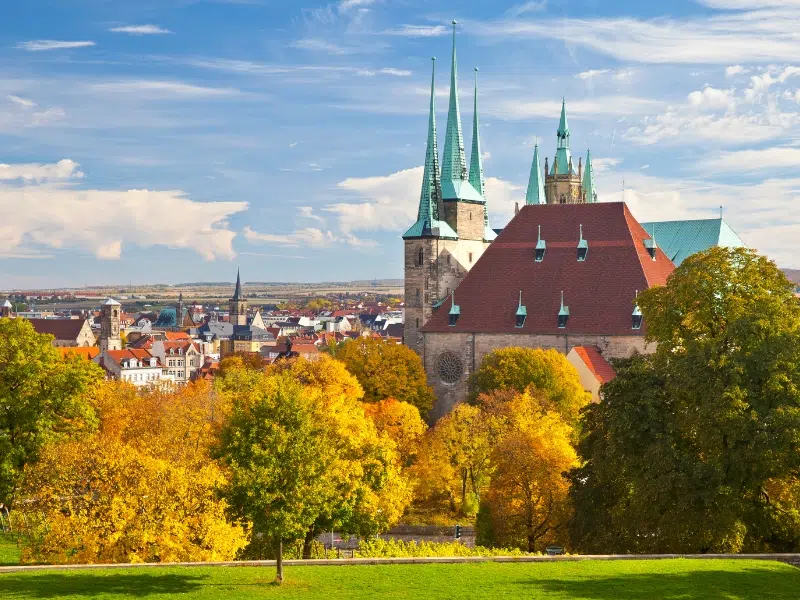
Erfurt, capoluogo della Turingia, si arricchì nel Medioevo con il commercio e con una tintura blu, e sopra il centro storico svettano così tanti campanili che fu soprannominata la Roma della Turingia. Gran parte del suo centro medievale è sopravvissuta alla Seconda guerra mondiale. Ecco i fatti e le storie che rendono speciale la città.
10 curiosità su Erfurt
- Case su un ponte: il Krämerbrücke, un ponte in pietra completato nel 1325, è fiancheggiato da 32 case ancora abitate, con negozi al pianterreno. È spesso definito il ponte abitato più lungo d’Europa.
- Seventy steps to two churches: St Mary's Cathedral and the Church of St Severus stand side by side on a hill above Domplatz, reached by a broad flight of 70 steps.
- A giant medieval bell: the Gloriosa, cast in 1497 by Gerhard van Wou and hanging in the cathedral's central tower, is one of the largest free-swinging medieval bells in the world. It rings only on major feast days.
- A synagogue from the 11th century: the oldest parts of Erfurt's Old Synagogue date from 1094, making it one of the oldest preserved synagogue buildings in Europe. Today it is a museum.
- A treasure in the wall: in 1998, building work uncovered the Erfurt Treasure, more than 3,000 silver coins and over 700 pieces of goldsmiths' work, probably hidden by a Jewish family during the massacre of 1349. It is on show in the Old Synagogue.
- Patrimonio mondiale dal 2023: la Vecchia Sinagoga, un mikveh medievale (bagno rituale) vicino al Krämerbrücke e la Casa di pietra sono diventati insieme Patrimonio mondiale dell’UNESCO nel 2023.
- Luther's university town: Martin Luther studied at the University of Erfurt from 1501. Founded by papal charter in 1379, the university was closed in 1816 and refounded in 1994.
- L’oro blu: il guado, una pianta da cui si ricava una tintura blu, fece la ricchezza di Erfurt nel Medioevo. I mercanti lo vendevano in tutta Europa finché l’indaco d’oltremare non lo soppiantò, e le loro belle case fiancheggiano ancora le strade.
- Una caduta poco gloriosa: nel 1184 il pavimento di una sala crollò durante un’assemblea di nobili convocata dal re Enrico VI, e decine di loro precipitarono nel pozzo della latrina sottostante e morirono. L’episodio è noto come il disastro della latrina di Erfurt.
- Willy Brandt to the window: on 19 March 1970 West German Chancellor Willy Brandt met East Germany's Premier Willi Stoph at the Erfurter Hof hotel, the first meeting of the two German heads of government. The crowd outside chanted for Brandt to come to the window.
Lutero e il temporale
On 2 July 1505, the young law student Martin Luther was walking back to Erfurt when a violent thunderstorm caught him near the village of Stotternheim. Lightning struck close by, and in terror he cried out to Saint Anne, promising to become a monk if he survived. About two weeks later, against his father's wishes, he knocked on the door of Erfurt's Augustinian monastery. He was ordained a priest in Erfurt Cathedral in 1507. The monastery, with the cloister and church Luther knew, can still be visited and also works as a guest house.
Domplatz e Petersberg in breve
Below the cathedral steps spreads Domplatz, the stage for Erfurt's Christmas market and, in summer, for open-air performances on the steps themselves. Behind it rises the Petersberg, a hill crowned by one of the largest baroque citadels in Central Europe, built from 1665. You can walk its walls and bastions freely, and they give the best view over the city's towers.
Cosa mangiare a Erfurt
- Thüringer Rostbratwurst: la salsiccia della Turingia grigliata sulla carbonella e servita in un panino. La prima menzione scritta di una bratwurst turingia risale al 1404.
- Born mustard: Erfurt's own mustard, made by the Born company since 1820, is the classic partner for a bratwurst.
- Thüringer Klöße: grandi gnocchi di patate lisci, serviti con l’arrosto e tanto sugo, soprattutto la domenica.
- Brunnenkresse: watercress has long been grown in Erfurt's spring-fed beds, and you'll find it in soups, salads and spreads.
Da sapere prima di partire
- Weimar, la città di Goethe e Schiller, è a circa 15 minuti di treno: perfetta per una gita di mezza giornata.
- Visita insieme la Vecchia Sinagoga e il mikveh. Il mikveh di solito si vede solo con una visita guidata, quindi controlla gli orari in anticipo.
- Il Krämerbrückenfest di giugno riempie il ponte e il centro di musica e bancarelle, e il mercatino di Natale in Domplatz è molto frequentato: in entrambi i casi prenota presto l’alloggio.
- Sali sul Petersberg nel tardo pomeriggio per la luce sul Duomo e sui campanili del centro.
Scopri Erfurt con World City Trail
Our Erfurt scavenger hunt turns these sights into a game you play on your phone. The route links 10 stops and takes around two hours, with about 28 minutes of walking, and leads you to places such as the Angermuseum, the city's art museum in a baroque weigh house.
A ogni tappa risolvi un enigma e ascolti una breve storia, al tuo ritmo. Puoi iniziare quando vuoi e giocare in italiano, inglese, tedesco, francese o olandese.
Gioca alla caccia al tesoro di Erfurt →
Fatti verificati a ottobre 2026.