
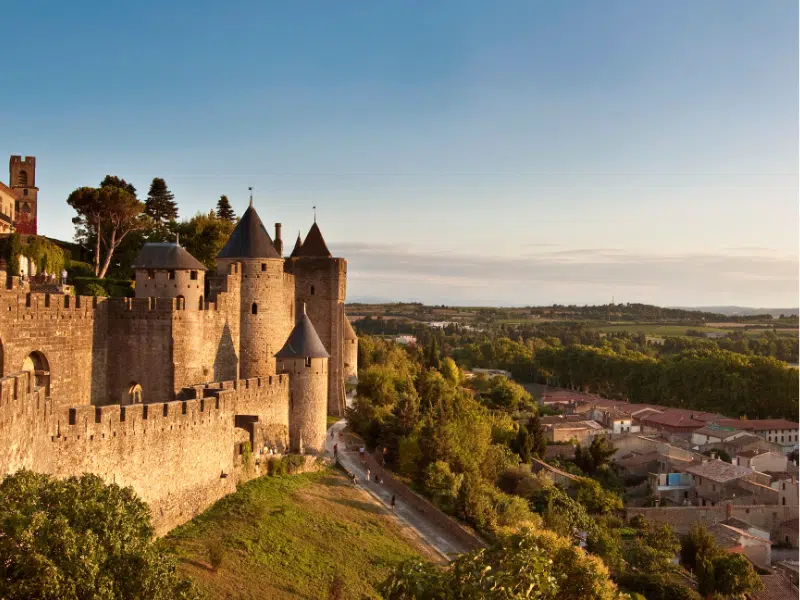
Carcassonne's Cité, a hilltop fortress ringed by two lines of walls, is one of the largest fortified towns in Europe. It was nearly torn down in the 19th century, then restored, and today it rises above the vineyards of the Aude like a castle from a picture book. Here are the facts and stories that make the city special.
10 curiosità su Carcassonne
- Two rings of walls: La Cité is enclosed by about three kilometres of double walls with 52 towers. The inner wall partly follows the line of the town's Gallo-Roman defences.
- Salvata dalla demolizione: nel 1849 il governo francese decise di abbattere le fortificazioni. L’opposizione locale, guidata dallo storico Jean-Pierre Cros-Mayrevieille e dallo scrittore Prosper Mérimée, ottenne che la decisione fosse revocata.
- Restaurata da Viollet-le-Duc: l’architetto Eugène Viollet-le-Duc iniziò il restauro della Cité nel 1853. I suoi tetti a punta in ardesia sono ancora discussi, perché i critici sostengono che tetti di tegole più piatti sarebbero più tipici del sud della Francia.
- Due siti Patrimonio dell’Umanità: l’UNESCO ha iscritto la città fortificata nel 1997. Il Canal du Midi, che passa accanto alla città bassa, è nella lista dal 1996.
- A basilica blessed by a pope: construction of the Basilica of Saint-Nazaire was authorised in 1096 with the blessing of Pope Urban II. Its Romanesque nave leads into a Gothic choir with medieval stained glass. It was the cathedral until 1803, when the bishop's seat moved to Saint-Michel in the lower town.
- L’assedio del 1209: durante la crociata contro i catari, i crociati assediarono la Cité dal 1º agosto 1209. Il visconte Raymond-Roger Trencavel si arrese il 15 agosto per salvare gli abitanti e morì a novembre, prigioniero nel suo stesso castello.
- Un castello nel castello: lo Château Comtal, costruito dai visconti Trencavel nel XII secolo, ha un proprio fossato e proprie mura all’interno della Cité.
- Due città in una: la città bassa, la Bastide Saint-Louis, fu tracciata a scacchiera sull’altra sponda dell’Aude a metà del Duecento. Il Pont Vieux, un ponte del Trecento, la collega ancora alla Cité.
- A board game named after it: Carcassonne, the tile-laying game by Klaus-Jürgen Wrede, came out in 2000 and won Germany's Spiel des Jahres award in 2001.
- Fireworks over the walls: every 14 July the Cité is the backdrop for one of France's best-known Bastille Day firework displays, the Embrasement de la Cité.
La leggenda di Dame Carcas
Legend says that in the 8th century Charlemagne besieged Carcassonne, then held by a Saracen prince, for five years. When the prince was killed, his widow, Dame Carcas, took command. She placed straw soldiers along the walls so the city looked well defended. When food ran out, she fed the last pig with the last sack of wheat and threw it from a tower. Seeing the well-fed pig burst on the ground, Charlemagne concluded the city could hold out for years and lifted the siege. Carcas had the bells rung, and one of his men cried 'Carcas sonne!', Carcas is ringing, which the story says gave the city its name. In reality the name is much older and goes back to the Roman town of Carcaso. A stone bust said to show Dame Carcas stands at the Porte Narbonnaise, the main gate of the Cité.
Cosa mangiare a Carcassonne
- Cassoulet: fagioli bianchi cotti a lungo in forno con confit d’anatra, salsiccia e maiale. Carcassonne, Castelnaudary e Tolosa difendono ciascuna la propria versione.
- Blanquette de Limoux: uno spumante di Limoux, appena a sud di Carcassonne, che fa risalire la sua storia al 1531.
- Corbières e Minervois: vini rossi delle colline intorno alla città, spesso anche al calice.
- Pélardon: a small, round goat's cheese from Languedoc, eaten fresh or aged until firm.
Da sapere prima di partire
- L’ingresso alla Cité, alle sue stradine e alle Lices, lo spazio tra le due cinte, è libero. Lo Château Comtal e il giro sui bastioni richiedono un biglietto.
- Vieni la mattina presto o la sera: la Cité è più affollata a metà giornata, soprattutto d’estate.
- Attraversa il Pont Vieux dalla città bassa per la classica vista sulle mura, illuminate di notte.
- I castelli catari di Lastours, sulle colline a nord di Carcassonne, e la cittadina di Limoux sono belle gite in giornata.
Scopri Carcassonne con World City Trail
La nostra caccia al tesoro a Carcassonne trasforma questi luoghi in un gioco sul tuo telefono. Il percorso collega 10 tappe e dura circa due ore, con circa 46 minuti di cammino, attraverso la Cité e lungo le sue mura fino alla basilica di Saint-Nazaire.
A ogni tappa risolvi un enigma e ascolti una breve storia, al tuo ritmo. Puoi iniziare quando vuoi.
Gioca alla caccia al tesoro di Carcassonne →
Fatti verificati a ottobre 2026.