
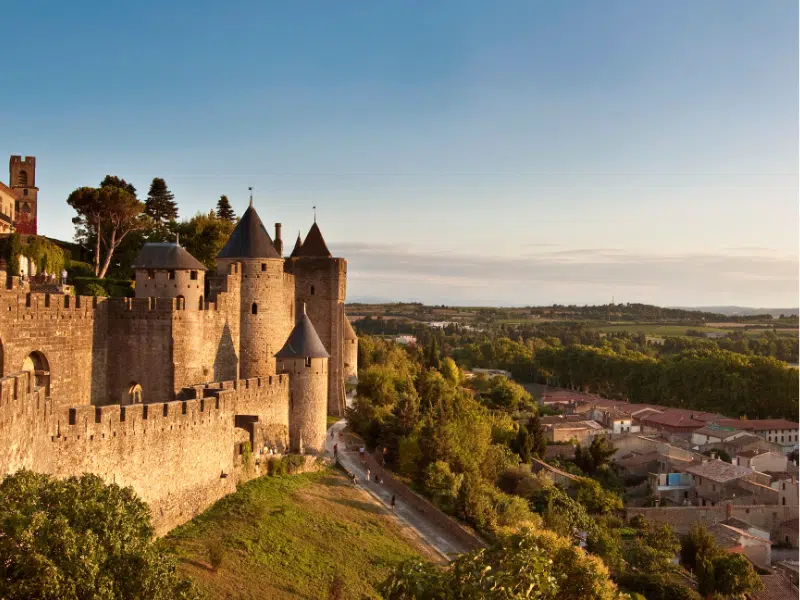
Carcassonne's Cité, a hilltop fortress ringed by two lines of walls, is one of the largest fortified towns in Europe. It was nearly torn down in the 19th century, then restored, and today it rises above the vineyards of the Aude like a castle from a picture book. Here are the facts and stories that make the city special.
10 fun facts about Carcassonne
- Two rings of walls: La Cité is enclosed by about three kilometres of double walls with 52 towers. The inner wall partly follows the line of the town's Gallo-Roman defences.
- Saved from demolition: in 1849 the French government decided to pull the fortifications down. Local opposition, led by the historian Jean-Pierre Cros-Mayrevieille and the writer Prosper Mérimée, got the decision reversed.
- Restored by Viollet-le-Duc: the architect Eugène Viollet-le-Duc began restoring the Cité in 1853. His pointed slate roofs are still debated, because critics say flatter tiled roofs would be more typical of the south of France.
- Two World Heritage Sites: UNESCO listed the fortified city in 1997. The Canal du Midi, which passes the lower town, has been on the list since 1996.
- A basilica blessed by a pope: construction of the Basilica of Saint-Nazaire was authorised in 1096 with the blessing of Pope Urban II. Its Romanesque nave leads into a Gothic choir with medieval stained glass. It was the cathedral until 1803, when the bishop's seat moved to Saint-Michel in the lower town.
- The siege of 1209: during the crusade against the Cathars, crusaders besieged the Cité on 1 August 1209. Viscount Raymond-Roger Trencavel surrendered on 15 August to save the townspeople and died a prisoner in his own castle that November.
- A castle inside the castle: the Château Comtal, built by the Trencavel viscounts in the 12th century, has its own moat and walls inside the Cité.
- Two towns in one: the lower town, the Bastide Saint-Louis, was laid out on a grid across the river Aude in the mid-13th century. The Pont Vieux, a 14th-century bridge, still links it to the Cité.
- A board game named after it: Carcassonne, the tile-laying game by Klaus-Jürgen Wrede, came out in 2000 and won Germany's Spiel des Jahres award in 2001.
- Fireworks over the walls: every 14 July the Cité is the backdrop for one of France's best-known Bastille Day firework displays, the Embrasement de la Cité.
The legend of Dame Carcas
Legend says that in the 8th century Charlemagne besieged Carcassonne, then held by a Saracen prince, for five years. When the prince was killed, his widow, Dame Carcas, took command. She placed straw soldiers along the walls so the city looked well defended. When food ran out, she fed the last pig with the last sack of wheat and threw it from a tower. Seeing the well-fed pig burst on the ground, Charlemagne concluded the city could hold out for years and lifted the siege. Carcas had the bells rung, and one of his men cried 'Carcas sonne!', Carcas is ringing, which the story says gave the city its name. In reality the name is much older and goes back to the Roman town of Carcaso. A stone bust said to show Dame Carcas stands at the Porte Narbonnaise, the main gate of the Cité.
What to eat in Carcassonne
- Cassoulet: white beans slow-baked with duck confit, sausage and pork. Carcassonne, Castelnaudary and Toulouse each defend their own version.
- Blanquette de Limoux: a sparkling wine from Limoux, just south of Carcassonne, which claims a history going back to 1531.
- Corbières and Minervois: red wines from the hills around the city, often on restaurant lists by the glass.
- Pélardon: a small, round goat's cheese from Languedoc, eaten fresh or aged until firm.
Good to know before you go
- Walking into the Cité and through its streets and the Lices, the space between the two walls, is free. The Château Comtal and the walk along the ramparts need a ticket.
- Come early in the morning or in the evening: the Cité is busiest in the middle of the day, especially in summer.
- Cross the Pont Vieux from the lower town for the classic view of the walls, which are floodlit at night.
- The Cathar castles of Lastours, in the hills north of Carcassonne, and the town of Limoux make good day trips.
Explore Carcassonne with World City Trail
Our Carcassonne scavenger hunt turns these sights into a game you play on your phone. The route links 10 stops and takes around two hours, with about 46 minutes of walking, through La Cité and along its ramparts to the Basilica of Saint-Nazaire.
At each stop you solve a puzzle and hear a short story, at your own pace. You can start whenever you like.
Play the Carcassonne scavenger hunt →
Facts checked in October 2026.