
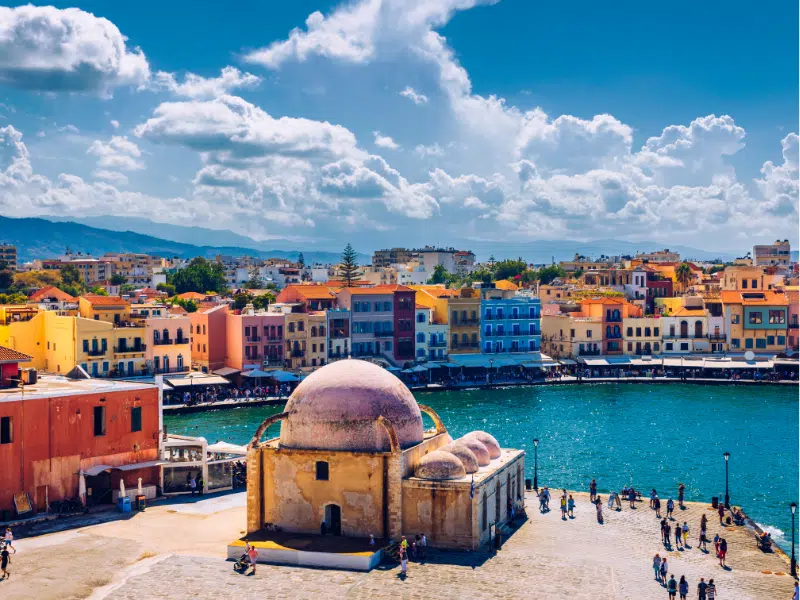
Chania has been ruled by Minoans, Venetians, Ottomans and Egyptians, and each of them left something behind around its curved harbour: a lighthouse, a domed mosque, vaulted shipyards and a maze of alleys. Until 1971 it was the capital of Crete, and it still feels like the island's most elegant town. Here are the facts and stories behind it.
10 fun facts about Chania
- A Minoan city underneath: the town stands on the site of ancient Kydonia, and excavations on Kastelli hill above the harbour have uncovered Minoan houses and clay tablets.
- Venetian for almost 400 years: the Venetians fortified Kastelli in 1252 and called the town La Canea. They ruled it until 1645, when the Ottomans took it after a siege of about two months.
- A lighthouse with an Egyptian makeover: the Venetians built the lighthouse at the harbour entrance around the end of the 16th century. During the Egyptian rule of Crete in the 1830s it was rebuilt, and many locals still call it the Egyptian lighthouse.
- A mosque from the year of the conquest: the domed Küçük Hasan Mosque, or Mosque of the Janissaries, on the harbour front was built in 1645. It stopped being used for worship in 1923 and now hosts exhibitions.
- Shipyards for galleys: the long vaulted halls at the eastern end of the harbour are Venetian arsenals, built to repair and shelter warships. Several still stand, and one has been restored as an exhibition space.
- Capital until 1971: Chania was the seat of government of Crete for more than a century. The capital moved to Heraklion only in 1971.
- Greek since 1913: on 1 December 1913 the Greek flag was raised at the Firkas fortress at the harbour entrance, marking Crete's union with Greece.
- Home of a statesman: Eleftherios Venizelos, who served several times as prime minister of Greece, was born in 1864 in Mournies, just outside Chania. He is buried on the Akrotiri hill overlooking the city.
- A synagogue reborn: Chania's Jewish community was deported in 1944, and almost all of its members died when the ship Tanais sank that June. The Etz Hayyim synagogue in the old Jewish quarter was restored and reopened in 1999.
- A street of knives: on the lane known as Machairadika, knife makers still sell traditional Cretan blades, often engraved with a mantinada, a rhyming Cretan couplet.
Crete joins Greece
After centuries of revolts against Ottoman rule, Crete became an autonomous state in 1898, under Ottoman sovereignty but with its own government in Chania and Prince George of Greece as High Commissioner. Many Cretans wanted full union with Greece, and a young Chania lawyer, Eleftherios Venizelos, became their leader. In 1908 the Cretan assembly declared union on its own, but the great powers refused to recognise it. Only after the Balkan Wars did the Ottoman Empire give up its claim, and on 1 December 1913, in the presence of King Constantine and Venizelos, by then prime minister of Greece, the Greek flag was raised over the Firkas fortress.
The old town quarters, explained
The old town inside the Venetian walls is made up of several quarters. Topanas, west of the harbour, has the grandest Venetian mansions. Evraiki was the Jewish quarter around Etz Hayyim. Splantzia, to the east, was the heart of the Ottoman town: its church of Agios Nikolaos has both a bell tower and a minaret, a reminder that it served as a mosque. Kastelli, the low hill between them, is the oldest part of all.
What to eat in Chania
- Bougatsa: Chania's version is filled with soft mizithra cheese and sprinkled with sugar, eaten warm for breakfast.
- Boureki: a baked dish of sliced courgettes and potatoes layered with mizithra and mint, a speciality of the Chania area.
- Dakos: a hard barley rusk topped with grated tomato, crumbled cheese, olive oil and oregano.
- Kalitsounia: small cheese pies, sweet or savoury, often flavoured with mint.
- Tsikoudia: the clear grape spirit of Crete, also called raki, which many tavernas bring to the table at the end of a meal.
Good to know before you go
- The Samaria Gorge in the White Mountains makes a long but rewarding day trip. It is usually open from late spring to autumn, depending on the weather.
- Balos lagoon and Elafonisi beach are popular day trips and get very busy in summer. Set off early.
- For the classic view, walk along the harbour wall to the lighthouse at sunset and look back at the town and the mountains.
- The cross-shaped Municipal Market, opened in 1913, has been closed for a long restoration and was due to reopen around the end of 2026. Check before you go.
Explore Chania with World City Trail
Our Chania scavenger hunt turns these sights into a game you play on your phone. The route links 10 stops and takes around two hours, with about 42 minutes of walking, and leads you through the Old Town alleys and around the Venetian harbour.
At each stop you solve a puzzle and hear a short story, at your own pace. You can start whenever you like and play in English, German, French, Italian, Dutch or Greek.
Play the Chania scavenger hunt →
Facts checked in October 2026.