
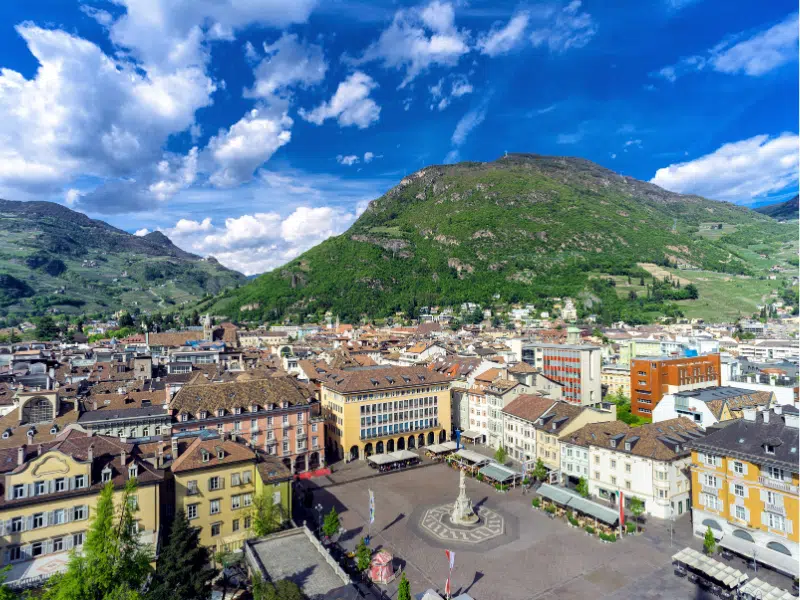
Bolzano is where the Alps start to feel Italian: Tyrolean arcades and espresso bars, street signs in two languages, and vineyards that climb the slopes right above the old town. It belonged to Austria until the end of the First World War and has been Italian since, and you notice both histories on every corner. Here are the facts and stories that make the city special.
10 fun facts about Bolzano
- Home of the world's best-known ice mummy: Ötzi, the Iceman, lived about 5,300 years ago. Since 1998 he has been kept at the South Tyrol Museum of Archaeology in a cold cell at around minus six degrees Celsius, and visitors see him through a small window.
- Two languages, one city: German and Italian are both official in South Tyrol, and Ladin is too in some valleys. Bolzano is the exception in its own province: about three quarters of its residents speak Italian as their first language, while German dominates in the countryside around it.
- A border that moved: for centuries Bolzano was part of the Habsburg County of Tyrol. After the First World War, the 1919 Treaty of Saint-Germain gave South Tyrol to Italy.
- A medieval shopping street: the Lauben, or Portici in Italian, were laid out in the 12th century by the prince-bishops of Trento as the town's market street. The arcades run for about 300 metres, and the narrow merchants' houses behind them reach deep into the block.
- A cathedral with a patterned roof: Bolzano Cathedral is covered with colourful glazed roof tiles, and its openwork Gothic tower was completed in 1519 by the stonemason Hans Lutz of Schussenried.
- A poet on the main square: the statue of the medieval poet Walther von der Vogelweide was unveiled in 1889 on the square that now carries his name. Under fascism it was moved to a park near Runkelstein Castle, and it only came back to the square decades later.
- A fascist relief, answered: the huge relief of Mussolini on horseback by Hans Piffrader, on the former fascist party building on Piazza del Tribunale, has carried a lit quotation by Hannah Arendt since 2017: 'No one has the right to obey', in German, Italian and Ladin.
- Italy's biggest Christmas market: the Christkindlmarkt on Piazza Walther was first held in 1991 and is billed as the largest in Italy, with wooden stalls selling glass ornaments, mulled wine and Zelten, a dense fruit bread.
- A trilingual university: the Free University of Bozen-Bolzano, founded in 1997, teaches in German, Italian and English.
- A castle full of stories: Runkelstein Castle, on a rock at the northern edge of the city, was turned into a summer residence by the Vintler brothers from 1385. Its walls hold what it calls Europe's largest visitable collection of secular medieval frescoes, including the tale of Tristan and Isolde.
The Iceman from the glacier
On 19 September 1991, two German hikers, Erika and Helmut Simon, came across a body melting out of the ice near the Tisenjoch pass in the Ötztal Alps, right on the border between Austria and Italy. At first it looked like a recent mountain accident. Only after the recovery did scientists realise the man had died more than 5,000 years earlier, and a survey showed that he had lain just inside Italy, which is why he came to Bolzano. In 2001, X-rays revealed an arrowhead in his left shoulder: Ötzi had been shot.
The Lauben and the fruit market
The Lauben are the backbone of the old town. Behind the arcades, the tall, narrow houses with their bay windows were built for merchants who traded between Venice and the German lands. At the western end the street opens onto Piazza delle Erbe, the old fruit market, where stalls still sell fruit, vegetables, speck and bread.
What to eat in Bolzano
- Speck Alto Adige: smoked, air-dried ham with EU protection, sliced thin and eaten with Schüttelbrot, a crisp flat rye bread.
- Knödel, or canederli: bread dumplings with speck, cheese or spinach, served in broth or with melted butter.
- Schlutzkrapfen: half-moon ravioli filled with spinach and soft cheese, finished with brown butter and Parmesan.
- Lagrein and St. Magdalener: the two local red wines. The St. Magdalener vineyards lie on the hills just above the city.
- Apfelstrudel: South Tyrol is one of Europe's biggest apple-growing regions, and strudel is on almost every café menu.
Good to know before you go
- The archaeology museum is busy in high season and over the Christmas holidays. Go early in the day to see Ötzi without a long queue.
- From the centre, a cable car climbs to the Ritten (Renon) plateau, where a historic narrow-gauge tram runs and footpaths lead to the earth pyramids.
- Runkelstein Castle is an easy walk or bike ride from the centre along the promenade by the Talfer river.
Explore Bolzano with World City Trail
Our Bolzano scavenger hunt turns these sights into a game you play on your phone. The route links 10 stops and takes around two hours, with about 33 minutes of walking. Stops include Bolzano Cathedral and the South Tyrol Museum of Archaeology, home of Ötzi.
At each stop you solve a puzzle and hear a short story, at your own pace. You can start whenever you like.
Play the Bolzano scavenger hunt →
Facts checked in October 2026.